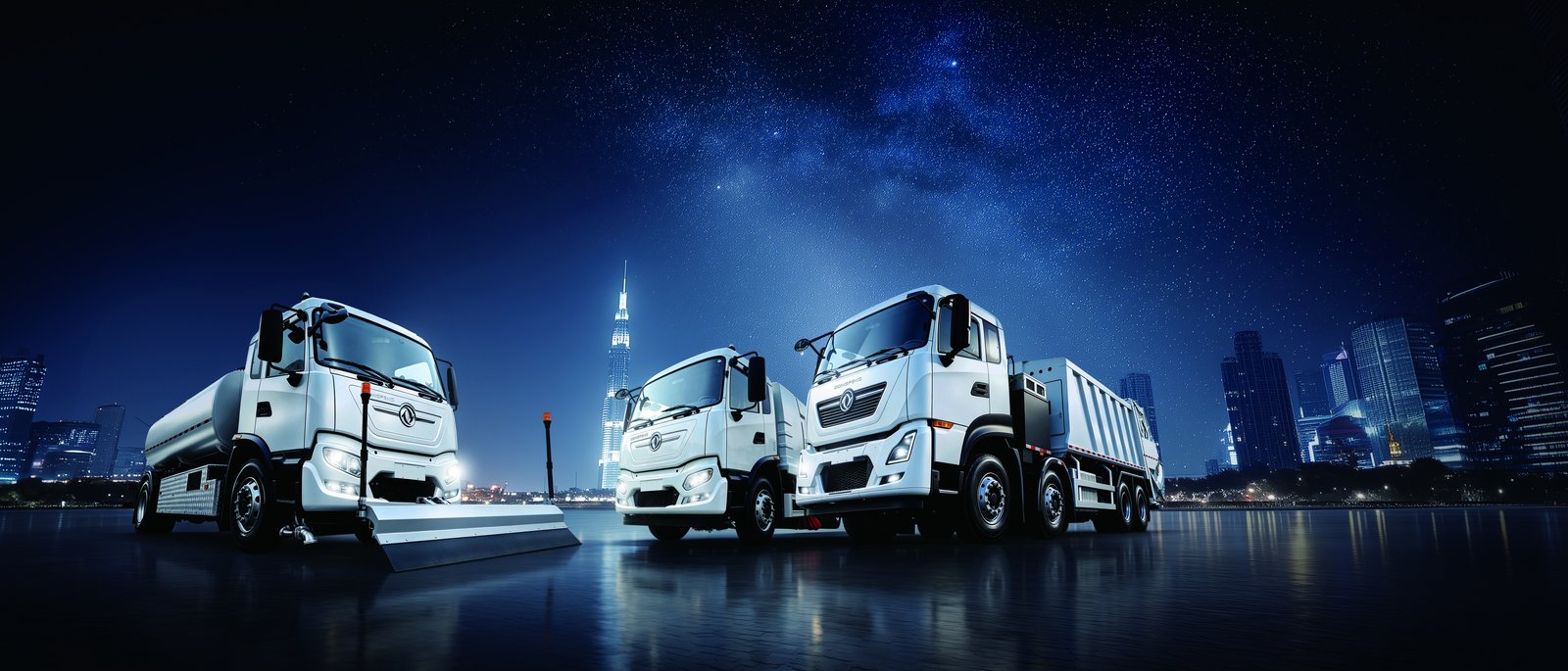
Refuse collection is contracted and reported in tonnes, which makes cost per tonne the metric that decides procurement. It is also a metric that behaves unusually under electrification: refuse duty is so energy-intensive per kilometre — because of the bin lift and compaction cycles rather than the driving — that the fuel saving alone is smaller than fleet buyers expect, while the maintenance saving is larger. The Dongfeng KT3E electric garbage truck — CATL 166–262 kWh LFP, LvKong 110–210 kW with a 4-speed AMT — is our refuse platform, and this article builds the complete per-tonne model honestly, including where the numbers are less flattering than the marketing.
| Parameter | Value | Note |
|---|---|---|
| Tonnes per shift | 9–14 t | Typical urban round with compaction |
| Lift cycles per shift | 250–600 | The dominant energy and wear driver |
| Distance per shift | 70–120 km | Includes transfer station run |
| Operating days | 300 per year | |
| Service life | 8 years | Municipal replacement cycle |
| Diesel / electricity | USD 1.05/L / USD 0.11/kWh | Substitute your own |
| Crew | 2–3 per vehicle | Unchanged by powertrain |
Refuse trucks are heavy consumers on any powertrain, because the lift and compaction cycle is continuous:
That is a genuine and large saving — roughly 65–70% on energy — but note the direction of the comparison: because diesel refuse consumption is so high, electrification saves more per kilometre here than in almost any other duty.
| Maintenance driver | Diesel refuse truck | KT3E electric |
|---|---|---|
| Engine and aftertreatment service | Major recurring cost | None |
| Transmission and driveline | High wear from stop-start | Greatly reduced |
| Brakes | Replaced frequently in stop-start duty | Extended by regeneration |
| Hydraulic packer system | Present on both | Present on both |
| Bin lift mechanism | Present on both | Present on both |
| Body and hopper repairs | Present on both | Present on both |
| Annual maintenance | USD 9,000–13,000 | USD 3,400–5,200 |
The refuse-specific point: the packer and lift mechanism are the same on both vehicles and remain the largest single maintenance item on an electric unit. Electrification removes the engine, transmission and brake costs — a large saving — but anyone claiming maintenance disappears is wrong.
Using 11 tonnes per shift, 300 shifts per year, 8-year life:
| Cost line | Diesel (USD/t) | KT3E (USD/t) |
|---|---|---|
| Capital, amortised | 2.75 | 3.15 |
| Energy | 1.74 | 0.53 |
| Maintenance | 3.33 | 1.30 |
| Insurance and licensing | 0.40 | 0.45 |
| Crew, allocated | 12.10 | 12.10 |
| Total cost per tonne | 20.32 | 17.53 |
| Annual total per vehicle | USD 67,050 | USD 57,850 |
A saving of roughly USD 2.79 per tonne, or about 14% of total cost. Crew cost dominates and is unchanged, which is why the headline percentage is modest even though the energy saving is large. This is the number to take to a finance committee — and the one to model sensitively.
Run at least these four sensitivities before presenting:
The CATL pack is warranted 8 years / 4,500 cycles to 80% state of health. Refuse duty at roughly 250–300 equivalent cycles per year means the cycle limit is not reached inside the service life, so battery replacement should be modelled as zero within the window. Where a finance committee requires explicit mitigation, warranty and residual risk can be insured, and our insurance underwriting guide explains what underwriters ask for.
East African cities are expanding municipal collection rapidly, with growing waste volumes, hot climates and strong solar resource for depot charging — a combination that suits electric refuse fleets. Our Tanzania market page covers deployment, import and support for Tanzanian municipal and private operators. Related: Dar es Salaam operations, Dodoma deployment and municipal tender bid strategy.
KT3E FOB pricing typically falls in the USD 52,000–82,000 band depending on body volume, pack and bin-lift specification.
Cost per tonne is also a function of fleet composition, not just vehicle choice. Three sizing errors are common and all of them raise the per-tonne figure:
Our recommended method is to build the round design from bin density and lift counts first, then size the body, then size the fleet. The vehicle specification follows the round, not the reverse. Related detail: hotel and resort collection rounds and municipal tender bid strategy.
Charging capex must be allocated across the tonnes collected over the asset's life, and doing so reveals how small its contribution actually is. For a single refuse vehicle collecting roughly 3,300 tonnes per year over eight years — about 26,400 tonnes — a depot charge point allocated at USD 8,000 adds roughly USD 0.30 per tonne, or about 1.5% of total cost. Spread across a fleet sharing a charger bank, the figure falls further.
What matters more is the tariff structure rather than the hardware cost. A depot that charges without load management can add USD 0.03–0.06 per kWh, which on refuse duty translates into several per cent of total cost per tonne — more than the entire charger capital contribution. Staggering charge start times, or installing a controller that does it automatically, is therefore one of the highest-return measures available in the whole model. See smart charging load management and demand charges and depot billing.
Ready to electrify your fleet? Contact Shaanxi Fenghan Trading — authorized Dongfeng EV truck exporter. WhatsApp: +86 153 1943 1311 | Email: sales@fenghan-trade.com | dongfengevtrucks.com
🌐 Our Network: Fenghan Trade (SAGMOTO/SHACMAN Truck Export) · SAGMOTO cargo truck flatbed box stake