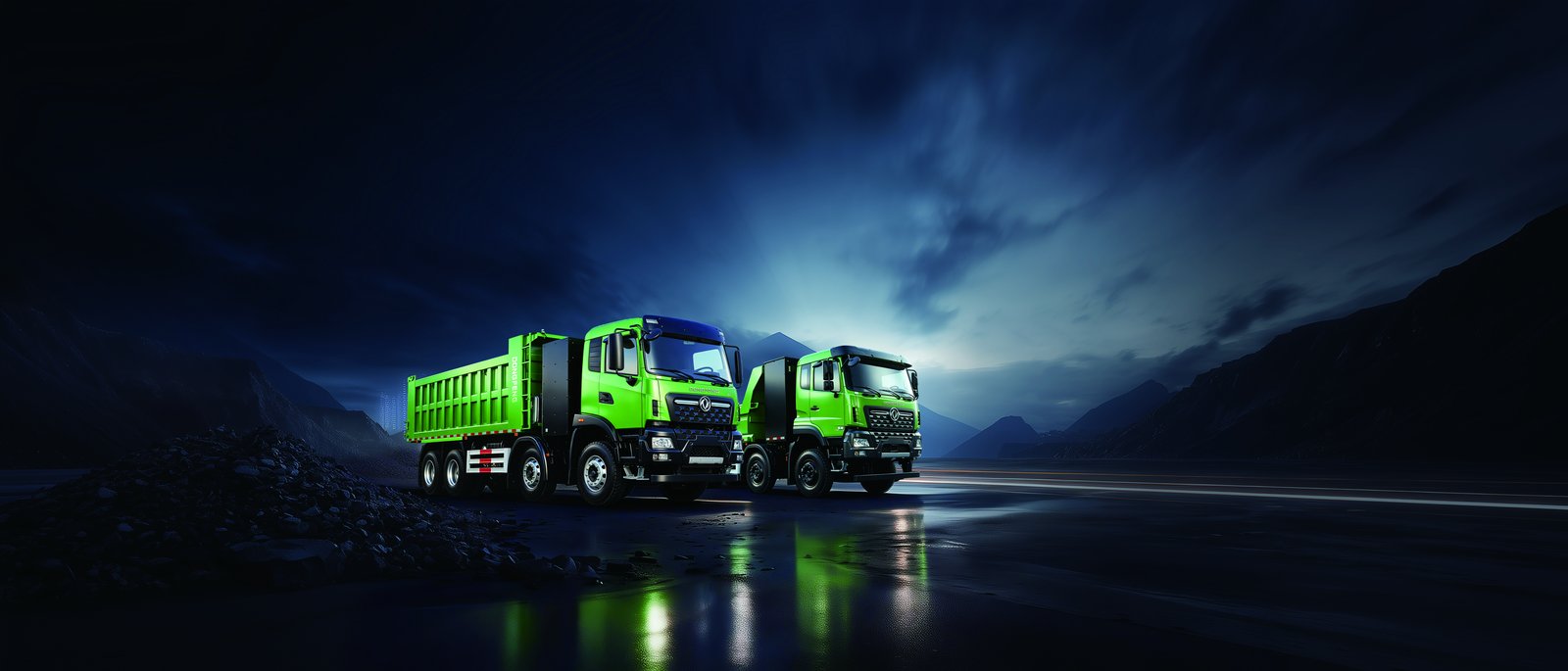
Quick answer: a modern electric dump truck carries 90–98% of the payload of the same-class diesel tipper. The battery adds roughly 2–2.5 tonnes on an 8×4 like the Dongfeng TZ3V with its 600 kWh CATL LFP pack, but deleting the diesel engine, gearbox, fuel tanks, and exhaust saves 1.3–1.8 tonnes back — a net penalty of about half a tonne to one tonne on a 25–30 t-class truck, and often zero when the electric variant is specified on a GVW-matched chassis. The payload question is the right one to ask, but the honest answer is that on real quarry and construction duty, the electric truck's per-trip loads are identical to diesel's, and its torque and cost profile more than cover the edge cases where they are not.
This question comes up in nearly every mining and construction fleet conversation we have — from Chile's copper operations to West African quarries — usually right after the price question. It deserves a proper, numbers-first answer, because payload anxiety is often the last thing standing between a fleet buyer and a decision the economics have already made. Let's take it apart.
An electric dump truck and its diesel sibling are the same truck from the front axle back: cab, chassis rails, tipper body, hoist system, axles. The difference is entirely in the powertrain bay. A diesel 8×4 tipper carries a 13-litre engine (~1.1–1.3 tonnes with fluids), a 12–16 speed gearbox (~0.4–0.6 t), fuel tanks holding 300–600 L (0.3–0.6 t full), an exhaust aftertreatment system with SCR and DPF (~0.15–0.25 t), plus cooling pack and driveshafts. Total: roughly 2–2.8 tonnes of propulsion hardware. An electric 8×4 replaces all of it with a battery pack, an electric motor or e-axle, an inverter, and a cooling loop. The motor and inverter are light — a few hundred kilograms combined. The pack is the story: LFP runs about 5.5–6.5 kg per kWh at pack level, so 350 kWh is roughly 2–2.4 tonnes and 600 kWh is 3.6–4.2 tonnes including enclosure and cooling. Net against the deleted diesel hardware, the electric truck is typically 0.5–1.5 tonnes heavier at the same configuration.
| Class | Diesel payload (typical) | Electric payload (typical) | Difference in practice |
|---|---|---|---|
| 6×4 light tipper (TZ3Z/KTA1 class) | 18–22 t | 17–21 t | ~0.5–1 t lighter; usually same trips |
| 6×4 heavy tipper (TZ5E class) | 22–26 t | 21–25 t | ~1 t; body spec decides it |
| 8×4 mining tipper (TZ3V class) | 28–32 t | 27–31 t | ~0.5–1 t; GVW-matched builds erase it |
| 80 t mining class (TZ5Y) | 70–80 t | 70–80 t | Payload is a design constant at this scale |
Two honest caveats belong beside that table. First, "typical" hides body choice: a steel U-body, hardox-lined ore body, or lighter alloy construction swings payload by a tonne on either truck, and buyers comparing an electric with a heavy ore body against a diesel with a light sand body are comparing bodies, not powertrains. Second, GVW law is the real referee: both trucks run the same axle ratings and gross-weight limits, and a mine loading to the legal limit will trim the electric truck's load by its weight delta unless the electric variant is ordered on the heavier-chassis option that erases it. Ask for the certified tare weights of both configurations — the answer is on the weighbridge ticket, not the brochure.
Run the arithmetic where it bites — maximum-density loads (wet sand, ore concentrates) on routes at the legal limit, the only scenario where the delta matters trip-by-trip. A hauler moving 30 t diesel loads who must trim to 29.2 t electric runs 2.7% more trips for the same tonnage: on a 10-truck operation that is the work of 0.27 extra trucks — one additional truck per 40-truck fleet. Set that against what the electric fleet saves: 55–70% lower energy cost per kilometre, half the maintenance, and no overhaul reserve, which on the same fleet is worth several complete trucks per year. For any material lighter than ore — aggregates, laterite, demolition spoil, C&D — loads are volume-limited before weight-limited, and the electric and diesel trucks carry identical heaped bodies with identical volumes. In our fleet deployments, the payload conversation ends the moment the customer's own weighbridge data enters the room: identical loads per trip, fewer kilogrammes of diesel bought.
The productive version of the payload conversation is four questions deep. What is the certified tare weight of this exact configuration (chassis + battery + body)? What is the GVW class, and is a heavier chassis option available at what cost? What is the body volume, because on volume-limited materials that is the payload? And how does loaded energy consumption per km compare to empty, because range-under-load is where electric trucks actually differ from diesel in daily operations — a full load raises consumption 25–40%, and regenerative braking claws back 20–30% of it on typical quarry cycles. That last exchange is where the electric truck reveals its actual advantage: the loaded descent into the plant that used to cook a diesel truck's brakes now recharges the pack.
The payload penalty of an electric dump truck in 2026 is a rounding error that diesel loyalists quote precisely because the cost, torque, and maintenance arguments have already been lost. On identical duty cycles, our TZ3Vs load the same tonnes per trip as the diesels they replaced; on ore runs at the legal limit, the trim is under a tonne, and the savings ledger covers it many times over each month. Payload is a fair question with a short, honest answer — and the answer should close the debate, not open it. If you want the numbers for your material, density, and route, we produce a per-cycle tonnage and cost model from your quarry's actual loading data.
A modern electric dump truck carries 90–98% of the payload of an equivalent diesel tipper. The 600 kWh CATL LFP pack on an 8×4 like the Dongfeng TZ3V adds roughly 2–2.5 tonnes over a diesel powertrain, but removing the engine, gearbox, fuel tanks and exhaust saves 1.3–1.8 tonnes back, so the net payload penalty is typically 0.5–1 tonne on a 25–30 tonne-class truck — and zero if the electric version is specified on a chassis rated for the same GVW.
LFP packs run roughly 5.5–6.5 kg per kWh at pack level including enclosure and cooling. That makes a 350 kWh pack about 2.1–2.4 tonnes and a 600 kWh pack about 3.6–4.2 tonnes. For comparison, a complete diesel powertrain with fluids, gearbox, and exhaust weighs 1.5–2 tonnes — which is why the net truck-level difference is so much smaller than the battery number alone suggests.
Yes — electric dump trucks are homologated on the same gross vehicle weight classes and axle ratings as their diesel counterparts. An 8×4 TZ3V runs the same 31-tonne-class GVW framework as an equivalent diesel 8×4; the battery mass is simply accommodated within that GVW, which is where the small payload difference appears. Heavier-chassis options are available where buyers need the full diesel payload figure.
Yes, by a calculable amount: a full load increases energy consumption by roughly 25–40% versus running empty, and regenerative braking recovers 20–30% of consumed energy on typical quarry duty with loaded descents. A TZ3V with a 600 kWh pack covering 250 km empty typically delivers 170–200 km fully loaded on flat-to-undulating haul cycles — the number your charge planning should use.
Yes — in most quarry and construction cycles the electric truck carries identical loads per trip, with instant torque from zero rpm actually improving loaded acceleration out of the pit. Only on maximum-density materials at the legal weight limit does the 0.5–1 tonne delta force an extra trip now and then — roughly one additional trip per day per truck in the worst case, which the electric truck's 55–70% lower energy and maintenance cost per kilometre overwhelmingly offsets.
Since payload bands decide the model as much as the powertrain, here is the platform map by the work: for construction and city-circuit duty in the 18–25 t class, the TZ3Z 6×4 electric dump truck and the KTA1 electric dump truck carry the standard aggregates and demolition loads with packs sized for one-charge city days; for heavier 6×4 construction and infrastructure work, the TZ5E 6×4 with its ~400 kWh CATL pack holds 21–25 t through the longest urban shifts; and for mining and quarry duty where payload is the business, the TZ3V 8×4 pairs its ~600 kWh pack with the 27–31 t class on the same GVW framework a diesel 8×4 uses — the truck this article's numbers are built on. Across the range, the payload logic holds: same GVW classes as diesel, same axle ratings, certified tare weights available per configuration, and the same one-line answer to the payload question — within a tonne of diesel, always, and on GVW-matched builds, exactly equal.
The selection question that actually deserves a buyer's attention is not payload but energy-to-duty fit: pack size against route length, charging windows against shift pattern, and thermal specification against climate — because those are the variables that differ meaningfully between electric configurations, and they are the ones our engineers model against a customer's loading data before any order is placed. Bring the weighbridge ticket from your current diesel operation — loads, cycle distances, grades — and the model that returns is your fleet's actual arithmetic, payload and all, on your numbers rather than a brochure's.
The payload question, in the end, is the industry's most reasonable habit — buyers checking whether the new technology quietly gives back what it promises — directed at the one variable where the honest answer is most favourable: almost nothing is given back, and everything else on the ledger is gained. Ask it of every vendor, including us; the ones who answer with certified weights and loaded energy curves are the ones whose trucks will carry what the answer said.
Ready to electrify your fleet? Contact Shaanxi Fenghan Trading — authorized Dongfeng EV truck exporter. WhatsApp: +86 153 1943 1311 | Email: sales@fenghan-trade.com | dongfengevtrucks.com
🌐 Our Network: Fenghan Trade (SAGMOTO/SHACMAN Truck Export) · heavy duty mining dump truck 6x4 8x4