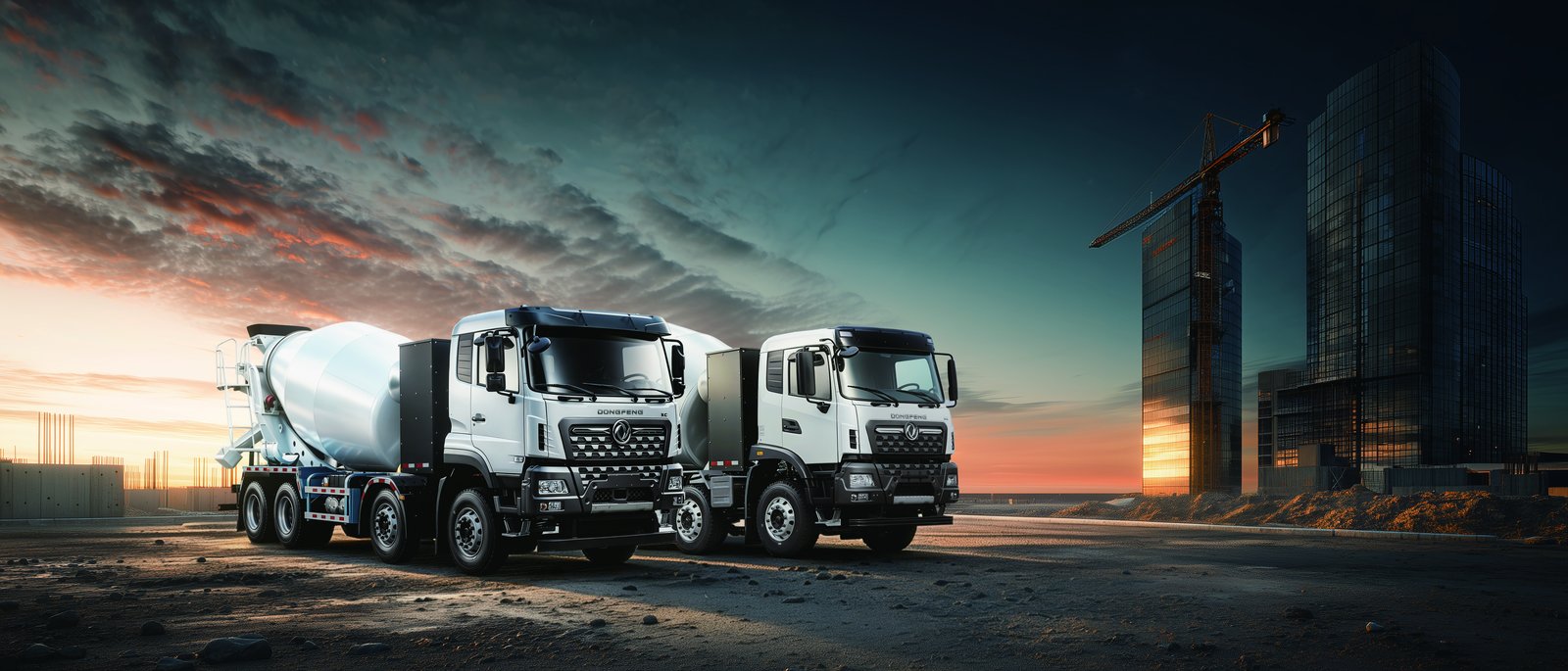
Riyadh is pouring concrete at a pace few cities in history have matched: the metro network's stations and depots, the road tunnels under the city, the downtown redevelopments, and the giga-project programmes feeding the capital's construction economy. Every cubic metre arrives by mixer truck from batching plants on the city's ring — and every mixer truck on that duty is a diesel drum burning fuel through Riyadh's traffic jams, its engine and drum running at every red light on Olaya or King Fahd Road. We have covered Saudi giga-projects and the national charging build-out; this piece is the electric truck concrete supply strategy for the capital's rail construction — the TZ8J 8x4 electric mixer truck (CATL 333 kWh LFP, 45 t GCW, 8 m³ drum on electric PTO) working alongside KT5M electric box trucks on site supply. Country context is in the Saudi Arabia market guide.
Rail construction concrete has a distinctive logistics profile:
| Metric (TZ8J, metro duty) | Diesel 8x4 mixer | TZ8J electric |
|---|---|---|
| Daily cycle | 5 loops × 50 km + drum time | same |
| Fuel/energy per day | ~90–110 L (traffic idle + drum) | ~180–220 kWh |
| Daily energy cost | ~USD 75–95 | ~USD 13–19 at Saudi industrial tariff |
| Noise on night pours | Diesel engine idling at site | Near-silent — drum on electric PTO |
| Indicative FOB | USD 75,000–90,000 | USD 105,000–125,000 |
The daily energy gap — roughly USD 60–75 per truck — is the widest of any body type we track, because the diesel mixer burns fuel on two fronts (traction and drum) while the electric mixer serves both from one efficient source. At 280 working days, the annual saving approaches USD 18,000–20,000 per truck before maintenance.
The batching plant is the natural charging host: an industrial power customer with 24-hour operations, substations already sized for the plant's own motors, and a loading queue that every truck passes through several times a day. The build we specify for a metro-corridor supplier:
Riyadh's mega-programmes carry public decarbonisation commitments, and the procurement machinery beneath them increasingly asks suppliers for emissions data — our giga-project piece documented the pattern; the metro corridor applies it to concrete specifically. A ready-mix supplier arriving with a zero-emission delivery fleet answers the embodied-plus-operational carbon question that project sustainability teams now raise at prequalification. The commercial translation: a TZ8J fleet is not just cheaper per cubic metre to operate — it is a differentiating line in the prequalification file that diesel competitors cannot copy until they buy the same trucks.
Riyadh's summer is a 45 °C-plus working environment, and concrete logistics in it run to strict hot-weather placement protocols. The TZ8J's battery thermal management holds cell temperatures in the optimal band through afternoon duty; the electric drum's speed control is precise at low rotation rates (a quality factor in hot-weather concrete, where over-rotation accelerates setting); and the drivetrain's indifference to intake-air temperature means the truck holds full power in the August afternoon where diesel mixers derate. Our Gulf specification adds the high-ambient cooling package and solar-reflective cab treatment described in our Gulf market pieces — standard, not optional, for Saudi-bound units.
Saudi-bound units ship to Jeddah or Dammam 26–32 days from China, with SASO conformity documentation handled in China, customs entry at the favourable EV tariff treatment, and registration support for the Kingdom's commercial fleet regime. Arabic/English documentation, mixer-crew training and a batching-plant-sited spares kit complete the package. For suppliers serving multiple programmes, our regional spares positioning in the Gulf keeps the parts line short.
The metro will be poured either way — the question is what pours it. A TZ8J fleet charges at the plant, glides silently through the night pours, and lands the contract line that the sustainability questionnaire rewards. In Riyadh's construction decade, the zero-emission concrete supplier is no longer a novelty: it is the supplier the programmes are beginning to ask for by name.
Ready to electrify your fleet? Contact Shaanxi Fenghan Trading — authorized Dongfeng EV truck exporter. WhatsApp: +86 153 1943 1311 | Email: sales@fenghan-trade.com | dongfengevtrucks.com
🌐 Our Network: Fenghan Trade (SAGMOTO/SHACMAN Truck Export) · SAGMOTO heavy duty diesel trucks