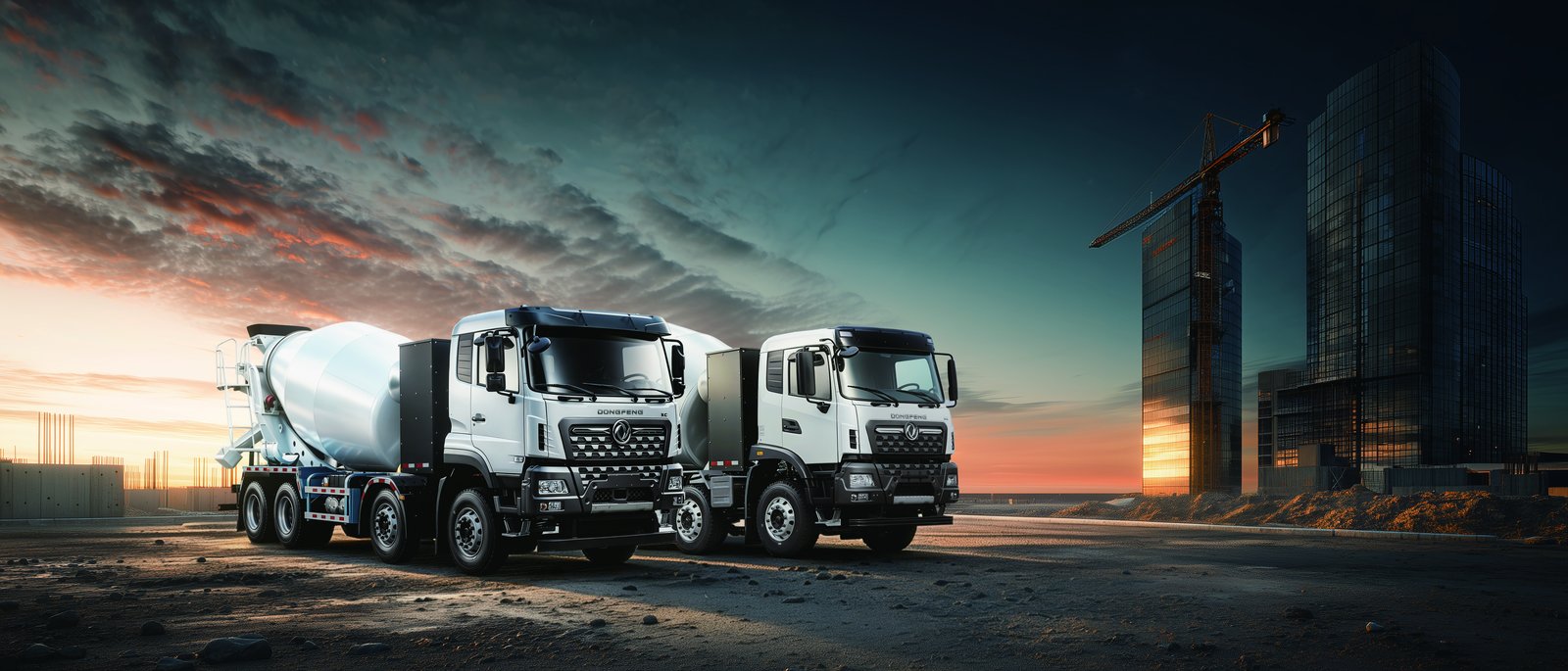
East Africa's construction cycle runs hot: Dar es Salaam's port expansion and satellite suburbs, Nairobi's expressway-linked developments, Addis Ababa's apartment boom. Behind every pour is a ready-mix operator whose truck fleet determines whether the concrete arrives in spec — and whose fuel bill determines whether the business makes money. Ready-mix is a rhythm business: batch plant to site to batch plant, 20–40 km urban loops, drum turning all day, two to six loads each shift. That rhythm is the precise envelope where an electric mixer out-earns its diesel equivalent, and this article details the strategy for deploying the TZ8J electric mixer truck with East African ready-mix operators, in the framework of our Tanzania electric truck market guide.
Ready-mix operators know their numbers by heart — loads per day, kilometres per load, drum hours. The electric case is built on how favourable those numbers are:
| Cost per delivered m³ (8 m³ drum) | Diesel mixer | TZ8J electric |
|---|---|---|
| Fuel / energy per cycle (25 km loop) | 14–18 l ≈ USD 17–24 | 70–95 kWh ≈ USD 7–11 |
| Drum idle during site + plant dwell | 1.5–2.5 l/h, USD 2.5–6/cycle | Included above |
| Maintenance accrual | USD 3.5–5.0/m³ | USD 1.2–1.8/m³ |
| Cost per m³ spread | USD 5.4–7.8 | USD 2.4–3.5 |
On a 40 m³-per-truck day (five loads), the TZ8J saves USD 120–175 daily versus a diesel mixer at East African fuel prices (USD 1.05–1.25/l). Annualised at 280 working days: USD 34,000–49,000 per truck. Set against a landed premium of USD 45,000–60,000, payback arrives in month 14–20 — and the operator's price-per-m³ competitiveness in a market where ready-mix margins are pennies per cubic metre is transformed.
For a plant running 10–14 mixers, we design the electrified core as follows:
Ready-mix plants already run on serious electrical infrastructure — batch control, cement screw conveyors, chillers. Adding 100–250 kW of charger load is usually absorbed by the existing connection, and plants with daytime grid constraints in some East African markets pair the chargers with a solar-plus-buffer arrangement. Because mixing loads and truck charging peak at different hours of the day, the plant's demand profile flattens rather than spikes — a point our depot engineering study demonstrates with the client's own meter data before any equipment is ordered.
Every ready-mix electrification enquiry gets the same six questions from our engineering desk before any quotation is issued — and the questions themselves are useful for operators to see, because they define what a serious supplier needs to know. What is the plant's radial market — the distance band within which 90% of pours happen? The answer sizes the battery, and the honest spread of answers is why one plant electrifies with a 333 kWh pack comfortably while another needs the charging architecture designed around its long-radius work. What is the load-per-truck-day profile through the season? Ready-mix is a seasonal business with construction-calendar peaks, and the fleet must be specified against the peak, not the average, or the electric trucks spend the busy months on the marginal pours while diesel carries the volume. Where on the site can chargers live, and what is the plant's electrical connection? The batching plant's own infrastructure usually holds the answer, and the between-loads charging pattern turns a modest connection into a full fleet's supply. What mix designs does the plant run — slump, aggregate size, ambient temperature at load-out? The drum's agitating duty and the body's wear specification follow from the answers. Who maintains the fleet, and to what schedule? The maintenance programme, our training and the consignment stock are designed around the workshop that will actually turn the wrenches. And finally: what does the plant's cost-per-m³ look like today, in the operator's own numbers? Because that figure is the baseline against which the electric fleet's advantage is measured, and the plant that knows it precisely is the plant that can price its next tender with the electric fleet inside it.
Operators who arrive with these six answers already written down are, without exception, the ones whose first electric mixer fleet performs exactly to model — because the questions are the deployment, in miniature.
Ready to electrify your ready-mix fleet? Contact Shaanxi Fenghan Trading — authorized Dongfeng EV truck exporter. WhatsApp: +86 153 1943 1311 | Email: sales@fenghan-trade.com | dongfengevtrucks.com
🌐 Our Network: Fenghan Trade (SAGMOTO/SHACMAN Truck Export) · SAGMOTO heavy duty diesel trucks