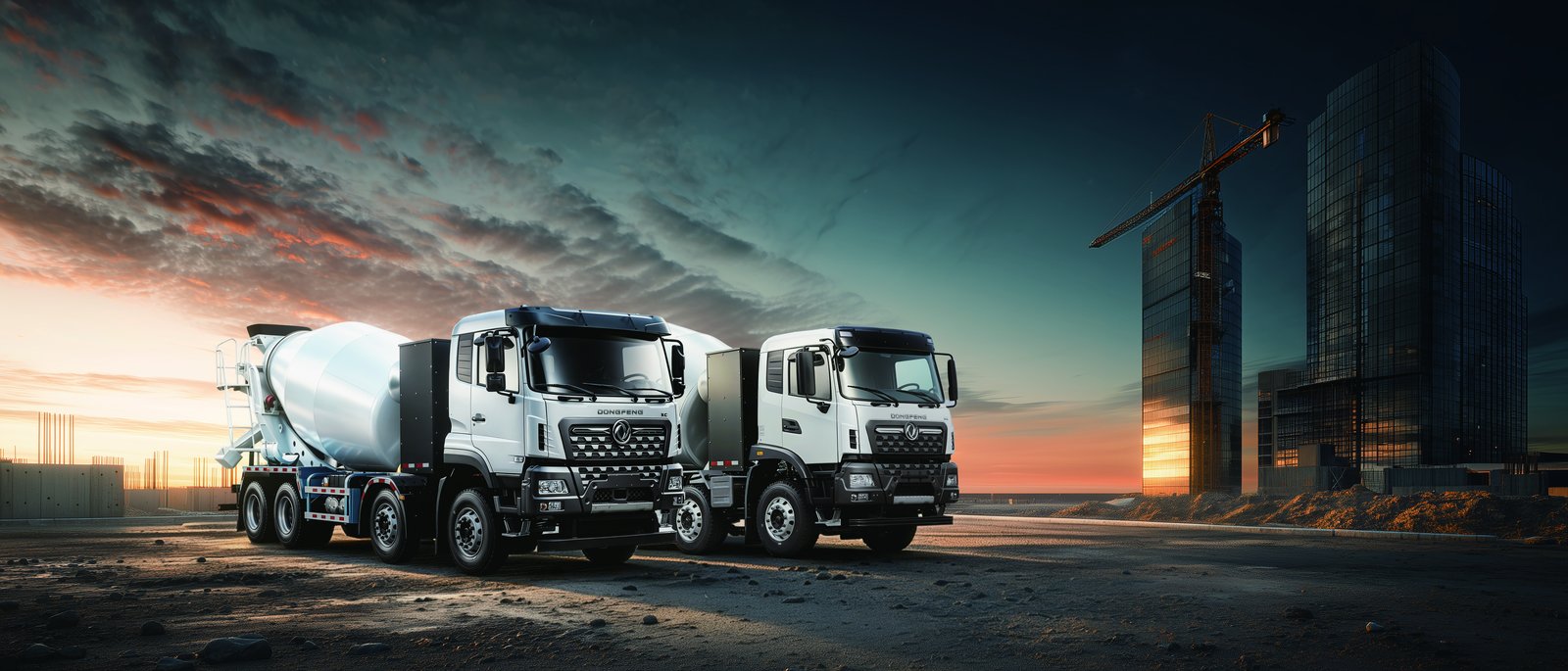
Basra is Iraq's economic gateway and its biggest reconstruction story. The port complex — Umm Qasr's container terminals and the city's oil-port infrastructure — moves the country's imports; the investment programme behind it runs housing, roads, the grand port expansion and the industrial projects of the southern oil belt; and the city's concrete demand grows with every phase. We covered Iraq's national market at policy level; this piece is the Basra electric truck operating strategy — the TE8M electric tractor (CATL 400 kWh, 49 t GCW) on port-to-city logistics and reconstruction freight, and the TZ8J 8x4 electric mixer truck (CATL 333 kWh, 45 t GCW, 8 m³ electric-PTO drum) on the rebuild's concrete supply. Country import context is in the Iraq market guide.
Basra's truck work runs three overlapping systems:
All three flows are fixed, known-distance and anchored to a handful of yards and plants — the geometry that electrifies cleanly even in a market where fuel logistics are traditionally the hard part.
Basra's electric case does not rest on price alone; it rests on supply reliability. Iraq's fuel distribution — for all the country's hydrocarbon wealth — imposes queueing, quality variance and administrative friction on diesel consumers, and every hour a truck spends in a fuel queue is an hour of lost availability. An electric fleet's energy arrives through a grid connection or a depot solar array, on schedule, at a price fixed by contract rather than by the fuel market's weekly reality. In our Egypt and Pakistan pieces we called this energy independence; in Basra it is often the first argument that closes the sale:
| Metric (per truck-year) | Diesel | Electric |
|---|---|---|
| Energy cost (TE8M, 55,000 km) | ~USD 23,000 | ~USD 7,700 at Iraqi industrial tariff |
| Fuel-queue availability loss | 100–200 truck-hours/year | zero |
| Maintenance | ~USD 8,000 | ~USD 4,000 |
| Value of recovered hours (at cost/hour) | — | USD 4,000–8,000 |
Combined, the TE8M's annual operating advantage on Basra duty reaches USD 23,000–27,000 per tractor — payback on the electric premium inside 30 months before counting the availability gains, which in a port drayage contract are pure service level.
The mixer case adds the drum: a diesel mixer's rotating drum burns fuel in every queue and every traffic hold, and Basra has no shortage of either. The TZ8J's electric drum drive runs at a fraction of that energy, and the plant-to-site loops sit well inside its 333 kWh range:
Basra's charging build follows the flows and the sun:
Basra is one of the hottest cities on the planet — sustained summer highs above 45 °C with peaks near 50 °C. Our Gulf specification is the baseline: high-ambient battery thermal management, upgraded cooling on motor and inverter circuits, solar-reflective cab treatment, and night-weighted charging schedules in the summer months. The electric drivetrain's summer advantage is structural: no charge-air cooling limit means no power derate in the August afternoon, and the fleet's charging happens overnight when temperatures favour both battery efficiency and grid load. Dust adds the sealed-system requirement — no air intake, no turbo ingestion wear in a dust environment that eats diesel engines.
Basra-bound units ship to Umm Qasr 24–30 days from China, with the Iraqi import package covering customs entry, conformity documentation, and registration support; Arabic/English documentation and crew training complete delivery. Two Basra-specific disciplines from our delivery experience: security planning for depot siting (fenced yards with access control, standard for port-adjacent compounds), and a generously sized on-site spares kit — the supply lines into southern Iraq reward self-sufficiency, and our pre-positioned parts strategy is sized accordingly.
Every reconstruction programme is a logistics programme wearing a hard hat, and Basra's is among the largest in the region. The contractors and operators who bring TE8M tractors and TZ8J mixers to the rebuild will run its freight at half the energy cost, with zero fuel-queue exposure and a summer derate profile the diesel fleet cannot match. The city is being rebuilt either way — the question is what moves it.
Ready to electrify your fleet? Contact Shaanxi Fenghan Trading — authorized Dongfeng EV truck exporter. WhatsApp: +86 153 1943 1311 | Email: sales@fenghan-trade.com | dongfengevtrucks.com
🌐 Our Network: Fenghan Trade (SAGMOTO/SHACMAN Truck Export) · 4x2 6x4 tractor truck prime mover