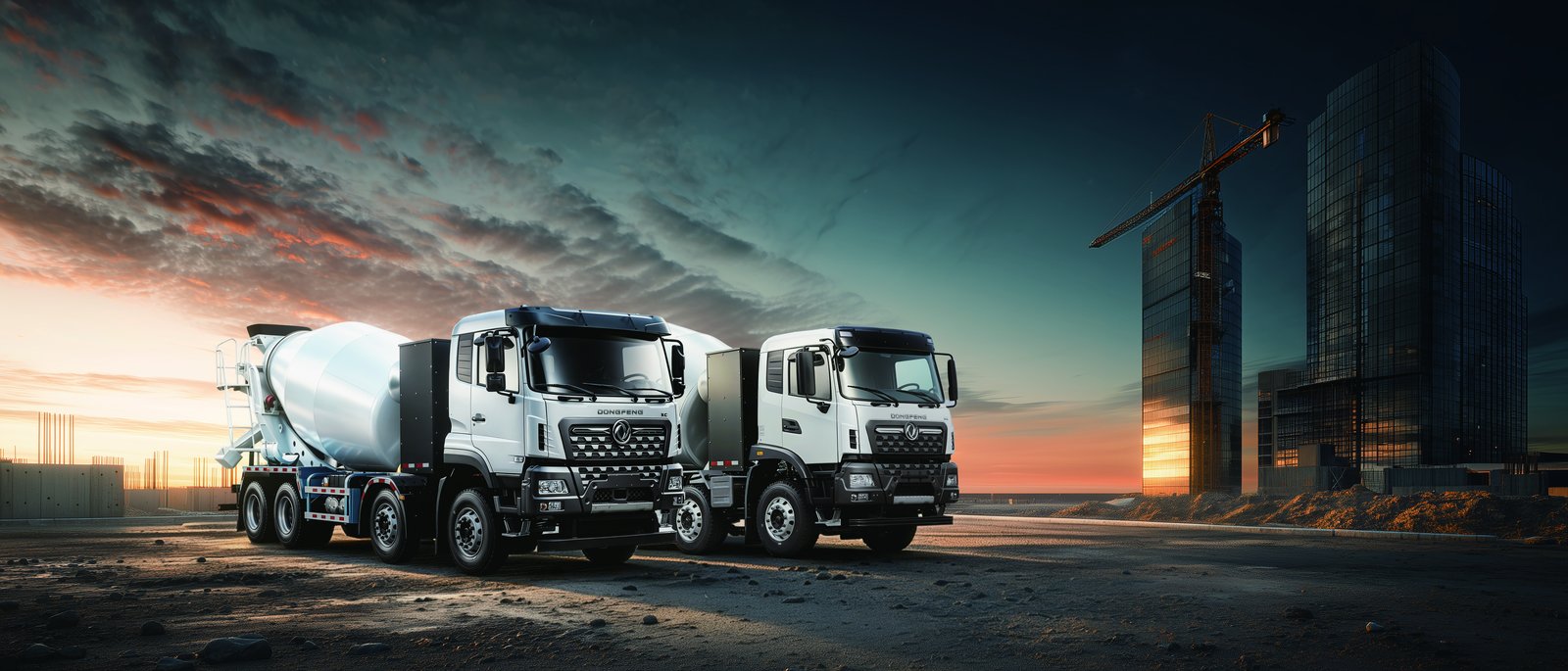
Jakarta gets Indonesia's headlines, but Surabaya moves East Java. The Tanjung Perak port complex feeds the second-largest metropolitan economy in the country, the Gerbang Kertosusila corridor east of the city hosts a dense belt of manufacturing — from Sidoarjo's footwear plants to Gresik's cement and smelter industries and Mojokerto's industrial estates — and Surabaya itself runs a permanent construction programme: toll road extensions, flood-control works, the city's transit projects and the endless vertical growth of the CBD. We have covered Nusantara and Indonesia's national subsidy picture; this piece is the Surabaya playbook, built on the KT5M electric box truck and the TZ8J 8x4 electric mixer truck. Import, subsidy and homologation context is in the Indonesia market guide.
Surabaya's truck work divides cleanly into a distribution economy and a construction economy, and the two share geography — both orbit the port-to-west and port-to-south corridors:
The TZ8J — CATL 333 kWh LFP, 45 t GCW, 8 m³ drum on an electric PTO — is purpose-built for the second bullet. Drum rotation in a diesel mixer burns fuel continuously, including every minute stuck in Surabaya traffic; the TZ8J's electric drum drive consumes a fraction of that energy and rotates silently through the same jam. The KT5M, CATL 262/310 kWh on an 18 t GVW chassis with a 45 m³-class box, takes the distribution and lighter industrial work.
| Metric | TZ8J (ready-mix) | KT5M (distribution) |
|---|---|---|
| Battery | CATL 333 kWh | CATL 262/310 kWh |
| Rating | 45 t GCW, 8 m³ drum | 18 t GVW, box body |
| Daily cycle | 4–6 plant-site loops, 150–220 km | Multi-drop, 120–180 km |
| Energy cost/day | ~USD 22–30 | ~USD 14–20 |
| Diesel equivalent/day | ~USD 75–95 (incl. drum idle) | ~USD 50–60 |
| Indicative FOB | USD 105,000–125,000 | USD 48,000–62,000 |
The mixer line deserves emphasis: a diesel mixer's drum typically accounts for a quarter to a third of daily fuel because it rotates at every red light and in every queue. Electrifying the drum removes that entire loss, which is why the daily energy gap for mixers runs wider than for any other body type we track.
Industrial electricity in East Java runs near IDR 1,100–1,450/kWh (about USD 0.07–0.09) for the relevant tariff classes, and Indonesia's diesel subsidy structure means industrial users pay market prices at the pump — roughly IDR 14,000–15,000 per litre for non-subsidised solar. That combination gives East Java one of the healthiest electric-versus-diesel spreads in Southeast Asia. On top sits the national policy stack: the EV purchase incentive programme has applied to battery-electric commercial vehicles, and electric vehicles receive reduced value-based tax benefits at registration in a number of provinces. Indonesian-language coverage of the subsidy mechanics is in our earlier market piece; for Surabaya fleets the practical summary is that the effective CAPEX premium after incentives is materially smaller than the FOB gap suggests.
For a mixed first-phase fleet of six TZ8J and eight KT5M:
Total infrastructure budget: USD 210,000–270,000. The fourteen-truck fleet's daily energy savings of roughly USD 350–420 compound to over USD 120,000 per year, repaying the infrastructure inside two years.
For the ready-mix operator, the number that matters is cost per m³ delivered. On a 25 km plant-to-site loop at five cycles a day: a diesel mixer consumes roughly USD 12–14 of fuel per cycle plus USD 4–5 of maintenance-per-cycle allocation; the TZ8J consumes about USD 4.50 of electricity per cycle plus USD 2 of maintenance allocation. Per m³ of an 8 m³ load, that is a delivered-cost saving of roughly USD 1.20–1.40 per cubic metre — on a 100,000 m³-year operator moving volume through twenty trucks, an annual saving in the range of USD 120,000–140,000 on energy and maintenance alone, before the tender-preference value that Indonesian project owners increasingly attach to zero-emission concrete supply.
Surabaya receives China-sourced vehicles directly at Tanjung Perak, with 10–14 day sailings from main Chinese ports making it one of our shortest and cheapest delivery lanes. Import handling includes the standard Indonesian package: BKIPM/Kemenhub type registration support, customs entry with the EV incentive documentation, LHD as national standard, Bahasa Indonesia manuals and driver training, and a pre-positioned spares kit at the operator's depot. Where fleets prefer staged deliveries, we ship in monthly tranches so driver training and charging build-out keep pace with vehicle arrivals.
Surabaya's combination — a compact port-city geography, a construction economy that runs year-round, manufacturing corridors with fixed flows, and some of the best tariff-to-diesel spreads in the region — makes it the strongest single-city EV truck business case in Indonesia after the capital. The fleets that build around Tanjung Perak now will set the cost benchmark East Java's logistics market for years.
Ready to electrify your fleet? Contact Shaanxi Fenghan Trading — authorized Dongfeng EV truck exporter. WhatsApp: +86 153 1943 1311 | Email: sales@fenghan-trade.com | dongfengevtrucks.com
🌐 Our Network: Fenghan Trade (SAGMOTO/SHACMAN Truck Export) · SAGMOTO cargo truck flatbed box stake