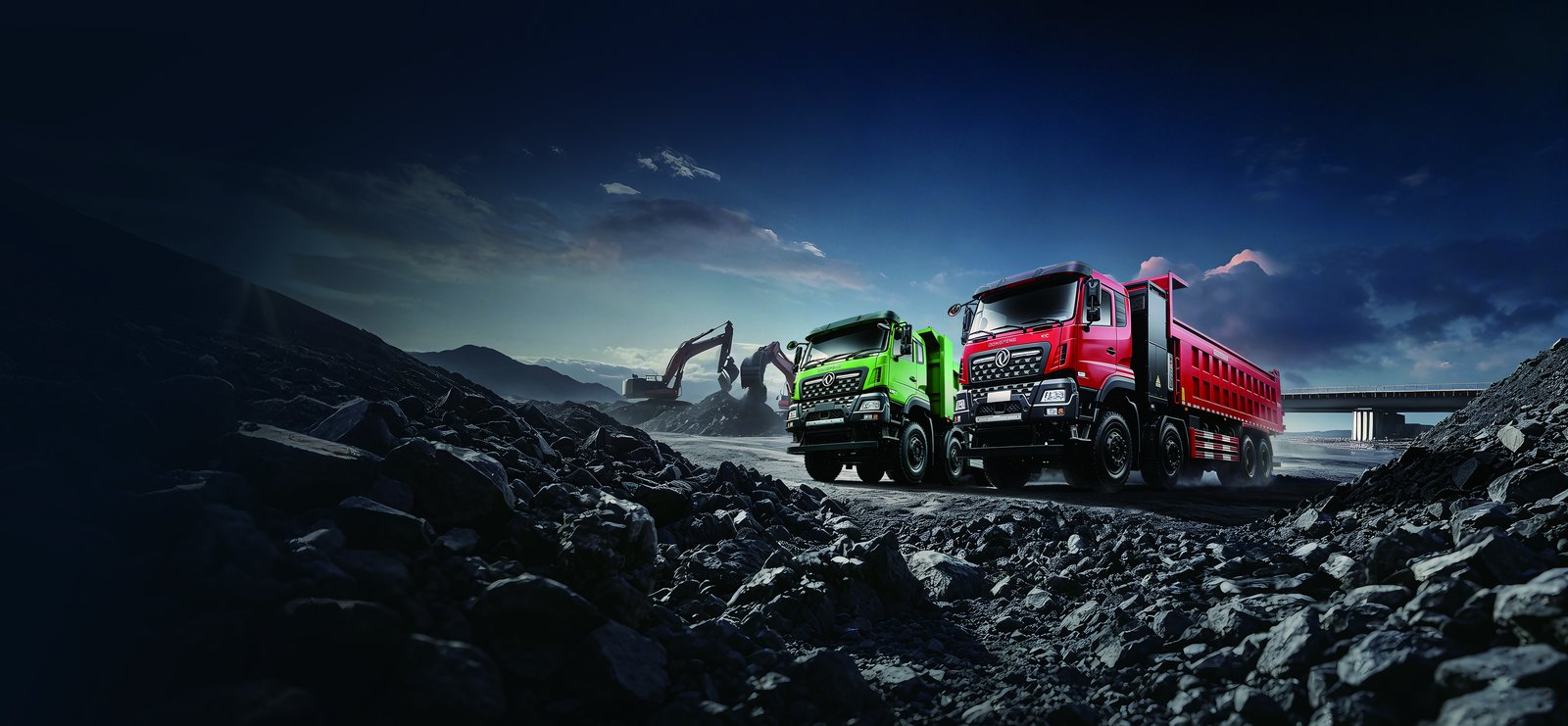
Chile is the world's largest copper producer, the second-largest lithium producer, and — thanks to the Atacama's solar resource and a national grid moving past 60% renewables — one of the cheapest places on Earth to charge a truck. The mining services and construction fleets that radiate out of Santiago into the Valparaíso region, the Aconcagua valley and the northern mining corridors face a structural problem that plays directly into the hands of an electric truck: diesel at USD 1.20–1.45/L delivered to remote sites, versus mine-site electricity increasingly sourced from dedicated solar. Codelco, Antofagasta Minerals and the lithium producers of the Salar de Atacama have all committed to carbon-neutral operations, and their contractors are being asked to electrify the light end of haulage — the 4x2 to 8x4 rigid trucks that move ore, tailings, construction materials and personnel around mine sites and between pits and plants. This article lays out the Dongfeng heavy electric dump truck case for Chile: the TZ5E 6x4 for regional construction and the TZ5Y 80t-class machine for mine service haulage, the import structure, charging at Chilean tariffs, and a worked TCO. For the full country picture, see our Chile electric truck market guide.
Four Chile-specific facts shape the electric truck case:
The TZ5Y is the heaviest electric rigid in our export range: an 80t-class 6x4 electric dump truck built around roughly 600 kWh of CATL LFP energy (twin-pack architecture with swap capability), a 510 kW-class LvKong drive system and a heavy-duty rear tandem engineered for 35–40 t payloads. On the classic mine service cycle — ore transfers from pit crusher to concentrator, tailings haulage, road construction fill on 4–8% grades at 2,500–4,000 m — it consumes roughly 2.2–2.8 kWh/km loaded and recovers a meaningful share of that on descent legs.
| Parameter | TZ5Y 6x4 | TZ5E 6x4 | Diesel 6x4 baseline |
|---|---|---|---|
| Battery | CATL LFP ~600 kWh, swap-capable | CATL LFP ~400 kWh | — |
| Payload | 35–40 t | 20–25 t | Comparable per model |
| Motor | 510 kW-class LvKong | 360 kW-class | ~300 kW |
| Range, mine duty | 180–240 km | 200–260 km | ~600 km tank |
| Energy cost per km, loaded | USD 0.14–0.20 | USD 0.10–0.15 | USD 0.55–0.70 |
| FOB reference | USD 155,000–180,000 | USD 110,000–130,000 | USD 75,000–95,000 |
The TZ5Y's battery-swap architecture is the key enabler for continuous mine shift operation: a 5–6 minute pack exchange at a swap station sited at the crusher returns the truck to duty without a 2-hour charge window, and the twin-pack layout lets a mine run swap for the primary fleet while opportunity-charging during blasting holds and shift changes.
Chile is one of the most open import markets in South America: a flat 6% duty applies to virtually all trucks regardless of origin (no local-content penalty for Chinese units), plus 19% IVA, recoverable for VAT-registered operators. Freight from Shanghai to San Antonio or Valparaíso runs USD 6,000–9,000 per unit on 30–35 day transits. The Chilean homologation file needs the standard emissions-free designation and our CATL battery certificates; the Dirección de Vialidad axle-load rules cap the operating GCW, which we model into every configuration before order confirmation. Landed premium versus a comparable diesel 6x4 runs USD 60,000–85,000 per unit — the number the operating savings must clear.
Chilean sites are increasingly self-sufficient in power:
Assumptions: 6 TZ5Y on ore-transfer duty (180 km/day, 38 t payload, 2,800 m altitude) and 4 TZ5E on road-fill and tailings duty (150 km/day), 320 operating days, diesel at USD 1.35/L, electricity at USD 0.06/kWh under a solar-PPA-blended tariff:
| Annual item (10 trucks) | Diesel fleet | Electric fleet |
|---|---|---|
| Fuel / energy | USD 780,000–920,000 | USD 105,000–135,000 |
| Maintenance & brakes | USD 210,000 | USD 78,000 |
| Charging/swap infra (annualised) | — | USD 62,000 |
| Total annual operating | USD 1,000,000 | USD 260,000 |
That is roughly USD 740,000 of annual savings against an incremental capital cost of USD 650,000–800,000 — payback inside 14 months on the energy line alone, which is why Chilean mining-services groups are among the most aggressive electric-truck adopters we work with. Over eight years the fleet avoids roughly 6,500 tonnes of CO2 — a number contractors quote directly in their tender ESG sections. The TZ5Y's 8-year / 4,500-cycle CATL warranty frame matches the typical mining-services contract horizon.
Not every Chilean operator needs 80t. Santiago's construction cycle — the Costanera corridor works, highway expansion into the outer comunas and the post-earthquake resilience programme — runs 6x4 tippers at 20–25 t payloads on 120–180 km day-cycles. The TZ5E with 400 kWh of CATL LFP energy and a 360 kW-class drive covers that duty with 200–260 km of range, and its FOB of USD 110,000–130,000 lands at roughly USD 135,000–155,000 after Chile's flat duties — a two-to-three year payback truck for mid-size constructoras, and the natural first order before scaling to the TZ5Y mine class. Its smaller sibling the KTA1 serves quarry and recycling loops at 18–20 t payloads where a compact electric tipper beats a big one on cycle time.
Three practical notes. First, altitude and dust: the TZ5Y's sealed IP-rated battery enclosure and filtered cooling loops are engineered for Andean dust, but daily compressed-air cleaning of radiator and pack surfaces should be in the maintenance schedule. Second, winter at 3,000 m in the southern cone drops below −10 °C: specify the pack pre-heating option for those fleets. Third, Codelco-zone procurement cycles are long — start the homologation and pilot conversation two quarters before the tender you want to influence.
Chile's mining economy is going electric from the grid inward. The contractors who arrive at the next tender with electric haulage experience will find the questions have changed — and they will be the only ones with answers.
Ready to electrify your fleet? Contact Shaanxi Fenghan Trading — authorized Dongfeng EV truck exporter. WhatsApp: +86 153 1943 1311 | Email: sales@fenghan-trade.com | dongfengevtrucks.com
🌐 Our Network: Fenghan Trade (SAGMOTO/SHACMAN Truck Export) · heavy duty mining dump truck 6x4 8x4