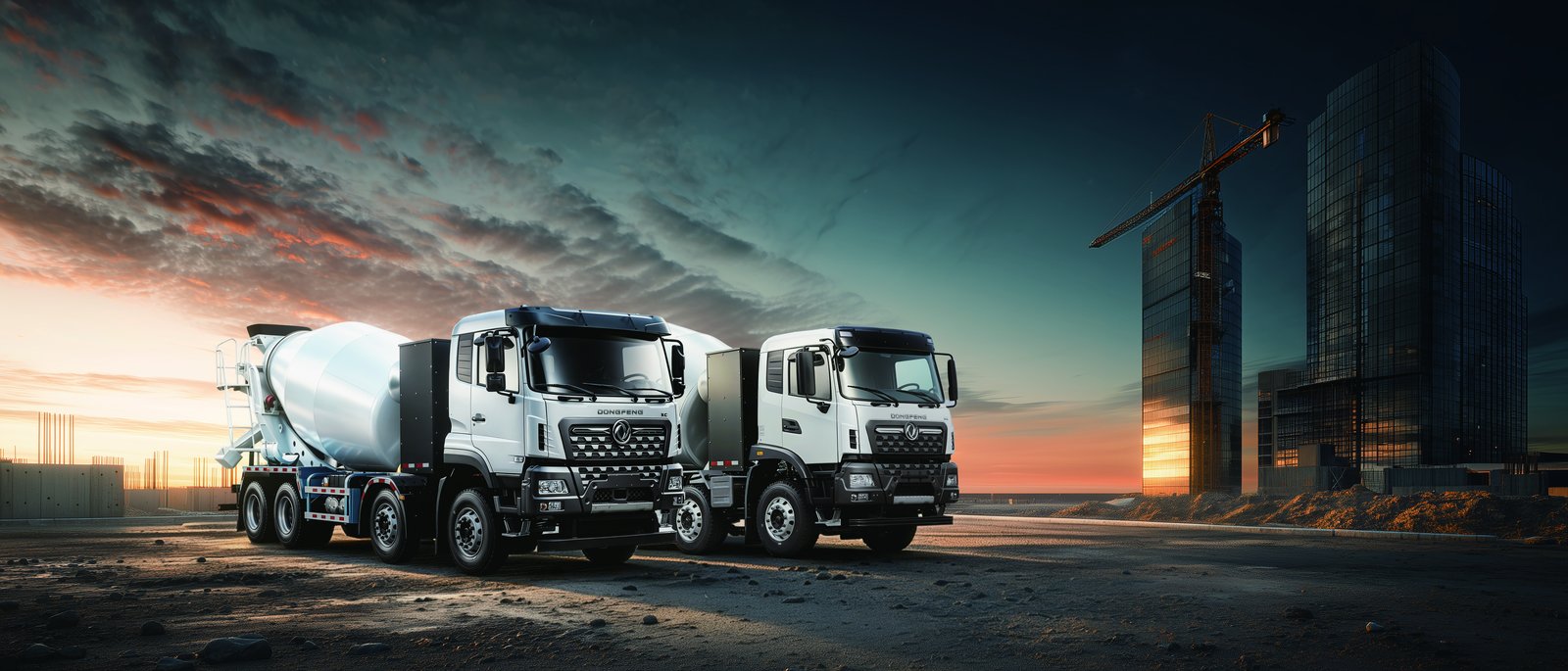
A concrete mixer truck is a chemical plant on wheels with a deadline. The drum must keep its load agitated from batching plant to pour — typically a 60–90 minute window before workability decays — and everything about the machine's economics flows from how well the drum, the drive and the chassis work as one system. On a diesel mixer, the drum runs off an engine-driven hydraulic pump whose speed follows whatever the driver is doing with the throttle. On an electric mixer like the TZ8J or the KT9X, the drum runs on its own electric drive at precisely controlled speed — and that single change rewrites the drum specification. This guide covers the complete drum specification for electric mixer fleets: drive architecture, volume against payload, mixing versus agitating duty, the energy budget, and wear and maintenance items. For the pour-level economics of electric concrete logistics, see our Saudi giga-project analysis; for the market context, see our Qatar electric truck market guide.
| Aspect | Diesel-hydraulic drum | Electric drum drive (KT9X / TZ8J) |
|---|---|---|
| Drum speed control | Tied to engine rpm — driver modulates by throttle | Stepless, load-matched, speed set independently of driving |
| Agitating while queued | Engine at high idle, burning 5–8 L/h | ~3–5 kWh/h from the traction battery — near-silent, near-free |
| Mix quality control | Variable with driver habit | Programmed speed profiles per mix design and ambient |
| Reversing to discharge | Hydraulic reversal, slower response | Electric reversal, precise chute-side control |
| Night-shift noise | Diesel idle dominates site acoustics | Quiet enough for regulated urban night pours |
The queue idling line is the quiet revolution. A mixer spends 40–60% of its life waiting — at the plant, in site traffic, behind other trucks at the pump. A diesel mixer burns fuel the entire time to keep the drum turning; an electric mixer turns the same drum for a rounding error of battery energy. On a 45 °C Gulf duty day with two hours of cumulative queue, that difference alone is worth 10–14 L of fuel or 30–45 km of driving range per truck per day.
Most transit mixers agitate rather than mix: central-mixed concrete arrives mostly blended, and the drum's job is to hold workability, not finish the chemistry. Specify accordingly:
Dispatch planning on electric mixers must include the drum's draw, not just the driving:
| Drum duty | Energy draw | Note |
|---|---|---|
| Charging at plant (12–14 rpm) | 6–9 kW average | Highest load state |
| Transit agitation (2–3 rpm) | 2.5–4 kW | Load-dependent |
| Queue holding (1–2 rpm) | 1.5–2.5 kW | The state diesels can't do cheaply |
| Discharge (10–14 rpm) | 5–8 kW | Includes pump and chute auxiliaries |
A full batching-to-pour-return cycle of 90–120 minutes therefore draws roughly 6–10 kWh of drum energy — against 130–180 kWh of driving energy on a typical 60–100 km day. The drum is thus 5–8% of the truck's daily budget: real enough to model, small enough that it never threatens the route. Route models that ignore it, however, will systematically over-promise range by half a pour.
| Duty | Platform & drum | Notes |
|---|---|---|
| Urban ready-mix, giga-project pours | KT9X 8x4, 8–9 m³ delivered | Programmable profiles, night-shift quiet, tender ESG scoring |
| Metro/tunnel underground supply | TZ8J-class, matched to site logistics | Zero exhaust in the heading — see our tunnel-construction analysis |
| Dam and infrastructure mass pours | 8x4 fleet + swap-capable packs | Battery swap keeps pour continuity across shifts |
The drum is the mixer truck's payload, its quality system and its single most maintenance-sensitive assembly — and on an electric chassis it becomes a precision instrument instead of a throttle-dependent compromise. Specify the drive architecture, the volume honestly, the weight budget tightly, and the washout discipline religiously: the fleet that does all four pours better concrete for less money, which is the entire business.
Ready to electrify your fleet? Contact Shaanxi Fenghan Trading — authorized Dongfeng EV truck exporter. WhatsApp: +86 153 1943 1311 | Email: sales@fenghan-trade.com | dongfengevtrucks.com
🌐 Our Network: Fenghan Trade (SAGMOTO/SHACMAN Truck Export) · SAGMOTO heavy duty diesel trucks