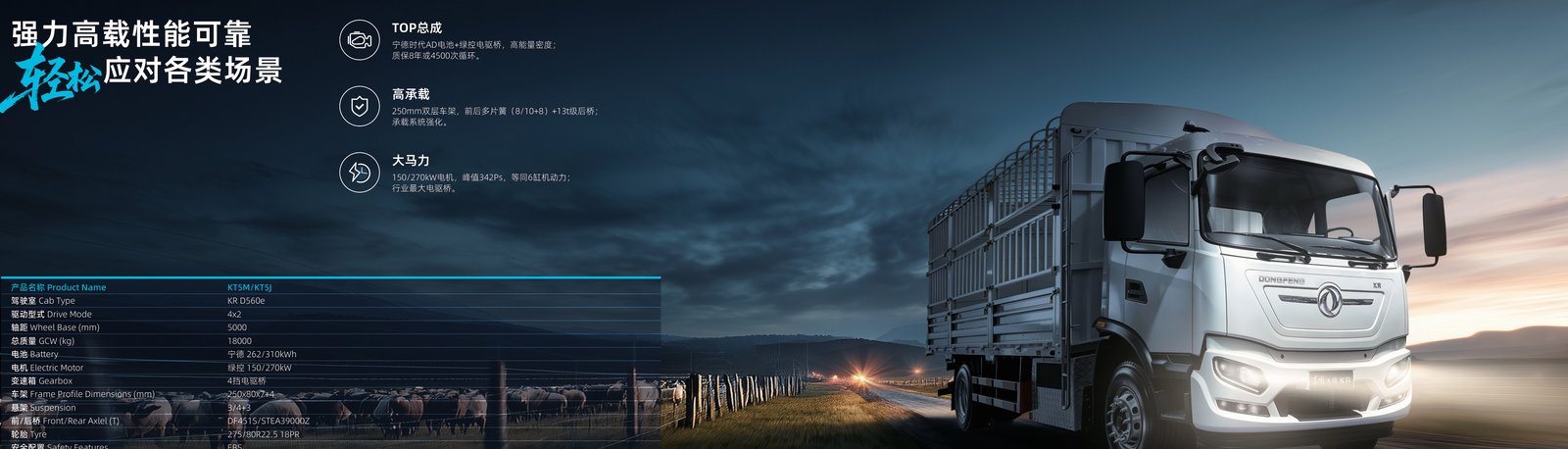
Autonomous electric truck deployment today is real but narrow: the proven use cases are fenced, repetitive, low-traffic environments such as open-pit mines and container terminals, where an EV truck can run a fixed loop without sharing roads with the public. A Dongfeng TZ5E electric dump truck with its 424 kWh heavy-duty pack is a credible platform for these closed sites. This article sets out what L4 autonomy actually means, where it works, the safety case, the teleoperation fallback, the deployment cost, and what an overseas fleet should plan for in 2026.
L4 means the truck can drive its defined route without a human driver on board, but only inside a geofenced operating domain. It is not L5 unrestricted driving. The vehicle relies on a mapped route, on-site positioning beacons or GPS-augmented localization, and a fleet management system that sequences each truck's trips. Outside the fence, the same truck must have a driver or be towed. Buyers should reject any claim that an autonomous EV tractor can legally run on public highways today; that remains a research and pilot activity in every export market, and no reputable supplier will promise otherwise on a purchase order.
The business logic is strong where it applies. In a mine or port, a driverless truck runs three shifts without fatigue, without air-conditioned cab heating in winter or cooling in summer for the operator, and without the safety exposure of a human in a rollover-prone environment. The energy case is unchanged from a manned EV: the TZ5E still draws from the same CATL LFP pack and recovers 15 to 25 percent through regen on graded haul roads, so autonomy adds productivity without changing the underlying efficiency.
Open-pit mines run short, repeated cycles: load at the face, haul up a grade, tip at the crusher, return empty. That predictability is ideal for autonomy. A TZ5E at roughly 60 to 70 tonnes payload on a 2 to 4 km loop can complete 40 to 60 cycles per 20-hour operating day, limited by charging rather than by driver hours. With DC fast charge from 20 to 80 percent in 45 to 90 minutes, a site typically runs one or two charge windows per truck per day and schedules them during low-demand shifts to keep the fleet moving.
The 8-year or 4,500-cycle battery warranty matters here because mining duty is the hardest on cells. Fleets should model pack degradation against the 4,500-cycle ceiling and plan a battery refresh inside the warranty window for highest-utilization trucks. Regen on the loaded downhill return is the single biggest energy win, often covering 15 to 25 percent of the round-trip draw, which stretches the interval between charge windows and raises daily cycle counts.
Container terminals and bulk ports use EVs for yard shuffling, quay-to-stack moves, and short drayage inside the gate. Routes are flat, slow, and fully controlled, which simplifies the autonomy stack and cuts sensor cost. A port that already runs electric yard tractors can extend to driverless operation once the fleet management and collision-avoidance systems are certified by the site operator. The quiet, zero-tailpipe operation also improves air quality for dock workers, a growing compliance point in unionized ports and in cities with strict emissions zones.
No site should deploy driverless trucks without a documented safety case: hazard analysis, fail-safe braking, redundant perception, and a teleoperation fallback for edge cases the truck cannot resolve. Teleoperation means a remote operator can take control over a low-latency link when the autonomous system raises a hold. This is not the same as remote driving for miles; it is exception handling, typically a few minutes per truck per day. Sites also need geofencing that physically prevents the truck leaving its domain and an emergency stop reachable by any worker on foot.
| Autonomy level | Driver on board | Public road | Typical EV truck use in 2026 |
|---|---|---|---|
| L2 driver assist | Yes | Yes | Available now, lane and speed support |
| L4 closed area | No | No | Mines, ports, yards (proven) |
| L4 public road | No | Yes | Pilot only, not for sale |
The table makes the boundary clear. Procurement teams should scope only the L4 closed-area row for a 2026 purchase; anything in the public-road row is a future option, not a deliverable, and should not be priced into the business case or promised to stakeholders.
Autonomy adds cost in three buckets: the sensor and compute stack on the truck (roughly $40,000 to $90,000 per unit for mining grade), the site infrastructure (beacons, private network, fleet management software, often $200,000 to $1 million for a mid-size site), and integration and certification labor. Against that, the saving is driver wage and the ability to run continuous shifts. On a site running 10 trucks across three shifts, removing 30 driver positions at local wage rates can recover the premium in 2 to 5 years, faster where labor is scarce or turnover is high and recruitment is a real constraint.
A realistic integration project runs 6 to 18 months. Months one to three cover mapping, network build and risk assessment. Months four to nine cover supervised autonomy with a safety driver, then driverless on the easiest loop. Months ten to eighteen cover expansion to full site and handover to site staff. Cybersecurity is part of this: the private network should be segmented from corporate IT, with signed software updates and logged access, because a driverless truck is a physical asset that must not be remotely hijacked.
Data from the fleet management system also feeds maintenance. Autonomous trucks report battery temperature, cycle count and fault codes continuously, which lets the depot schedule the TZ5E's service before a failure rather than after. That predictive maintenance further improves uptime on a site where a stopped truck directly cuts throughput and revenue.
The Chile electric truck market is a natural early adopter because the country's copper mines need low-emission haulage and have the capital and the controlled sites to justify autonomy. High-altitude Andean operations also benefit from removing humans from thin-air, dust-heavy environments. For a Chilean miner, the TZ5E's heavy-duty 424 kWh pack and Dongfeng's LFP warranty are a defensible starting point, provided the site builds the autonomy stack with a qualified integrator rather than expecting turnkey self-driving out of the box.
Autonomous EVs are not a general freight solution yet. They do not replace line-haul tractors on public roads, they need significant site preparation, and the software is typically licensed and supported by a specialist rather than the truck OEM alone. Plan a 6 to 18 month integration project, not a drive-away capability.
Not every mine or port qualifies for autonomy on day one. The best first sites have a single, well-paved loop with few intersections, reliable private connectivity, and a management team ready to own the system. Sites with frequent mixed traffic, poor roads or weak network should start with manned EVs and build the data before adding driverless mode. A simple scoring sheet that rates loop simplicity, connectivity, shift pattern and safety culture predicts success better than any sales pitch, and prevents expensive false starts on unsuitable terrain where the technology would struggle and where the payback case falls apart.
Start small with one or two TZ5E units on the easiest loop, prove the uptime and the energy numbers, then expand. This de-risks the integration budget and gives the site team real familiarity with the failure modes before the whole fleet depends on the system for daily output.
For the right closed site, however, the combination of electric powertrain and L4 autonomy is already delivering measurable total cost of ownership and safety gains that justify the upfront spend.
Ready to electrify your fleet? Contact Shaanxi Fenghan Trading — authorized Dongfeng EV truck exporter. WhatsApp: +86 153 1943 1311 | Email: sales@fenghan-trade.com | dongfengevtrucks.com
🌐 Our Network: Fenghan Trade (SAGMOTO/SHACMAN Truck Export) · SAGMOTO heavy duty diesel trucks