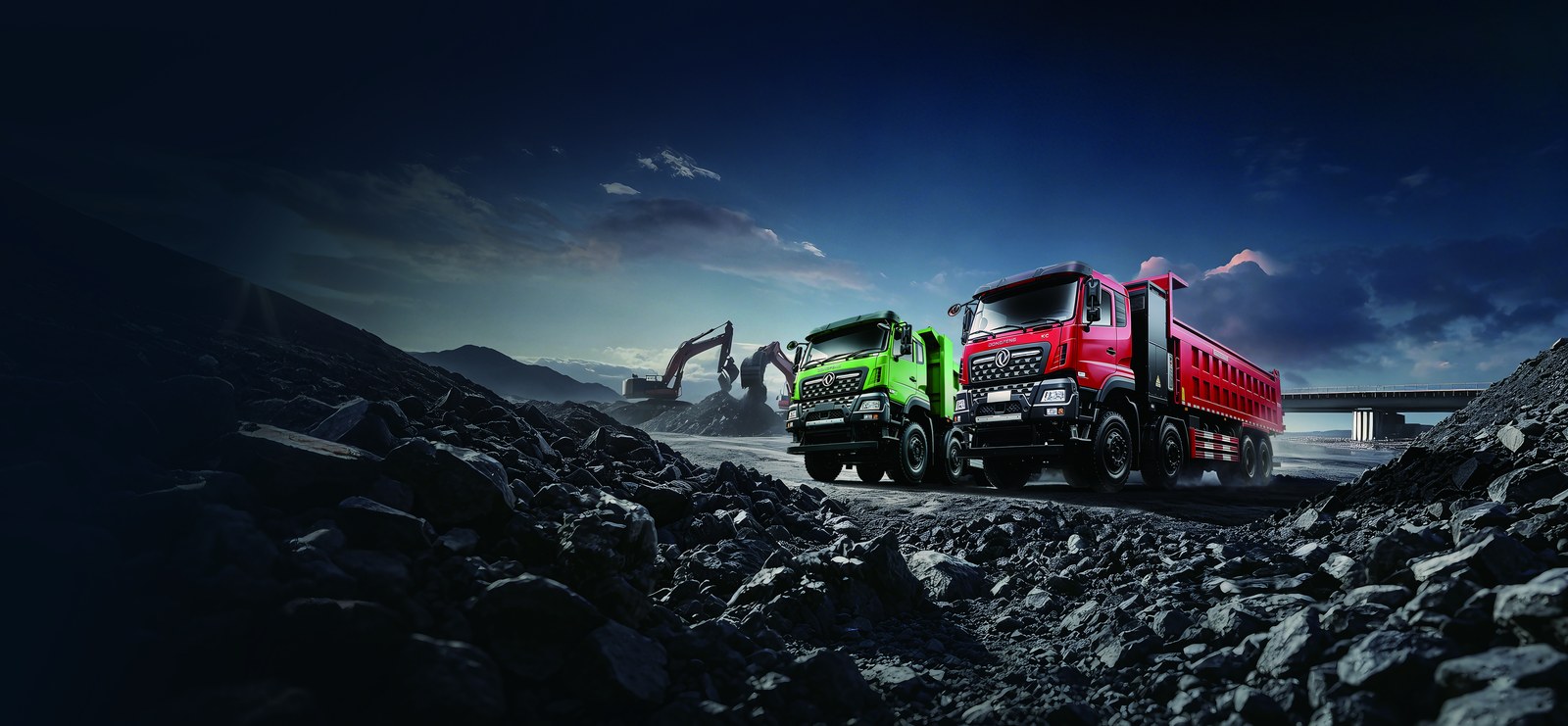
Cameroon’s freight economy runs on one road: the 230 km corridor from the port of Douala up the escarpment to Yaoundé. Everything the capital consumes — food, fuel-adjacent goods, construction materials, consumer products — climbs that road, and everything the coast imports for CEMAC transhipment passes through it. It is a demanding profile for any truck: a loaded climb from sea level to 750 m, heavy seasonal rain, and traffic that compresses speeds into the 40-60 km/h band where diesel engines run least efficiently. This article assesses the Dongfeng KTH3 electric cargo truck on exactly this corridor — with midpoint charging, the route is inside EV truck range today, and the descent economics are remarkable.
The Douala-Yaoundé profile is a study in asymmetric energy. Douala to Yaoundé, loaded at 20 t payload, the KTH3 consumes roughly 1.55-1.75 kWh/km on the climbing legs — the battery delivers about 260-290 kWh into the ascent. The return, loaded or empty, descends the same escarpment, and regenerative braking recovers 22-28% of the round-trip energy. A diesel truck converts that same descent into heat in its brake linings — and Cameroonian corridor fleets replace brake components at intervals their drivers know by heart. The practical consequence: the electric truck’s round-trip energy cost per kilometre is far lower than a naive range calculation suggests, because the topography itself refunds a quarter of the energy.
The single-charge question needs a direct answer. The KTH3’s 350 kWh CATL LFP pack covers 200-240 km of loaded corridor work — enough for the full one-way trip with reserve, but not the round trip. The corridor therefore needs one midpoint or destination charger, and the natural site is Yaoundé’s own freight yards on the city’s southern approach, where most Douala freight terminates anyway. A 240 kW DC charger at the Yaoundé depot restores 20-80% in about 50 minutes — inside the standard unloading window. For operators whose freight continues to Bafoussam or the far north, a second charging point at the destination completes the pattern.
| Parameter | KTH3 6x4 Electric Cargo Truck |
|---|---|
| GVW / payload | 28 t / 18-20 t (box or stake body) |
| Battery | 350 kWh CATL LFP, liquid-cooled |
| Motor | LvKong 360 kW peak / 2,400 Nm |
| Range (loaded corridor profile) | 200-240 km |
| DC charge 20-80% | ~50 min at 240 kW |
| Gradeability | ≥30% — escarpment climbs at speed |
| Regeneration on Douala–Yaoundé | 22-28% of round-trip energy recovered |
| FOB price band | US$88,000-105,000 |
The wet-season question is the one every Cameroonian operator asks, and the engineering answer is straightforward: the KTH3’s HV system is sealed to IP67, the battery pack sits above the wading line used for diesel intake design, and there is no air intake, turbo, or exhaust to ingest water. Electric drivetrains handle the corridor’s flooded-season sections better than the diesels they replace — the traction control modulates motor torque in milliseconds on wet laterite, where a diesel’s clutch and throttle response is an order of magnitude slower.
A diesel 28 t cargo truck on this corridor burns 0.50-0.60 L/km; at Cameroonian pump prices around US$1.15-1.25/L, energy runs US$0.60-0.70 per kilometre. The KTH3’s round-trip consumption nets to 1.3-1.5 kWh/km after regeneration; at ENEO industrial tariffs of roughly US$0.14-0.16/kWh, that is US$0.19-0.23 per kilometre. On a 460 km round trip, 22 days a month, the monthly energy saving is about US$4,200-4,700 per truck. Add maintenance — brake component life extends 3-4x with regenerative braking on descents that destroy diesel brakes, and there is no engine service calendar at all — for another US$800-1,200 monthly. Against the purchase premium of US$35,000-45,000, payback arrives in 8-11 months of corridor service. This is one of the fastest paybacks in our entire deployment portfolio, and it is entirely a function of the corridor’s severity on diesel equipment.
The infrastructure plan is simple because the freight pattern is simple: chargers belong where trucks already stop. Douala’s port-side yards host the base installation — one 240 kW DC charger per 4-6 trucks with managed overnight AC. Yaoundé’s southern freight district hosts the destination unit. ENEO medium-voltage service at both sites is a standard industrial connection class, and we deliver the utility application documentation with the truck order. For operators running beyond Yaoundé, the next logical node is Bafoussam (another 290 km), and the same depot-charging logic applies: the trucks sleep where the freight ends, and that is where the charger goes.
Solar integration is worth serious attention in Cameroon. The corridor’s Yaoundé end receives 4.5-5.0 peak sun hours daily, and a 200-300 kWp canopy over a freight yard offsets 35-50% of annual charging energy while providing covered staging. Several Douala cold-storage operators already run solar-plus-diesel-hybrid yard power; substituting truck charging for diesel genset load is the cheapest electrification increment available in the market.
Cameroon applies reduced duty treatment to electric vehicles under its 2023 finance measures, and Douala’s RoRo terminal handles truck imports with 30-38 day sailings from China. We supply the full French-language homologation dossier — critical for CEMAC markets — plus UN R100 battery certification and the two-year parts kit. Corridor operators should also review our Nigeria market page: several Cameroonian freight groups operate cross-border into eastern Nigeria, and a shared EV truck platform across both markets halves parts stock and technician training. The Douala-Yaoundé electrification template replicates directly onto the Douala-N’Djamena and Yaoundé-Bata corridors as those fleets modernise.
Service support for Cameroon follows our Central African structure: parts kits shipped with the fleet, CATL module stock reachable in 12-18 days, and telematics-based remote diagnostics with French-language support. The KTH3’s drivetrain — one motor, one reduction gear, no clutch, no aftertreatment — removes the maintenance categories that keep diesel trucks in Douala workshops for weeks waiting on imported engine parts. On a corridor where every day off the road is a missed round trip, drivetrain simplicity is not a convenience; it is revenue.
The natural first fleets are the large FMCG and beverage distributors with their own Douala yards and Yaoundé DCs — captive routes, captive depots, maximum daily utilisation. Cement and construction-materials haulers are second; their backhaul patterns are predictable and their diesel bills are the largest in the corridor. The economics above are not projections from a spreadsheet: they are the same architecture already operating in East African escarpment corridors we have electrified, where the descent-regeneration effect is identical. Cameroon’s corridor is ready; the first operator to electrify it owns a cost position the diesel competition cannot answer.
The Douala-Yaoundé corridor’s rainy seasons — March to June and September to November — define operating reality, and electric trucks handle them with specific advantages worth detailing. Traction: the LvKong motor’s torque is modulated in milliseconds by the traction control system, so loaded pull-aways on rain-slicked laterite and the corridor’s notorious wet-season surface happen without the wheelspin cycles that chew diesel clutches and tyres. Wading: flooded sections that drown diesel intakes every season are a non-event for the sealed IP67 drivetrain — the truck fords water that stops the diesel fleet, and several of our African deployments report the electric trucks becoming the corridor’s only reliable vehicles during peak rains. Braking: regenerative retarding on the wet escarpment descents reduces dependence on friction brakes exactly when friction braking is least trustworthy, a safety margin professional drivers notice in the first week.
Maintenance planning through the rains is correspondingly simple. The fleet’s wet-season calendar — connector inspections, brake checks, underbody wash-downs to prevent laterite buildup — is measured in hours per month, against the diesel fleet’s wet-season ritual of fuel-system draining, air-dryer servicing and electrical-fault chasing. Corridor operators should also note the resilience argument: Cameroon’s fuel supply to the interior tightens periodically, and a truck fleet charged from grid and solar power is insulated from a supply chain that has stranded diesel fleets before. On a corridor where reliability is the product being sold, that insulation has commercial value beyond the energy arithmetic.
Ready to electrify your fleet? Contact Shaanxi Fenghan Trading — authorized Dongfeng EV truck exporter. WhatsApp: +86 153 1943 1311 | Email: sales@fenghan-trade.com | dongfengevtrucks.com
🌐 Our Network: Fenghan Trade (SAGMOTO/SHACMAN Truck Export) · SAGMOTO cargo truck flatbed box stake