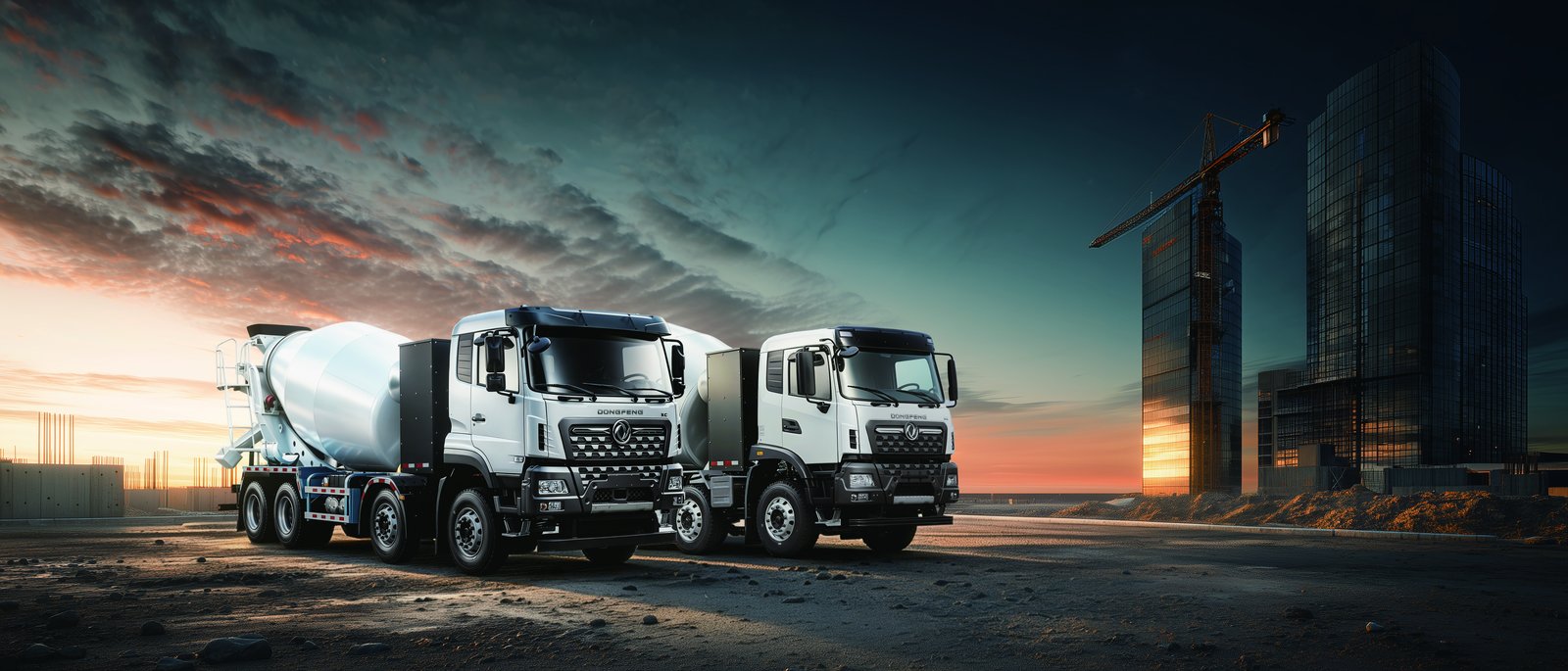
A large hydropower dam is, before it is a power station, a concrete delivery system. Gravity dams carry one to ten million cubic metres of concrete; even run-of-river and weir projects run hundreds of thousands. That concrete moves from batching plants to pour faces in a continuous, rhythm-critical choreography of mixer trucks — in canyon settings on haul roads with 8–12% grades, at altitudes where diesel engines derate, on projects where the eventual purpose is clean generation and the financing increasingly expects clean construction. The Dongfeng TZ8J — an 8x4 electric mixer with CATL 333 kWh LFP, 45 t GCW and an 8 m³ drum on electric PTO — is built for exactly this duty, and it carries one structural advantage no diesel mixer can copy: dam projects have power on site from the earliest construction phases. This article lays out the duty cycle, the machine and the economics for hydropower EPC contractors and concrete subcontractors.
| Parameter | TZ8J Specification |
|---|---|
| Configuration | 8x4 electric concrete mixer |
| GCW | 45 t |
| Drum | 8 m³, electric PTO drive (no hydraulic/diesel auxiliary) |
| Battery | CATL LFP 333 kWh, liquid thermal management |
| Drive | Central motor, ~282–350 kW class with grade-tuned gearing |
| Range (dam duty: haul + continuous drum) | 150–200 km equivalent — 1.5–2 full shifts |
| Charging | Dual-gun DC fast charge 40–60 min; plant-queue opportunity charging |
| Warranty | 8 years / 4,500 cycles (pack) |
| Indicative FOB | USD 90,000–120,000 |
Consider a typical dam cycle: 4 km loaded haul at 6% average grade, 25 minutes of queue-and-pour with the drum turning, 4 km empty descent, 10 minutes at the plant loading. Per cycle the truck covers 8 km of road and roughly 35 minutes of drum time. Diesel consumption for that cycle: 6–8 L of traction fuel plus 1.5–2 L of PTO idle — call it 8–10 L per cycle. The TZ8J covers the same cycle on 12–16 kWh including drum duty, of which the descent returns 2–3 kWh to the pack. At dam-site power prices (USD 0.05–0.08/kWh on project supply), the cycle costs USD 0.70–1.20 electric against USD 8–10 diesel. Over 12 cycles a day, 26 days a month, 30 months of pouring, a single truck saves USD 60,000–90,000 in energy alone across one dam project — most of a replacement mixer.
Assumptions: 15 units, 12 cycles/day, 55,000 km/year each with drum-time equivalent; site power USD 0.06/kWh; diesel USD 1.00/L:
| Annual cost per truck | Diesel mixer | TZ8J |
|---|---|---|
| Fuel / energy (incl. PTO/drum) | USD 24,000–30,000 | USD 3,200–4,200 |
| Engine + hydraulic PTO maintenance | USD 6,500–8,500 | USD 1,800–2,400 |
| Brakes (descent regen saves linings) | USD 2,800 | USD 1,100 |
| Annual saving per truck | — | USD 26,000–34,000 |
| 15-truck annual fleet saving | — | USD 390,000–510,000 |
A 30-month pour schedule puts the fleet saving at USD 975,000–1,275,000 per dam. Charging infrastructure — two dual-gun 240 kW chargers at the batching plant plus one 120 kW unit at the downstream yard, fed from the project substation — runs USD 130,000–200,000 and is retired into the permanent O&M fleet when pouring ends.
Dam pouring is a queue business — trucks line up at the plant and at the pour face. The TZ8J exploits both queues: a 120–240 kW charge point at the batching plant restores 15–25% of the pack during every loading wait, meaning a truck that started the shift at 90% finishes at 60–70% rather than deep-discharging. This opportunity-charging pattern is why the 333 kWh pack, modest by heavy-EV standards, comfortably covers double-shift dam duty — the truck refuels itself in the queues where diesel trucks merely idle.
Mass concrete pours run around the clock through night windows when ambient temperatures allow. In canyon topography, diesel mixer noise accumulates — the EPCM environmental plans for major dams increasingly carry night-noise limits that diesel fleets strain against. The TZ8J at a pour face is dramatically quieter: no engine, a drum driven electrically, and its own 69–72 dB(A) operating noise class. Projects under stricter environmental supervision have found electric mixers effectively eliminate the night-noise compliance issue, extending permissible pour windows. On a schedule-critical dam, longer legal pour windows are worth real money.
Dam sites deliver canyon heat, blasting dust and river humidity in various regional mixes. The CATL pack's liquid cooling manages the thermal load; the IP68 HV architecture seals against dust and wet-season moisture; and the mixer body hardware (drum, chute, water system) is standard construction equipment that site mechanics already know. Our remote-site support package — commissioning training, an on-site critical-spares kit, remote diagnostics over the camp's connectivity — is designed for projects two hundred kilometres from the nearest city, which dam projects usually are.
Hydropower is financed on green credentials; the same multilateral lenders and climate funds that finance dams now read construction-phase emissions in the environmental and social governance reports. A concrete fleet burning diesel through a three-year build is a visible line item in that report; a fleet charging from the project's construction-phase power supply, eventually from the dam's own output, converts logistics from a compliance liability into a project feature. Several EPC contractors bidding internationally have concluded that fleet electrification strengthens tenders — and the TZ8J at 45 t GCW with an 8 m³ drum is the unit that carries the argument on the pour face.
Dam concrete logistics is a two-layer system — aggregate supply feeding the batching plant, and mixers carrying fresh concrete to the pour face — and the electrification case strengthens when both layers convert together. The aggregate layer (crusher to batching plant, 2-10 km loops) is electric dump-truck duty: our TZ-series tippers run it with fixed-radius charging identical to quarry operations. The mixer layer is the TZ8J's domain. When both layers run electric, three synergies appear:
A factor that dam engineers raise more often than logistics managers expect: drum consistency. Concrete quality depends on continuous, uniform agitation between batching and placement — specifications typically require the drum turning within minutes of loading and continuous through delivery. The TZ8J's electric drum drive holds drum speed with precision the hydraulic systems on diesel mixers cannot match, independent of engine rpm (which varies with traction demand on canyon grades). The result is measurably more uniform slump at the pour face on long or steep hauls — a quality margin that matters doubly on dam concrete, where mix consistency feeds directly into strength-test variance and acceptance criteria. No TCO model prices this; every concrete engineer understands it. On pour-critical structures, it is occasionally the deciding argument by itself.
Dam construction ends; mixer fleets do not. The redeployment path for a TZ8J fleet: (1) rotate to the next dam or hydropower project in the region — the equipment's 8-year warranted life comfortably spans two mid-size projects; (2) transition to urban ready-mix duty, where the same truck serves city concrete markets with the identical economic advantages at municipal scale; or (3) sell into the regional secondary market, where documented SoH telemetry on the CATL pack supports strong resale values (a 333 kWh LFP pack at year six retains a tradeable second-life value even if the mixer body retires). We structure fleet purchases with this lifecycle explicitly — several dam contractors now finance their mixer fleets against a blended-duty model that assumes redeployment, which the banks accept precisely because the redeployment paths are real and documented. The diesel mixer fleet's residual value story has never been this clean.
Ready to electrify your fleet? Contact Shaanxi Fenghan Trading — authorized Dongfeng EV truck exporter. WhatsApp: +86 153 1943 1311 | Email: sales@fenghan-trade.com | dongfengevtrucks.com
🌐 Our Network: Fenghan Trade (SAGMOTO/SHACMAN Truck Export) · SAGMOTO heavy duty diesel trucks