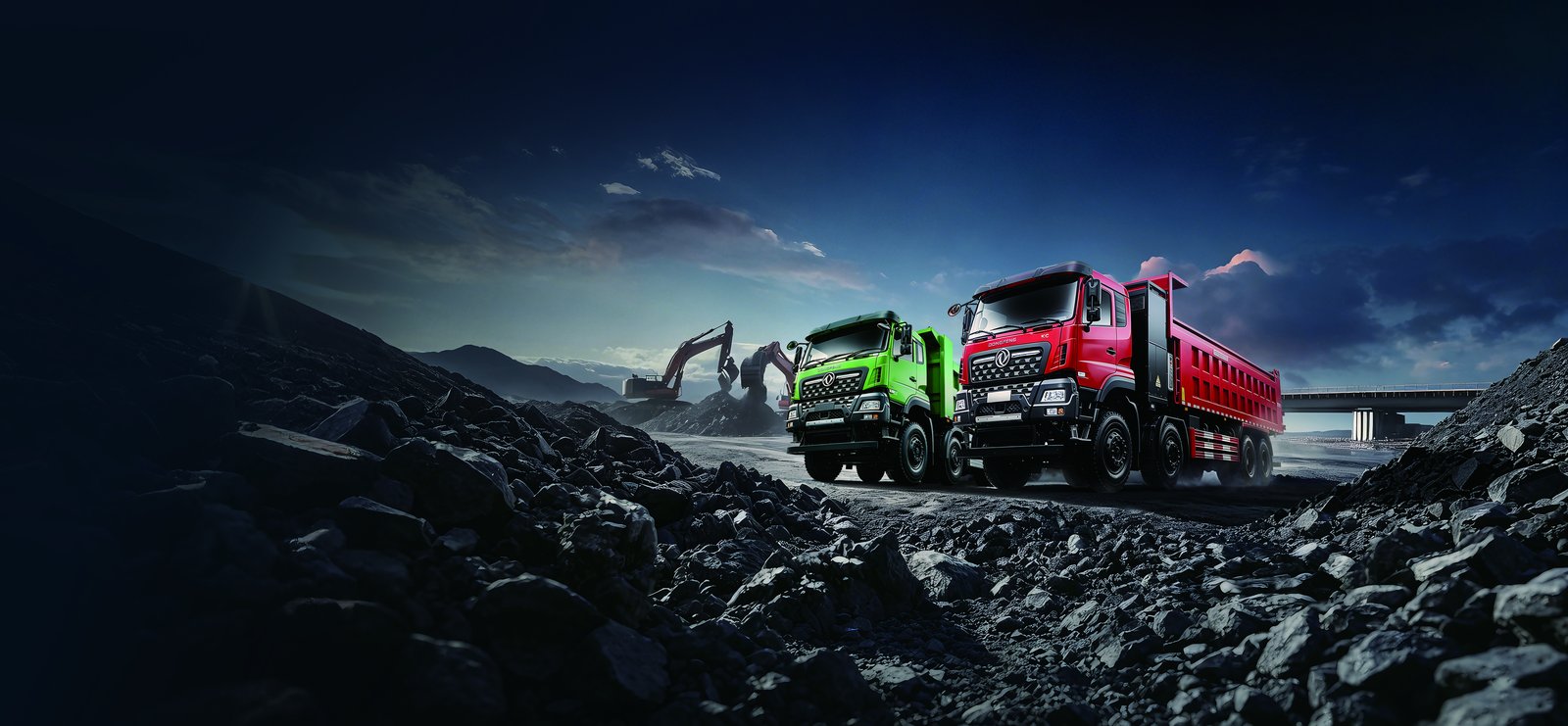
Chinese OEMs have taken different routes into electric mining haulage. XCMG's XDE family attacks the 100–120 tonne class with large-format rigs aimed at big iron-ore and coal operations; Dongfeng's approach, embodied in the TZ5Y 80-tonner and its smaller sibling the TZ3V 8×4 electric dump truck, targets the enormous middle of the market: quarries, mid-size copper and gold pits, nickel laterite operations, and construction-scale earthmoving across Africa, Southeast Asia, and Latin America — the sites that haul 80,000–300,000 tonnes a month, not a day. Buyers converting these operations to electric ask us the same question: is the bigger truck worth the bigger ticket? Here is how the decision actually decomposes, drawn from deployments in Indonesia's nickel belt and West African gold country.
A 100 t-class rig does not replace an 80 t-class truck one-for-one in a mid-size pit. The comparison that matters is the fleet that moves a given monthly tonnage:
| Fleet parameter (target: 300,000 t/month, 3.5 km haul) | TZ5Y 80 t fleet | XDE-class 100 t+ fleet |
|---|---|---|
| Trucks required | 6 | 5 |
| Unit capital (approx. FOB) | USD 170,000–200,000 | USD 320,000–450,000+ |
| Fleet capital | ~USD 1.1–1.2 M | ~USD 1.6–2.2 M |
| Spare-unit cost (n+1 fleet) | 1 extra truck = ~USD 185k | 1 extra truck = ~USD 380k+ |
| Road width / ramp design | Standard quarry haul roads | Wide ramps and turning circles often required |
| Battery per truck | CATL LFP, high-capacity pack, swap-capable | Larger packs; swap infrastructure heavier |
Read the capital line twice: for the same monthly tonnage, the smaller-class fleet costs 30–45% less to acquire and leaves the difference available for charging or swap infrastructure, solar generation, and a spare truck. At mid-size-mine utilisation, that arithmetic usually decides the tender before any spec-sheet argument.
Haul-profile fit. The TZ5Y was engineered around the 1–5 km hauls, rolling terrain, and mixed-grade ramps that define emerging-market pits. Its CATL LFP pack delivers 350 km-class range in a 282–510 kW LvKong drive envelope, and its swap-capable architecture restores a full pack in 5–6 minutes — the feature that converts electric mining from a charging-schedule problem into a diesel-beating availability story.
Road compatibility. An 80 t truck runs on the haul roads mid-size quarries already have. No re-engineering of ramps, berms, or tipping areas — the silent budget killer in fleet-class upgrades.
Capital density. At USD 170,000–200,000 per unit, the TZ5Y lets a mine convert its whole fleet for the price of half an XDE fleet, or convert now and expand later — the staged path most mid-size mines' balance sheets actually allow.
Servicing reality. The TZ5Y shares its drivetrain family with the wider Dongfeng commercial range, meaning regional technicians, common diagnostic tooling, and drive-unit spares from the same pipeline that keeps thousands of electric dump trucks running across Africa and Asia.
Run the two fleets on a 5-year discounted model with your parameters, and the ranking flips on exactly three variables: electricity price (favouring whichever fleet has better t/kWh on your grade profile), utilisation (favouring the bigger class only above ~20 h/day truck duty), and haul length (above ~6 km one-way, the 100 t class starts to close the capital gap). Below those thresholds — which describes the majority of gold, quarry, laterite, and copper operations in our markets — the 80 t electric fleet wins on cost per tonne, and the margin is usually 10–20%. One more practical note: the TZ5Y's swap architecture pairs naturally with a solar-plus-buffer depot; mid-size mines increasingly value the energy independence that gives them during grid events or fuel-supply shocks, a resilience argument the 2020s keeps re-teaching.
If you share your monthly tonnage, ramp profile, and electricity tariff, we will build both fleet models side by side — including swap-station sizing — so the decision rests on your site's numbers rather than either OEM's brochure.
Abstractions end when the tender lands, so let us run the comparison on a concrete operation — a mid-size copper quarry hauling 300,000 t/month on a 3.5 km one-way haul with a 120 m net descent from pit to crusher, in a market with USD 1.20/L diesel and USD 0.10/kWh industrial power. The TZ5Y fleet: six trucks at ~USD 185,000 FOB each, swap-capable, with one swap station (~USD 600,000 installed with buffer) sized to hold 20-truck capacity for future growth. The XDE-class fleet: five trucks at ~USD 400,000 each with matching charge-swap infrastructure scaled up for the larger packs. Capital: ~USD 1.7 M versus ~USD 2.6 M. Energy per tonne favours the larger truck slightly on the long loaded descents (better t/kWh at higher payload), but the 900,000-dollar capital difference buys 45,000,000 additional tonne-kilometres of energy at the local tariff before the bigger fleet catches up — a gap of more than four years at this operation's rate.
The same worked example exposes the secondary factors. Road width: the 80 t trucks run the existing haul roads; the 100 t+ class wants a metre more width on the ramps and a larger turning basin at the crusher, civil works the smaller fleet prices at zero. Spare-unit economics: n+1 redundancy costs USD 185k in the TZ5Y configuration and double that in the bigger class. Tyres and wear parts scale with mass, and the smaller fleet's consumables cost less per hour despite more cycles. And the driver pool: 80 t-class drivers are the standard quarry workforce on every continent; 100 t+ rigs want specialised operators whose availability in emerging markets sets the roster's real ceiling.
The worked example closes the way most real tenders do: the size class that matches the mine's existing roads, workforce, and capital structure wins on total cost per tonne, and the larger class wins only when the tonnage, the ramps, or both genuinely require it. For the thousands of mid-size operations in our markets, that arithmetic lands on the 80 t class — which is exactly the habitat the TZ5Y was engineered to own.
A closing note on the decision's reversibility, because mining capital plans punish mistakes in both directions. Choosing the 80 t class does not foreclose the larger class later: the TZ5Y's swap architecture and depot design scale directly, and a mine that outgrows the fleet can layer the bigger class in alongside it — mixed-size haulage is the historical norm in open pits, with trucks assigned by ramp and face. Choosing the 100 t+ class first, by contrast, embeds its requirements — wider ramps, heavier civils, specialised operators, deeper capital — into the mine's fixed geometry, and the step-down path from an oversized fleet to a right-sized one runs through write-offs. In emerging-market mining, where ore bodies get revised and finance arrives in tranches, optionality has a book value: the fleet that matches today's tonnage and scales by addition is worth a measurable premium over the fleet that bets the pit's geometry on a tonnage forecast. The TZ5Y-versus-XDE question, asked honestly, is usually that question wearing truck specification's clothes.
Ready to electrify your fleet? Contact Shaanxi Fenghan Trading — authorized Dongfeng EV truck exporter. WhatsApp: +86 153 1943 1311 | Email: sales@fenghan-trade.com | dongfengevtrucks.com
🌐 Our Network: Fenghan Trade (SAGMOTO/SHACMAN Truck Export) · heavy duty mining dump truck 6x4 8x4