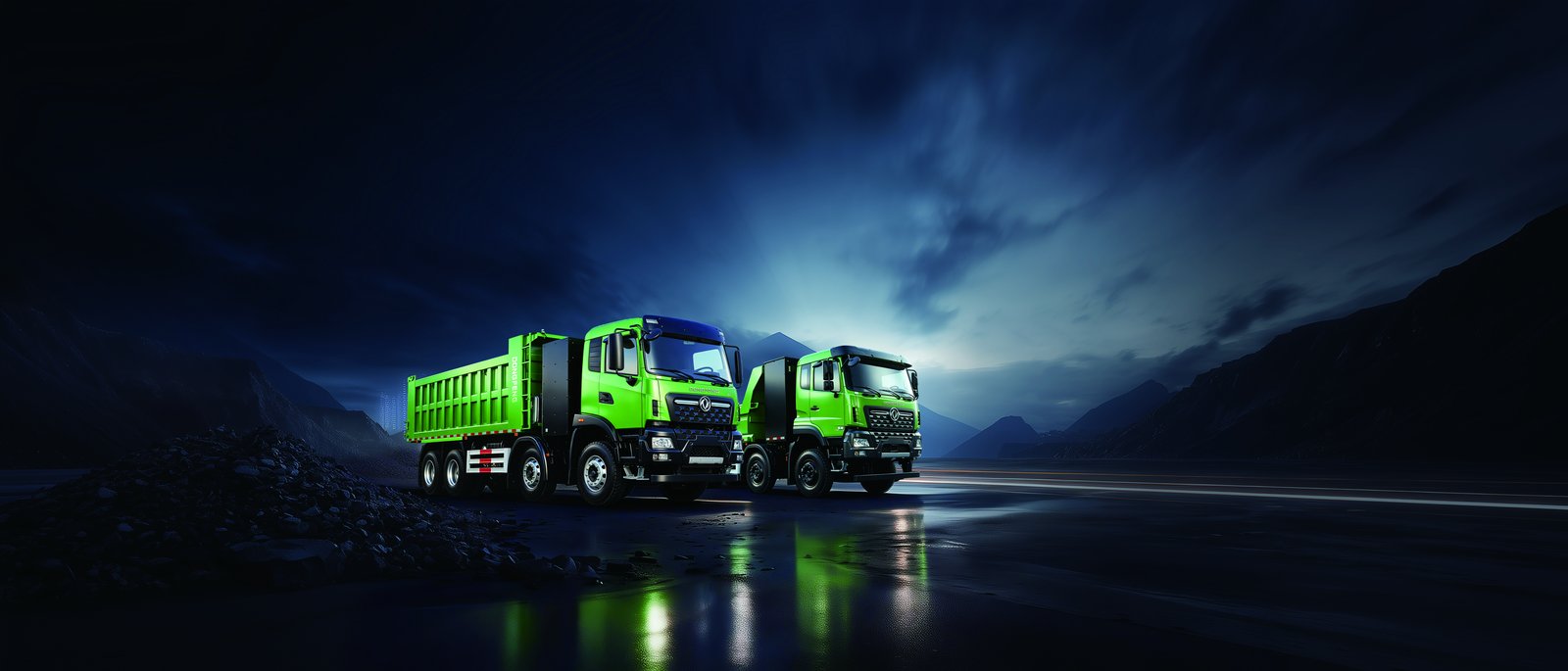
The September 2023 Al Haouz earthquake damaged or destroyed tens of thousands of buildings across the High Atlas and the Marrakech region, and Morocco answered with a five-year reconstruction programme of rare ambition: whole-village rebuilds, seismically upgraded housing, new schools and clinics, and hundreds of kilometres of mountain access roads — with the Crown's reconstruction fund committing roughly USD 12 billion. The programme's logistics run through exactly the terrain where a conventional truck fleet struggles most: steep valleys, narrow village tracks, 1,000–2,000 m altitudes, and supply chains rooted at the crushers and depots of the Marrakech plain. That combination — massive sustained materials demand, brutal gradients, fixed corridor logistics — is the natural habitat of an electric tipper. This article covers the case for the Dongfeng TZ5E 6x4 electric dump truck on Al Haouz reconstruction duty: the gradient physics, the corridor structure, the operating economics at Moroccan prices, and the deployment plan. For the wider national picture, see our Morocco electric truck market guide.
Reconstruction duty in the Atlas is defined by vertical movement. The classic cycle: load laterite and aggregate at a plain-side crusher, climb 15–35 km of valley road gaining 400–900 m of elevation, discharge at the village site, and descend empty:
| Parameter | TZ5E on Al Haouz duty | Diesel 6x4 comparator |
|---|---|---|
| Cycle | 25–60 km loaded climb / empty descent, 6–9% grades | Same |
| Cycles per day | 4–6 | Same |
| Daily distance / energy | 180–280 km / 380–560 kWh | 180–280 km / 130–200 L |
| Daily energy cost | USD 40–62 (at USD 0.11/kWh) | USD 145–225 (at USD 1.12/L) |
| Battery sizing | 400 kWh pack + mid-day 120 kW boost at the crusher | — |
| FOB reference | USD 110,000–130,000 | USD 65,000–80,000 |
The TZ5E's 400 kWh pack covers four loaded cycles from a full charge, and the crushing-plant dwell — the truck loads under the hopper for 15–25 minutes anyway — is a natural opportunity-charging window at 120 kW, which recovers 30–50 km of climbing range per stop. The crusher, in other words, is the depot: grid-connected, fenced, and already staffed.
Assume a contractor running 12 TZ5E tippers on Al Haouz village-rebuild supply, 300 operating days, at the pricing above:
| Annual item (12 trucks) | Diesel fleet | TZ5E fleet |
|---|---|---|
| Fuel / energy | USD 570,000–710,000 | USD 155,000–195,000 |
| Maintenance incl. brakes (regen halves brake wear) | USD 175,000 | USD 62,000 |
| Charging infrastructure (annualised) | — | USD 38,000 |
| Total annual operating | USD 760,000 | USD 270,000 |
Roughly USD 490,000 of annual savings against an incremental capital cost of USD 480,000–600,000 (trucks plus the crusher-site charging) — payback inside 15 months, comfortably inside the reconstruction programme's multi-year horizon. The 8-year / 4,500-cycle CATL warranty frame covers the machine far beyond the works.
The Al Haouz programme is state-funded and internationally supported, and its contracting structure favours electric in three soft ways. First, Moroccan public procurement increasingly carries sustainable-development scoring — a fleet plan citing zero-emission haulage answers it directly. Second, the programme's village-first image — reconstruction as a national act of care — rewards contractors whose equipment is quiet and clean around the communities being rebuilt; the optics of silent electric tippers in a mountain village versus idling diesels are not subtle. Third, Morocco's national EV push (covered in our market guide) means the bureaucracy is already fluent in electric-vehicle registration and incentives.
Where the electric case still waits on Al Haouz duty: the deepest single-day cycles beyond 280 km (the KTA1/TZ5E mid-day boost covers most, but a bigger pack or a second boost stop must be engineered); contractors whose fleet rotates between widely dispersed sites without a fixed depot; and the very smallest village tracks where payload law and road width favour lighter trucks altogether — a compact KTA1 covers that end. Within the programme's main supply corridors, the arithmetic holds: a five-year reconstruction, the widest fuel-power spread in North Africa, and the topography that regeneration loves.
Reconstruction logistics is the purest form of fixed-corridor freight — the kind electric trucks were designed for. The Moroccan contractors who electrify their Atlas fleets now will finish the programme with the operating margins, the fleet hours and the tender record their competitors spend the next decade chasing.
Reconstruction programmes end, and fleet planning should price that horizon. A TZ5E that finishes Al Haouz duty at five years old carries perhaps 60–65% of its original battery capacity used, a full remaining CATL warranty tail, and — this is the Moroccan advantage — a national market that by then will have spent a decade building charging infrastructure and EV registration fluency. The second life options are concrete: the Atlas tourism and agriculture corridors the reconstruction roads themselves opened; the phosphate-belt industrial towns around Khouribga and Benguerir; the Casablanca construction market whose demand never closes. Alternatively, the used-electric-truck market that our residual-value analysis tracks internationally gives a five-year-old CATL-powered tipper a real secondary price — certified battery health turns the truck into a liquid asset rather than a write-off.
The point for the procurement case: an electric fleet bought for a five-year programme is not a stranded asset at the end of it. Between the domestic second market and the export channels, the reconstruction fleet retires into work — and the fleet manager who planned that exit at purchase financed the whole programme more cheaply.
Ready to electrify your fleet? Contact Shaanxi Fenghan Trading — authorized Dongfeng EV truck exporter. WhatsApp: +86 153 1943 1311 | Email: sales@fenghan-trade.com | dongfengevtrucks.com
🌐 Our Network: Fenghan Trade (SAGMOTO/SHACMAN Truck Export) · heavy duty mining dump truck 6x4 8x4