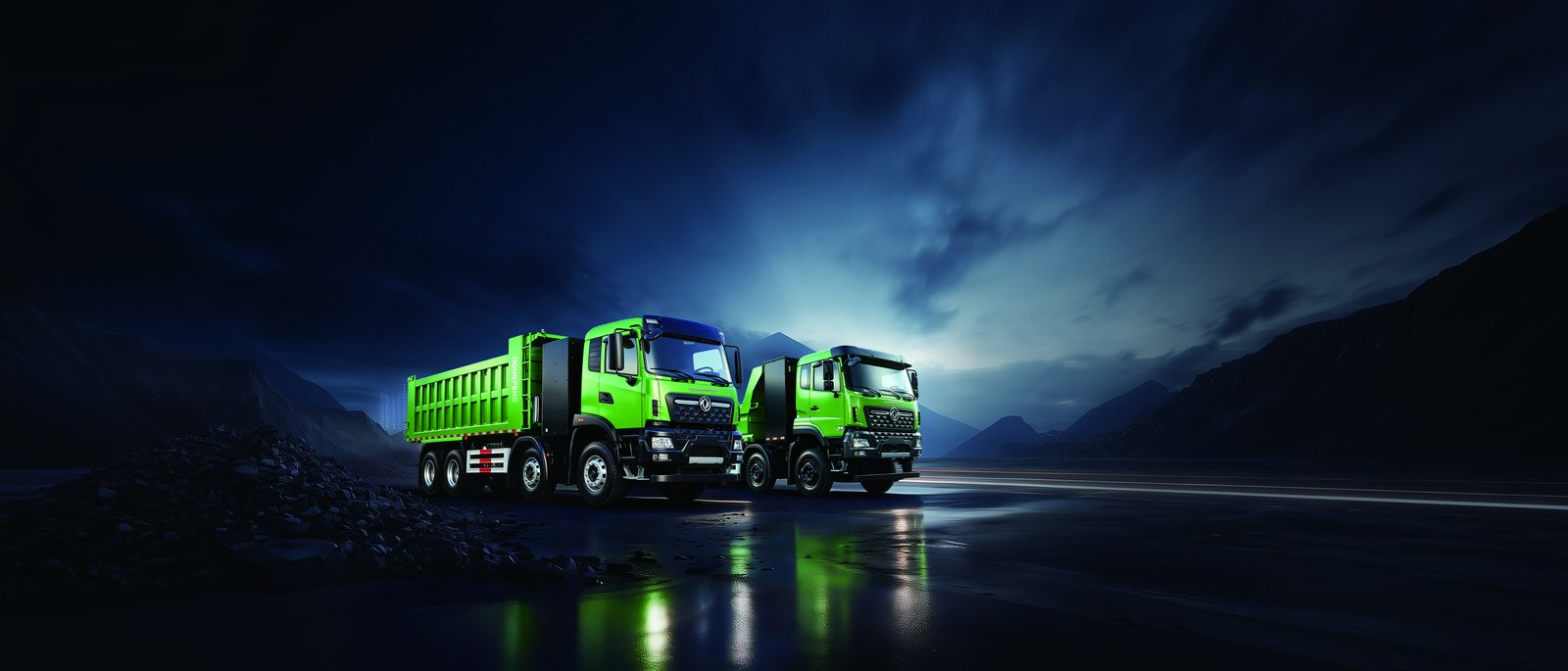
Algeria runs one of Africa's largest state-backed construction programmes: continuous housing waves (the AADL programmes have delivered hundreds of thousands of units), the ongoing East-West Highway network upgrades, dams, desalination plants and the new commercial port at El Hamdania outside Cherchell. Chinese contractors have historically executed a major share of this pipeline, and the trucks moving aggregate and fill for it have been diesel 6x4 tippers — 25-tonne-class workhorses running 15–40 km site radii. The Dongfeng TZ5E, a 6x4 electric dump truck with CATL 400 kWh LFP, 25 t GVW and 315/510 kW motors, matches that exact duty class with zero tailpipe emissions and roughly a third of the energy cost. With Algeria's grid dominated by domestic natural gas (and a fast-growing solar programme under the Solar 1000 MW initiatives), the fuel-import argument for electric trucks is increasingly a national-policy argument, not merely a fleet one. This analysis covers the market, the machine, the import path and the economics.
| Parameter | TZ5E Specification |
|---|---|
| Configuration | 6x4 electric dump truck |
| GVW | 25 t |
| Battery | CATL LFP 400 kWh, liquid thermal management |
| Drive | Dual motor, 315 kW continuous / 510 kW peak |
| Range (loaded site duty) | 200–250 km — 1–2 shifts per charge |
| Charging | Dual-gun DC fast charge, 40–60 min |
| Suspension | Heavy-duty multi-leaf, construction-rated axles |
| Warranty | 8 years / 4,500 cycles (pack) |
| Indicative FOB | USD 95,000–125,000 |
The TZ5E's fit for Algerian housing-programme duty is almost mechanical: quarry-to-site loops of 15–40 km at 25 t GVW are exactly the cycle the 400 kWh pack was sized for. On routes with elevation — and Algerian sites frequently sit on plateau terrain with 100–200 m of relief — regenerative braking returns 8–14% of energy on loaded descents and saves the brake rebuilds that define diesel tipper maintenance on the same routes.
Assumptions: 20 TZ5E units, 70 km/day average cycle, 300 operating days, ~62,000 km/year per truck; Algerian diesel at the subsidised pump equivalent of USD 0.34–0.40/L (and roughly double that at unsubsidised parity); industrial electricity at USD 0.05–0.07/kWh; site charging on two dual-gun 240 kW chargers plus one 120 kW unit:
| Annual cost per truck | Diesel 6x4 tipper (subsidised fuel) | TZ5E |
|---|---|---|
| Fuel / energy | USD 8,200–10,000 | USD 2,000–2,700 |
| Engine & driveline maintenance | USD 3,200–4,200 | USD 900–1,200 |
| Brakes & consumables | USD 1,500 | USD 600 |
| Annual saving per truck | — | USD 8,000–10,500 |
| 20-truck annual fleet saving | — | USD 160,000–210,000 |
Read that table carefully: it is computed against subsidised diesel. Should Algeria follow through on fuel-subsidy rationalisation — as the finance ministry has signalled repeatedly — the diesel column roughly doubles and the annual saving per truck rises to USD 14,000–19,000. Fleets buying electric now are, in effect, hedged against the single largest cost risk in Algerian road freight.
Algeria ships through the main ports of Algiers, Oran, Béjaïa, Djen Djen and Mostaganem, with RORO services from Chinese ports in 25–35 days. The Algerian import regime for trucks involves customs duty (with the 2020 African Continental Free Trade Area framework gradually reshaping intra-African rates, though Chinese-origin trucks remain under MFN treatment), plus TVA and other charges on the landed stack. Algerian importers generally operate through established customs brokers with agément — and the practical essentials we handle are the same everywhere: UN 38.3 test summary for the CATL pack, IMDG Class 9 (UN 3171) dangerous-goods documentation at transport state-of-charge, full technical file, and coordination so the DG paperwork arrives before the vessel does. Algerian banks operate documentary-credit routines for vehicle imports that our documentation package is built to satisfy.
Construction-yard charging in Algeria is straightforward: a 20-truck fleet needs two 240 kW dual-gun chargers and one 120 kW unit on a dedicated site transformer — infrastructure that the project's electrical contractor installs alongside batching-plant power. The compelling Algerian upgrade is solar: project sites in the Hauts Plateaux and the south receive world-class irradiance. A 1–2 MW solar array with battery buffering feeds the chargers through the day and covers 40–60% of haul energy, dropping the effective energy cost below USD 0.04/kWh and giving the project an ESG number for its completion report. We size these hybrid arrays with the truck order — the arithmetic is a function of fleet size, cycle length and shift pattern, and it takes one engineering session to fix.
Algerian construction sites deliver the full North African package: 42–45 °C summers, fine dust, and long unsealed haul approaches. The CATL pack's liquid cooling holds cells in their optimal band through the summer; the IP68 HV architecture seals against dust; and the filtration-and-inspection regime in our commissioning manual is written for exactly these conditions. The same specification trucks run our Sahel and GCC deployments — this is proven equipment in the environment, not adapted equipment.
Our advice to Algerian contractors and importers: begin with a 3–5 unit pilot on the longest-utilisation site in the current programme — ideally one with a Chinese main contractor who can absorb the equipment into existing maintenance structures — validate for one quarter against the diesel benchmark, then scale. The trucks move between sites as programmes complete; the chargers move with them or consolidate at the central yard. Housing programmes run for years; the fleet that starts electric now compounds its saving across every subsequent site.
The solar question deserves the engineering detail, because it is where Algerian deployments outperform the default. The sizing method we use with contractors:
Algerian construction contractors live on a project portfolio — housing programmes, road sections, industrial facilities — each with its own site radius and duration. The fleet economics improve when the portfolio view drives the electrification decision:
This portfolio logic is why we quote Algerian contractors on fleet-plus-infrastructure packages rather than trucks alone: the truck price is one line; the decade of projects it serves is the business case.
Ready to electrify your fleet? Contact Shaanxi Fenghan Trading — authorized Dongfeng EV truck exporter. WhatsApp: +86 153 1943 1311 | Email: sales@fenghan-trade.com | dongfengevtrucks.com
🌐 Our Network: Fenghan Trade (SAGMOTO/SHACMAN Truck Export) · heavy duty mining dump truck 6x4 8x4