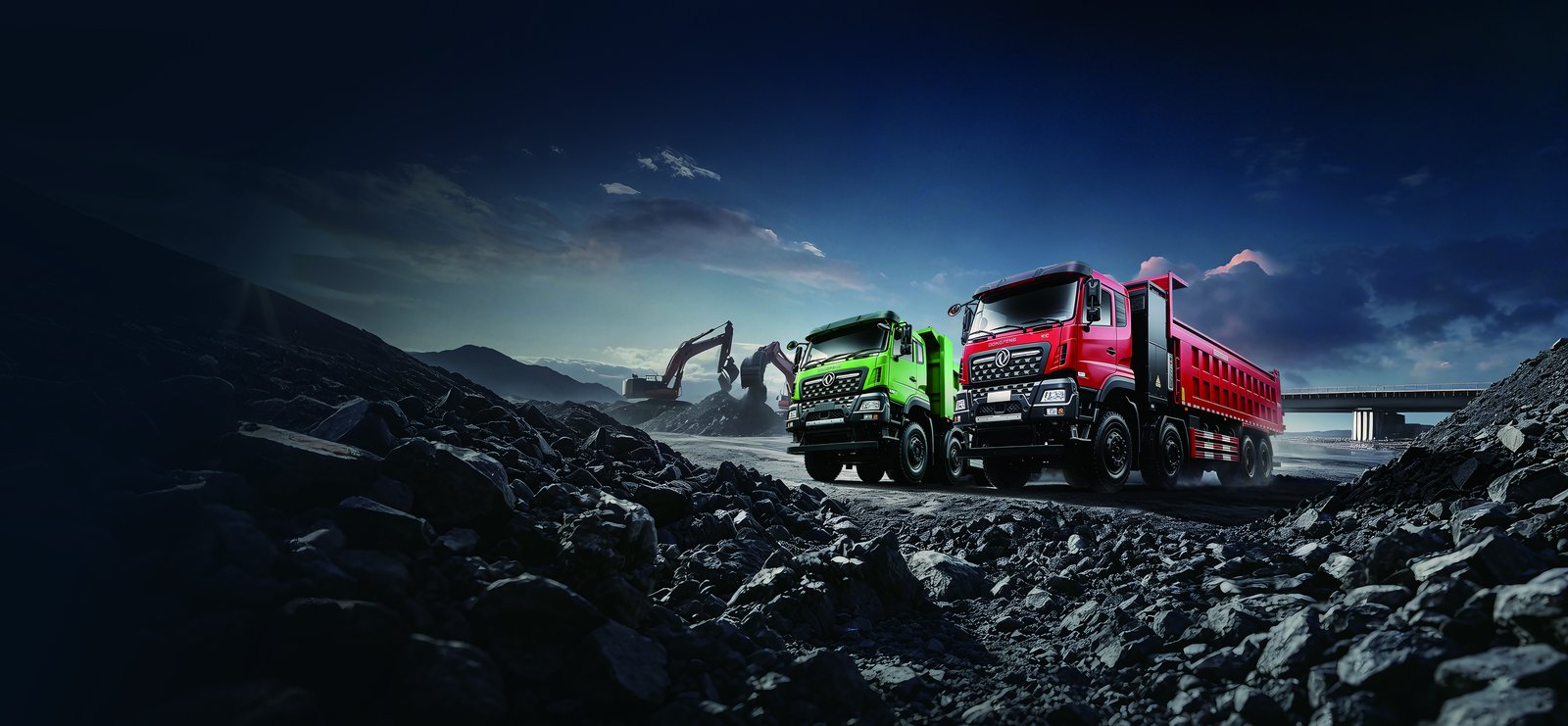
Chinese engineering groups produce most of the world's electric mining haulage hardware, and African and Asian mine procurement teams evaluating an 80-tonne-class electric dump truck typically shortlist three brands: Dongfeng (through authorised exporters like us), XCMG and SANY. All three build serious machines — but they build them from different engineering traditions, and those traditions express themselves in ways that matter enormously on a remote mine site: battery chemistry and warranty, drivetrain philosophy, parts logistics, and the dealer experience after delivery. This article compares the three brands' mining-class electric dump trucks as an export buyer sees them, honestly — including where our competitors are strong. The reference spec for the Dongfeng side is the TZ3V: 8x4, CATL 600 kWh LFP, 400 kW continuous / 550 kW peak dual-motor drive, 80–95 t GCW.
XCMG and SANY come from the construction-machinery world — cranes, excavators, concrete machinery — and their electric mining trucks inherit that DNA: purpose-built rigid frames, mining-specific styling, and an engineering culture optimised for heavy plant. Dongfeng comes from the trucking world: millions of commercial vehicles on the road, a drivetrain and chassis tradition built around duty-cycle economics, serviceability and the CATL battery partnership that defines the Chinese heavy-EV industry. None of these traditions is superior in the abstract; they resolve differently depending on what your operation actually does with the truck.
| Dimension | Dongfeng TZ3V | XCMG mining EV class | SANY mining EV class |
|---|---|---|---|
| Configuration philosophy | 8x4 truck-class electric tipper, road-legal | Rigid mining hauler family, also wide-body variants | Truck-class electric tipper plus mining variants |
| Battery | CATL LFP 600 kWh, liquid-cooled, 8-yr/4,500-cycle warranty | CATL LFP in the ~350–600 kWh band depending on model | CATL-class LFP in the ~350–600 kWh band depending on model |
| Drive | Dual central motor, 400/550 kW, conventional axle path | Often distributed/wheel-motor or central depending on platform | Central motor layouts in truck-class units |
| Swapping | Swap-capable variants available (CAS standard) | Swap-capable variants on some platforms | Swap-capable on some platforms |
| GCW class | 80–95 t | Comparable tonnage classes | Comparable tonnage classes |
| Indicative FOB | USD 130,000–180,000 | Comparable, model-dependent | Comparable, model-dependent |
On the spec sheet, the three converge: CATL LFP is effectively the industry battery, tonnage classes overlap, and prices cluster in the same band. The differentiation is in the details a spec sheet hides — which is exactly where an export buyer should look hardest.
| Buyer priority | Best fit among the three |
|---|---|
| Pure open-pit haulage on private roads, short fixed cycles, heavy frames | Genuinely contested — all three; XCMG/SANY mining-rigid heritage shows here |
| Mixed duty: pit, public-road segments, inter-site redeployment | TZ3V — road-legal truck-class configuration |
| 8-year bankable battery warranty + residual-value story for financiers | TZ3V — the CATL 8-year/4,500-cycle term is the cleanest in class |
| Simplest HV maintenance architecture for remote sites | TZ3V — central-motor, conventional-axle layout, fewest HV nodes |
| Swap ecosystem with export logistics for the station | Contested — CAS-standard swap on TZ3V is the most export-proven path we deploy |
| Deepest domestic China service network (if operating in China) | All three excellent domestically; irrelevant for export fleets |
Run the evaluation on four documents, not on brochures: the battery warranty text (actual terms, not marketing), the spares and response-time commitment (in the contract, with penalty clauses), the full technical file for your destination market's registration process, and a reference fleet operating in conditions resembling yours — with a phone call to the operating fleet, not just to the seller. Any brand that hesitates on any of the four has told you something. We are comfortable being evaluated this way — the TZ3V's deployments across East, West and Southern African mines, Indonesian nickel operations and Central Asian quarries answer all four documents directly.
One point of convergence deserves emphasis because it is the real reason all three brands are winning diesel conversions globally: an 80 t-class electric tipper with 600 kWh LFP hauls at roughly USD 0.020 per tonne-kilometre against a diesel equivalent's USD 0.045–0.055 on typical mine power prices — a saving of 55–60% that no drivetrain philosophy dispute touches. Whichever badge ends up on your fleet, the decade's biggest mining cost decision is diesel-to-electric; the brand comparison is the second-order question. But second-order questions decide real money too — over an eight-year, 20-truck fleet life, the spares, downtime and warranty differences between brands can swing several hundred thousand dollars. That is why the four documents matter more than the spec sheet.
Battery swapping deserves its own diligence section because it is where brand ecosystems can quietly lock in. A mine that builds a swap station buys not just hardware but an interface standard — pack form factor, locking mechanism, communication protocol, rack geometry. The TZ-series swap-capable variants follow the CAS-standard architecture with station hardware we export and deploy alongside the fleet, and the station's charger inventory charges packs on open-standard DC hardware. When evaluating any brand's swap offering, ask three questions: (1) Can packs from more than one truck model use the station, or is it single-model? (2) Who owns the pack inventory and under what terms — purchased, leased, or BaaS? (3) If the fleet later adds a second brand's swap trucks, can the station serve both, or does the mine buy a second station? The answers determine whether the station is infrastructure or a leash. Our preference — stated plainly because we benefit from buyers who ask it of everyone, including us — is that mines treat swap stations the way they treat fuel farms: multi-user infrastructure whose ownership and control sit with the mine, not the truck brand.
FOB price is the headline; total delivered cost per operating hour is the decision. The full stack for a mining dump truck landing in, say, Zambia or Indonesia:
| Cost layer | What to compare across brands |
|---|---|
| FOB price | Comparable across the three at equal spec — verify against included options (cab spec, cooling package, tyre policy) |
| Freight + DG handling | IMDG Class 9 documentation quality; RORO vs flat-rack routing; identical across brands when handled by the same exporter, wildly variable when left to the brand's default forwarder |
| Duty and clearance | Identical tariff lines — but documentation quality determines clearance speed, and port demurrage is real money (USD 150-400/day per truck when it goes wrong) |
| Commissioning and training | Engineer days on site, HV technician training, spares kit inclusion — ranges from included to separately invoiced |
| First-year spares and consumables | Brake linings, filters, coolant service, HV connector spares — ask for the priced list, not "available on request" |
| Downtime risk | Response-time commitments, remote diagnostics inclusion, air-freight lane for critical parts |
Across an 8-year mine-fleet life, the bottom three rows routinely swing more total cost than the FOB price difference between brands. This is why our comparison advice always ends the same way: evaluate the support contract as hard as the truck, because that is where the money actually separates.
The three-brand shortlist is a healthy discipline — Chinese heavy-EV engineering is genuinely competitive at the top, and mine procurement teams should make manufacturers compete. The evaluation framework that produces good outcomes: fix your duty cycle first (tonnage, gradient, cycle time, altitude, operating hours), then evaluate battery warranty terms and support commitments in writing, then let price settle the tie. Fleets that reverse the order — price first, duty cycle last — buy the wrong truck cheaply, which is the most expensive way to electrify. The TZ3V's pitch in that framework is specific: road-legal 8x4 flexibility, the industry's cleanest battery warranty term, the simplest HV maintenance architecture, and an export support model proven across the exact markets — African mines, Indonesian laterite belts, Central Asian quarries — where most of the world's near-term mining electrification will happen. Bring the four documents; we will bring the trucks.
Ready to electrify your fleet? Contact Shaanxi Fenghan Trading — authorized Dongfeng EV truck exporter. WhatsApp: +86 153 1943 1311 | Email: sales@fenghan-trade.com | dongfengevtrucks.com
🌐 Our Network: Fenghan Trade (SAGMOTO/SHACMAN Truck Export) · heavy duty mining dump truck 6x4 8x4