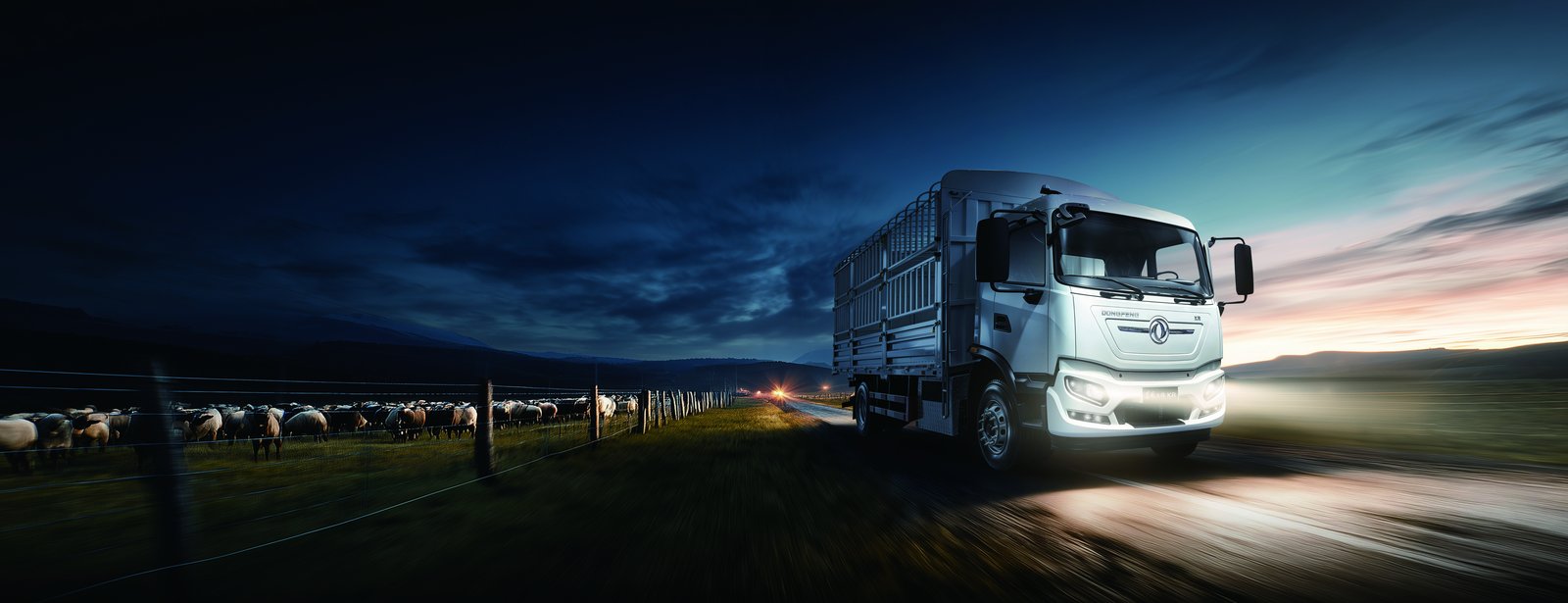
Ghana's bauxite belt around Awaso in the Western North Region feeds alumina refineries and export terminals that are under growing pressure to cut mining-sector emissions. For the short, graded haul roads typical of Ghanaian bauxite pits, a battery-electric EV truck outperforms diesel on both cost and site air quality. The Dongfeng TZ3V electric mining dump truck carries a 600 kWh CATL LFP pack on an 8x4 rigid chassis, hauls up to 80 tonnes payload, and is priced at USD 160,000 to 180,000 FOB China.
Mine haul cycles are short and repetitive: load at the face, climb a graded ramp at 6 to 10 percent grade, dump at the crusher, return empty. A typical Awaso loop is 3 to 6 kilometers with a net elevation gain of 40 to 90 meters. The TZ3V recovers a large share of that climb energy through regenerative braking on the descent, which is precisely why electric mining trucks show their strongest advantage in hilly pits. Diesel trucks, by contrast, waste that descent energy as heat in the retarder.
| Parameter | TZ3V Electric Mining Dump Truck |
|---|---|
| Battery capacity | 600 kWh CATL LFP |
| Chassis | 8x4 rigid mining dump |
| Payload | up to 80 tonnes |
| Gross vehicle weight | 110 tonnes |
| Motor power | LvKong 510 kW peak |
| Cycle range | 8 to 12 loads per charge on a 5 km loop |
| DC fast charge | 20 to 80 percent in 75 to 90 minutes |
| Battery swap | 5 to 6 minutes (optional swap pack) |
| Battery warranty | 8 years / 4500 cycles |
| FOB China price | USD 160,000 to 180,000 |
The 600 kWh pack is the largest in the Dongfeng export range, sized for the energy intensity of a loaded 80-tonne climb. On a 5 km Awaso loop a full charge delivers 8 to 12 complete load-and-dump cycles before the pack needs a top-up, which lines up neatly with a shift meal break.
Field data from similar 80-tonne electric rigid trucks shows a loaded uphill draw of about 3.5 kWh per tonne-kilometer on a 7 percent grade, dropping to near zero and then negative (regen) on the return. Net energy per Awaso cycle of 5 km loaded plus 5 km empty lands near 45 to 55 kWh, so the 600 kWh pack supports roughly 11 cycles. Operators running the Dongfeng TZ3V electric dump truck schedule a 90-minute DC charge at mid-shift and a full overnight charge at the workshop.
Awaso pits can host a 300 kW DC fast charger on the 11 kV mine grid for about USD 70,000 installed, or pair two 150 kW units for redundancy. Because the charger sits beside the crusher, trucks charge during the mandated 45-minute operator rest, keeping the fleet moving. Battery-swap skids cut changeover to 6 minutes for mines running 24-hour production.
Diesel mining trucks are the dominant source of NOx and particulate matter inside a pit, and Ghana's mine inspectors increasingly flag operator exposure. An electric truck removes tailpipe emissions at the source, improving visibility and respiratory safety for the whole crew. For a concession holder, that is a direct contribution to the social license to operate and to export buyers demanding lower-carbon bauxite. The same platform is gaining traction in the wider electric truck market in Ghana beyond mining.
A diesel 80-tonne truck burns 55 to 70 liters per hour of pit duty at USD 1.10 per liter, costing USD 60 to 77 per operating hour. The TZ3V draws about 520 kWh across a comparable 8-hour shift at USD 0.15 per kWh, equal to USD 78, but with mine solar or captive generation that falls to USD 35. Maintenance savings from removing the diesel engine add USD 18,000 per truck per year. Across a 10-truck fleet the electric conversion saves USD 1.8 million to 2.5 million over the 8-year battery warranty. Contact Shaanxi Fenghan Trading for a mine-specific haul-road analysis and charging layout.
| Item | Specification |
|---|---|
| Battery | CATL LFP 600 kWh, swap-ready architecture |
| Traction motor | LvKong permanent-magnet motor, 510 kW peak |
| Real-world range | 220 km fully loaded, duty-cycle dependent |
| Charging | DC fast charge 20-80% in 45-90 min; battery swap in 5-6 min where stations exist |
| Battery warranty | 8 years or 4,500 cycles, 70% state-of-health guarantee |
| FOB price guide | $150,000-$180,000 depending on specification and options |
Charging an electric truck is a depot discipline, not a public-network gamble. A 600 kWh pack working a 220 km day typically returns with 25 to 35 percent in reserve, so overnight demand is about 360 kWh per truck. On a 120 kW DC charger the pack climbs from 20 to 80 percent in roughly 180 minutes; on 240 kW that falls to about 90 minutes, which lets two trucks share one charger on staggered shifts.
Size the site transformer for your busiest shift plus 30 percent headroom, keep cable runs under 30 metres to limit voltage drop, and meter each charger separately so energy cost per truck stays visible. In Ghana, grid connection lead times of three to nine months are common, so apply for the connection the day you sign the truck order, not the day the ship arrives. Shaanxi Fenghan Trading includes a charger layout drawing and load calculation with every EV truck quotation, so your electrician can price the civil works before the truck lands.
A comparable diesel 8x4 dump truck burns about 0.38 litres per kilometre in mixed duty; at $0.95 per litre that is roughly $0.36 per km. The electric equivalent consumes about 1.15 kWh per km fully loaded; at an industrial tariff of $0.10 per kWh the cost is near $0.12 per km, and overnight or solar-coupled charging can push it below $0.08. Over 70,000 km a year the saving is about $17,000 per truck, before any carbon or low-emission-zone benefit.
The gap widens in stop-start duty, where regenerative braking returns 15 to 25 percent of traction energy instead of burning it as brake dust. In Ghana, where diesel quality and price both fluctuate, locking in an electricity tariff also removes a major budgeting variable from the fleet P&L.
The TZ3V has roughly one moving drivetrain part where a diesel has hundreds: no engine oil, no DPF, no turbocharger, no clutch, no multi-gear transmission service. Scheduled maintenance lands near $0.035 per km against $0.11 per km for a diesel equivalent, a saving of more than $5,000 a year at typical utilisation. Brake pads last two to three times longer because the motor does most of the deceleration.
Uptime matters more than parts cost. Fleet data from Chinese operators running the same e-axle platform shows 96 to 98 percent availability once drivers are trained, versus 92 to 94 percent for diesel trucks of the same age. Keep a small stock of filters, coolant, brake pads and 12V batteries on site; Shaanxi Fenghan Trading quotes a two-year consumables kit with every truck so the first service interval never waits on freight.
Ready to electrify your fleet? Contact Shaanxi Fenghan Trading — authorized Dongfeng EV truck exporter. WhatsApp: +86 153 1943 1311 | Email: sales@fenghan-trade.com | dongfengevtrucks.com
🌐 Our Network: Fenghan Trade (SAGMOTO/SHACMAN Truck Export) · heavy duty mining dump truck 6x4 8x4