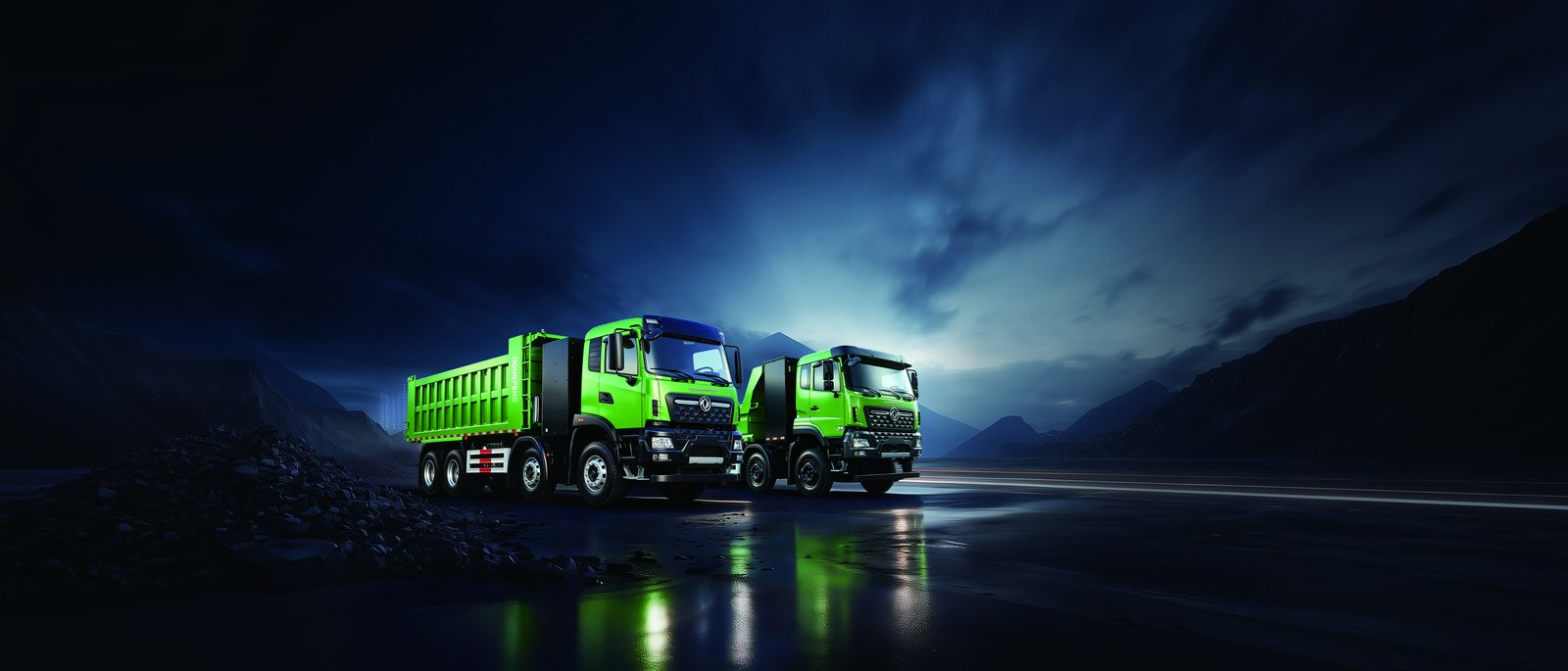
Tanzania’s Standard Gauge Railway is the country’s largest infrastructure programme in a generation — over 1,200 km of new line from Dar es Salaam to Mwanza and beyond — and building a railway consumes heavy haulage at industrial scale: transformers and switchgear to substation sites, precast girders and track panels to laying fronts, crushers and batching plants leapfrogging along the corridor. That freight moves on escorted multi-axle combinations at 60-120 tonnes GCW, on routes that repeat weekly along the same corridor. This article examines the Dongfeng TE8P electric heavy-haul tractor for SGR-scale logistics — a niche where this EV truck platform’s specific strengths (huge torque, depot-based cycles, regeneration on escarpment descents) align almost perfectly with the duty.
Heavy haulage surprises people as an electrification candidate, but the duty cycle argues for it. First, routes repeat: the corridor from Dar port to the current laying front runs the same roads weekly for months, so charging nodes at fixed points serve the whole programme. Second, speeds are low — 40-60 km/h escorted — where electric drivetrains are most efficient. Third, the loads are the heaviest torque demands in road transport, and the electric motor’s full-torque-from-zero character is precisely what pulling 100+ tonnes up a 6% grade requires; the TE8P’s 510 kW LvKong drive delivers it without a gearbox’s heat and slip. Fourth, the return legs are empty or light — and the descents that punish diesel retarders return 20-28% of cycle energy through regeneration.
| Parameter | TE8P 6x4 Electric Heavy-Haul Tractor |
|---|---|
| GCW rating | up to 120 t (multi-axle combinations) |
| Battery | 600 kWh CATL LFP, liquid-cooled |
| Drive | LvKong 510 kW peak / 4,200 Nm at wheels via reduction |
| Range at 80-100 t GCW | 180-240 km per charge |
| Fast charge | 360-500 kW DC, 20-80% ~70 min |
| Gradeability at 100 t | ≥10% sustained |
| Battery warranty | 8 years / 4,500 cycles to 70% SOH |
| FOB price band | US$160,000-185,000 |
The range figure shapes the operating model: heavy-haul days are short in distance (150-250 km is a full escorted day), so the tractor covers a day’s work per charge, then charges overnight at the staging camp. For the escarpment sections — the corridor crosses the Rift Valley shoulders — the regeneration profile means a loaded westbound climb is partially refunded on every eastbound return. Camp power is already on site: construction camps run megawatt-scale generation for crushers and batching plants, and truck charging is a schedulable night load on infrastructure that exists for the programme anyway.
Diesel heavy-haul tractors at 80-120 t GCW burn 1.2-1.6 L/km; at Tanzanian prices around US$1.20-1.30/L, US$1.50-2.00 per kilometre. The TE8P consumes 2.6-3.2 kWh/km at these weights; at camp power costs of US$0.15-0.22/kWh (genset-augmented) or grid tariffs near US$0.10 where TANESCO medium voltage reaches, US$0.30-0.70 per kilometre. On 200 km daily, 280 operating days, the annual energy saving runs US$45,000-75,000 per tractor depending on power source. Maintenance is the second dividend: heavy-haul diesel drivetrains — engine, multi-speed transmission, retarder — are the most maintenance-intensive kit in road transport, and the electric drivetrain deletes nearly all of it; add US$15,000-25,000 annually. Payback against the premium: 24-36 months, inside a programme scheduled to run years longer.
SGR construction logistics run on staging: materials consolidate at Dar port and Morogoro, move forward to camps, and distribute to the laying front. The electrification plan mirrors it: charging at the Dar consolidation depot, at the Morogoro mid-corridor camp, and at the advancing front camps (relocatable skid-mounted DC chargers that leapfrog with the programme). The TE8P’s dual-gun 500 kW capability means a 70-minute turnaround even on the 600 kWh pack — matched to the escorted convoy’s rest stops. For contractors running both heavy-haul and standard construction fleets on the programme, the same charging infrastructure serves the tippers and mixers — one energy system for the whole motorised fleet.
Heavy tractors enter through Dar es Salaam with 32-38 day sailings from China; we deliver with English documentation, UN R100 certification, and the heavy-haul support package including escort-duty parts kits. Tanzania’s treatment of electric vehicles carries duty advantages, and programme-linked procurement increasingly values emissions performance. Buyers can find the full operating context on our Tanzania market page, and contractors with multi-country infrastructure portfolios will recognise the same platform’s deployments on mining heavy-haul across the region — the TE8P’s 120 t GCW rating serves copper-belt and wind-farm logistics with identical architecture.
Support for programme duty is structured around the corridor: commissioning at the first camps, fly-in technical coverage tied to the convoy schedule, parts kits at the staging depots, and telemetry monitoring that tracks every tractor’s pack health, consumption and location across the corridor. The drivetrain’s service calendar — brakes, suspension, coolant — is a fraction of what a 120 t-rated diesel drivetrain demands, and on a programme where a stranded transformer load closes a road, availability is the whole business.
Africa’s infrastructure decade is a heavy-haulage decade, and the contractors who win its margins will be those who cut the two costs that define the niche: fuel and drivetrain maintenance. The SGR corridor — fixed routes, camp power, repeating cycles — is as close to a designed-for-electric heavy-haul environment as the continent offers. The contractors who electrify their programme fleets convert that fit into a cost position their diesel competitors cannot tender against — and into a reference that wins the next corridor, and the one after that.
Contractors considering the TE8P should evaluate it against the region’s project pipeline, not a single programme, because heavy-haul assets earn across decades and Tanzania’s corridor is the beginning, not the whole book. The regional pipeline is substantial: the EACOP-related logistics, the central-corridor standard-gauge extensions toward Burundi and the DRC, the hydropower and transmission build-out across East Africa (transformers are the classic heavy-haul load), port expansions at Dar and Tanga, and the mining sector’s own heavy moves. An electric heavy-haul tractor with relocatable charging serves this entire map — the skid-mounted DC chargers move on the same lowbeds as the plant, and the fleet’s value proposition — torque, control, and an energy cost per tonne-kilometre diesel cannot touch — travels intact to every project.
The expertise dimension compounds similarly. The contractor that electrifies heavy haulage first builds capabilities no competitor can buy quickly: escorted-convoy charging logistics, camp-power integration, driver cadres experienced in 120-tonne electric operation, and the telemetry-documented cost record that tenders increasingly request. Heavy haulage is a reputation business — clients trust contractors who have moved the load before — and the first operator with a documented electric heavy-haul portfolio becomes the default call for every project owner with emissions commitments, which increasingly means every internationally-financed project on the continent. The SGR corridor is where that portfolio starts; the contractors who see the electric tractor as a decade-long positioning asset rather than a single-programme experiment are the ones who will own the niche as African infrastructure’s electric decade unfolds.
Ready to electrify your fleet? Contact Shaanxi Fenghan Trading — authorized Dongfeng EV truck exporter. WhatsApp: +86 153 1943 1311 | Email: sales@fenghan-trade.com | dongfengevtrucks.com
🌐 Our Network: Fenghan Trade (SAGMOTO/SHACMAN Truck Export) · 4x2 6x4 tractor truck prime mover