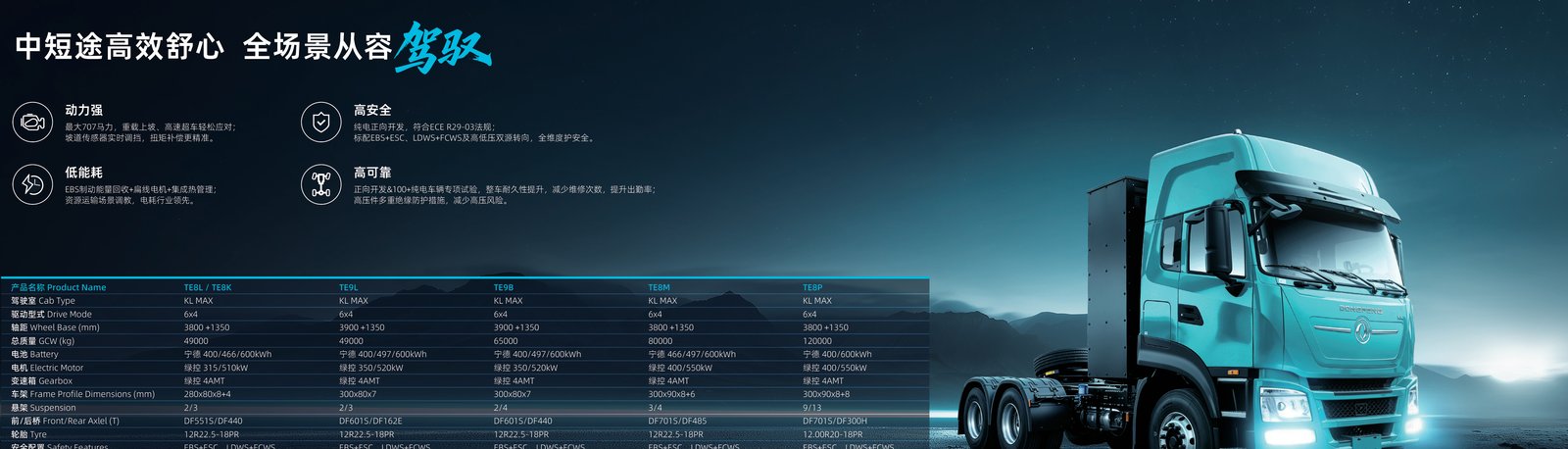
There is an irony worth naming at the start: wind farm construction — the world's flagship clean-energy project type — is built with diesel trucks. Tower sections, nacelles, hubs and blades arrive at site by heavy hauler; gravel, crane pads and cable drums move by tipper and tractor; and construction fleets log months of diesel burn inside projects whose purpose is displacing fossil energy. Owners and EPC contractors increasingly notice the contradiction, especially where the project's financing carries green requirements. The Dongfeng TE8P — a 6x4 electric tractor with CATL 600 kWh LFP, 120 t GCW and 550 kW peak drive — is the heavy-haul answer for wind farm logistics, and it brings a capability diesel never had: the construction fleet can charge on the wind farm's own grid power. This article details the duty cycles, the machine, and the economics.
The TE8P covers all three. Its 550 kW peak drive and low-speed torque character handle 120 t combinations on site grades that would force a 500 hp diesel into low gears; its 600 kWh pack covers the longest component corridors on one charge; and site-corridor speeds mean the range penalty of heavy loads stays inside the pack's envelope.
| Parameter | TE8P Specification |
|---|---|
| Configuration | 6x4 battery-electric heavy-haul tractor |
| GCW | 120 t |
| Battery | CATL LFP 600 kWh, liquid thermal management |
| Drive | LvKong motor, 400 kW continuous / 550 kW peak |
| Torque character | Full torque from zero rpm — gradeability engineered for site ramps |
| Range (loaded component duty) | 150–220 km at heavy combination weights |
| Charging | Dual-gun DC fast charge, 40–60 min; swap-capable variants |
| Cold package | Heat-pump cab and battery thermal preconditioning (validated to −40 °C) |
| Indicative FOB | USD 125,000–165,000 |
A tower section or blade is a USD 300,000–800,000 component riding on public roads at 15–40 km/h. What heavy-haul drivers value most is smooth, precisely metered torque — no driveline shock, no clutch engagement jolt, no gear-hunt on rolling grades. An electric drivetrain is categorically better at this than any diesel: torque delivery is continuous, instantaneous and exactly proportional to pedal input. Our heavy-haul clients consistently report fewer load-securing inspections triggered by driveline shock, lower driver stress on controlled movements, and smoother climbs on pad-access ramps than their diesel tractors managed. For cargo measured in six figures per unit, driveline refinement is not a comfort feature; it is damage prevention.
Assumptions: 12 TE8P units on a 60-turbine project over 18 months, then redeployment; average 60,000 km/tractor/year; site power at construction tariff USD 0.06–0.09/kWh (dropping near zero when the first turbines energise and the project consumes its own output); diesel at USD 1.00/L:
| Annual cost per tractor | Diesel heavy-haul tractor | TE8P |
|---|---|---|
| Fuel / energy | USD 30,000–36,000 | USD 5,500–8,000 |
| Engine & heavy driveline maintenance | USD 8,000–10,000 | USD 2,200–2,800 |
| Brakes & consumables | USD 3,000 | USD 1,300 |
| Annual saving per tractor | — | USD 29,000–38,000 |
| 12-tractor annual fleet saving | — | USD 348,000–456,000 |
The wind-farm-specific kicker: once the project's collector system and first turbines energise, construction power comes from the wind farm itself. Fleet charging drawn from the project's own generation costs the project nothing but curtailed-tail energy — and wind projects routinely curtail. A construction fleet that charges on curtailed wind is quite literally free-fuelled. We design the construction-phase charging around the project's temporary substation: two dual-gun 240 kW chargers at the site yard plus one 360 kW unit at the marshalling yard, total USD 150,000–220,000, decommissioned or retained for the O&M phase when the fleet shrinks.
Construction ends, but the wind farm runs for 25 years with a permanent O&M fleet: technician transport, spare-parts delivery, blade-inspection support vehicles, occasional crane moves. The TE8P-class tractors redeploy to the next construction site (electric heavy haulers move between projects just like diesel ones), while a smaller set of electric trucks — often our KT-series rigids — stays as the permanent O&M fleet, now charging on mature wind-farm power at effectively the lowest energy cost any fleet in the world enjoys. Several of our clients have structured exactly this lifecycle: heavy TE8P tractors rotating through construction projects, light KT units settling into permanent O&M duty, one charging infrastructure investment serving both phases.
Modern wind projects are financed with green bonds, climate funds and multilateral debt that increasingly carry construction-phase emissions reporting requirements. A diesel-burning construction fleet is a visible blemish in the project's environmental dossier; an electric fleet charging on the project's own wind turns logistics into a headline sustainability feature — telematics-verified kWh, zero tailpipe, CO2 avoided per tonne-km. EPC contractors bidding on green-financed projects are beginning to notice that fleet electrification scores points in evaluation. The TE8P is, in that sense, not just a tractor but a bid differentiator.
Wind farm corridors are typically unsealed or newly graded: dust, loose ballast, and 6–10% pad-access ramps. The TE8P's sealed IP68 HV architecture handles the dust; its low-speed torque and gradeability handle the ramps; and the reinforced suspension package specified for mining duty carries over to component hauling. Remote-site service is where our export support model earns its keep: commissioning training for site technicians, a critical-spares kit left on site, and remote diagnostics over the construction camp's connectivity. A 120 t tractor that cannot be serviced 200 km from the nearest city is a schedule risk; we build the support plan before the fleet ships.
For EPC contractors and wind farm owners considering the move: start by electrifying the site-logistics layer (aggregate, cable drums, consumables — fixed-radius, fastest payback), add 2–4 TE8P tractors for component delivery on the next project, and structure the charging around the temporary substation so the infrastructure cost is shared across phases. Within two project cycles most contractors reach the conclusion our early adopters did — the wind builds itself, so the fleet might as well run on wind too.
Blade transport deserves its own section because it is the most distinctive heavy-haul duty in the industry and the one where electric drivetrain characteristics matter most. A 80 m blade on a telescoping or extendable trailer sweeps a turning circle measured in town blocks; the movement runs at 15-40 km/h with pilot vehicles, and the driver's day is one long exercise in precise, low-speed control. What that duty demands — and what the TE8P's drivetrain delivers:
Component-delivery duty runs long days at low average speed — 150-220 km of corridor per shift with extended slow passages. The charging pattern that serves it: full overnight charge at the marshalling yard; a 40-60 minute dual-gun fast charge during the loading or unloading window at the pad (the crane crew needs 30-90 minutes anyway — the truck charges while the load is being secured or set); and a top-up at the yard between movements. Because component haul speed is low, aerodynamic losses are small and the 600 kWh pack covers even the longest blade movements with margin — the pack endurance at blade-transport speeds extends 20-30% beyond its loaded-trunk figure.
Wind project documentation is rigorous — owner's engineers review every logistics subcontractor. The questions we prepare fleet answers for: torque smoothness data under maximum combination weight (delivered from drivetrain telemetry), night-noise compliance figures, charging infrastructure siting relative to the temporary substation, and the availability guarantees with response times that EPC contracts demand. The TE8P's commissioning package includes the duty-cycle validation against the project's own movement schedule, so the fleet's capability is documented in the project's format, not the truck's. That single preparation step — matching our documentation to the owner's engineer's checklist — has converted more wind-farm fleet decisions than any spec sheet.
Ready to electrify your fleet? Contact Shaanxi Fenghan Trading — authorized Dongfeng EV truck exporter. WhatsApp: +86 153 1943 1311 | Email: sales@fenghan-trade.com | dongfengevtrucks.com
🌐 Our Network: Fenghan Trade (SAGMOTO/SHACMAN Truck Export) · 4x2 6x4 tractor truck prime mover