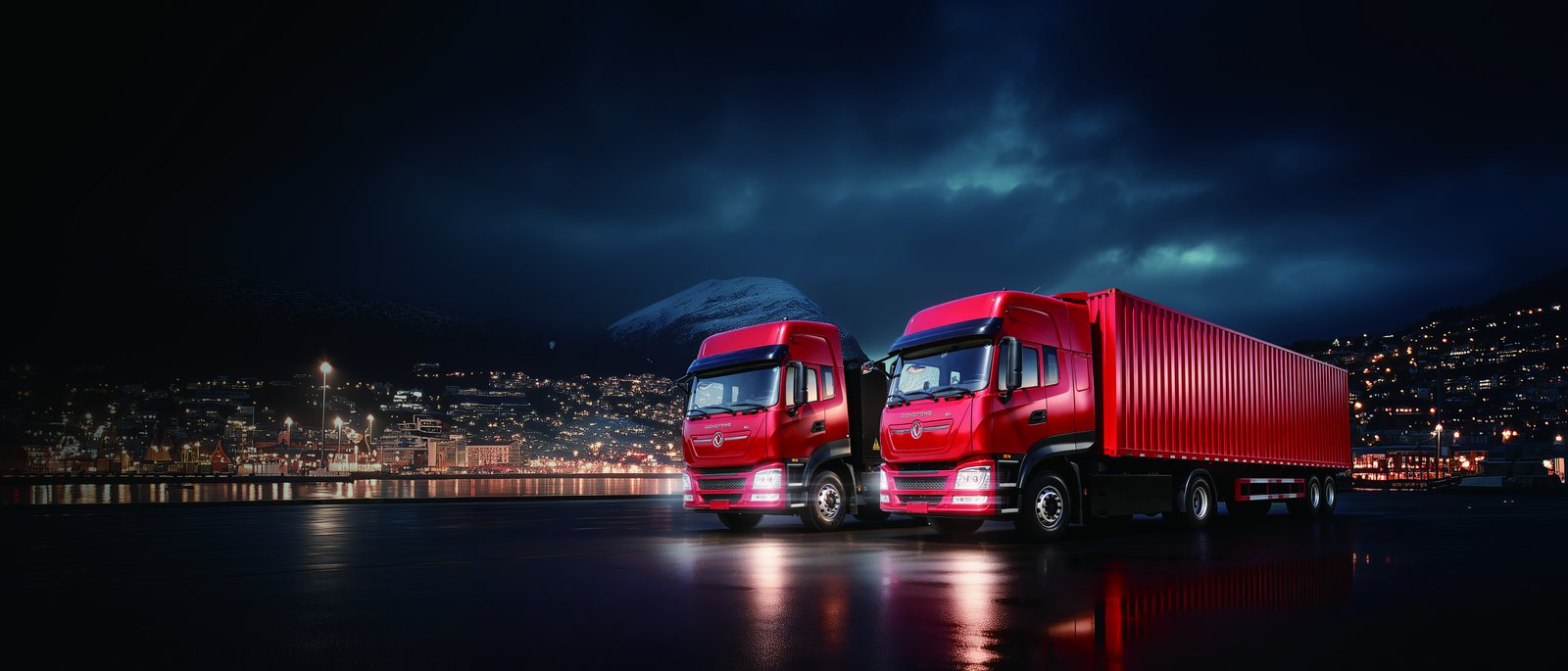
Intermodal is freight's growth story: as economies push cargo off highways and onto rail, the action concentrates at the terminals where steel wheel meets rubber tyre — dry ports, inland container depots, rail-served port districts. And the truck that dominates those facilities is the shuttle tractor: the 4x2 unit dragging containers between rail ramp, yard stacks, gate and warehouse, around the clock, in loops measured in hundreds of metres to a few tens of kilometres. We have covered the TE46 — Dongfeng's 4x2 battery-electric tractor with CATL 400 kWh and 42 t GCW — on port shuttle duty, the Egypt SCZone corridor, East Africa's RHD routes and the swap-versus-depot question. This article completes the picture for rail intermodal terminals specifically: why the duty cycle is the best electrification geometry in all of freight, what terminal operators should plan for, and what the fleet numbers look like.
| Parameter | TE46 Specification |
|---|---|
| Configuration | 4x2 battery-electric tractor |
| GCW | 42 t |
| Battery | CATL LFP 400 kWh, liquid-cooled |
| Drive | 282 kW continuous / 350 kW peak |
| Range (terminal shuttle duty) | 250–300 km — multi-shift capability |
| Charging | Dual-gun DC; 10–100% in 40–60 min; swap-capable variants available |
| Pack warranty | 8 years / 4,500 cycles |
| Indicative FOB | USD 90,000–115,000 |
Real consumption in terminal loops — loaded at 42 t GCW, constant stop-start, heavy regen recovery — measures 95–115 kWh per 100 km. On a demanding 300 km-equivalent terminal day, the 400 kWh pack finishes with margin; on the more typical 150–200 km day, one overnight charge covers two shifts. For the minority of terminals running true 24/7 single-truck utilisation, the swap-capable variant and the queue-charging choreography below close the gap.
Assumptions: 60,000 km per truck per year of terminal loops at 42 t, 24/6 operation with driver shifts rotating, diesel at USD 0.85–1.00/L, terminal industrial power at USD 0.06–0.10/kWh:
| Annual cost per truck | Diesel 4x2 shuttle tractor | TE46 |
|---|---|---|
| Fuel / energy (incl. idle burn) | USD 14,500–18,500 | USD 4,300–6,000 |
| Engine & aftertreatment maintenance | USD 4,800–6,000 | USD 1,400–1,900 |
| Brakes | USD 1,200 | USD 450 |
| Annual saving per truck | — | USD 11,900–16,250 |
| 20-truck fleet annual saving | — | USD 238,000–325,000 |
| 8-year fleet saving | — | USD 1.9–2.6 million |
Terminal charging for 20 trucks — six to eight dual-gun positions spread across queue points plus the overnight backbone — runs USD 300,000–500,000, comfortably absorbed within the programme's savings. Against a per-unit premium of roughly USD 40,000–55,000 over a diesel shuttle tractor, single-truck payback is 3–4 years inside the 8-year pack warranty. The idle-elimination line deserves emphasis: it is the purest saving in freight — money the diesel burns to accomplish nothing, recovered in full.
Every objection that slows electric truck adoption elsewhere dissolves at the intermodal terminal: no public charging is needed, no route uncertainty exists, the duty cycle rewards regen and punishes diesel idle, the facility already owns the grid connection, and the regulatory direction favours zero-emission on-site operations. Terminal shuttle fleets are where electrification's economics are strongest and its risks weakest — which is why our TE46 deployments at ports and dry ports consistently out-perform their own business cases. If you operate one terminal fleet, this is the first fleet to convert; if you operate many, it is the template for all of them.
The shuttle tractor is the anchor, but intermodal terminals are electrifying as systems, and the TE46 fleet is the natural first domino. The same grid connection, charge-management layer and technician competence that serve the tractors extend across the terminal's rubber-tyred estate: the TE46's larger 6x4 siblings handle the heavier inter-terminal transfers and the port-district legs where 42 t gives way to 80 t combinations; the KT-series rigid electrics take on the warehouse and CFS distribution work radiating from the rail gate; and the specialised units — terminal tractors in the strict sense, empty-container handlers' yard-support vehicles, the water and service trucks that maintain the apron — follow the same charging infrastructure and the same open telemetry standards. Terminals that sequence this way end up with one energy architecture, one maintenance competence and one data platform across the entire rubber-tyred fleet, instead of the vendor-by-vendor patchwork that plagues piecemeal conversions.
The rail interface itself deserves the closing thought. Every unit of freight moved from road to rail is moved at a fraction of the emissions of the highway alternative — but the terminal shuttle that connects rail's first and last kilometres has historically been diesel, quietly eroding the mode-shift's climate case and concentrating emissions exactly where regulators, neighbours and workers look. An electric shuttle fleet closes that gap and completes the argument: rail's low-carbon trunk, met by a zero-tailpipe terminal, delivering to urban distribution networks that are themselves electrifying. The TE46 is, in that sense, not just a truck but the missing link in a chain the industry has been building for years — the piece that lets an intermodal terminal claim, credibly and with telemetry to prove it, the emissions profile its mode always promised.
For terminal operators, the practical reading of this article is an ordering: pull your gate, ramp and yard duty data this quarter; run the idle-fraction arithmetic on your diesel shuttle fleet — the number is always worse than expected; and structure a pilot tranche of TE46 units with queue-point charging that converts your existing waits into energy. The geometry, the grid and the economics are already on your side. The remaining variable is the calendar — and every season of delay is a season of diesel idle that the balance sheet records and the neighbours notice.
Ready to electrify your fleet? Contact Shaanxi Fenghan Trading — authorized Dongfeng EV truck exporter. WhatsApp: +86 153 1943 1311 | Email: sales@fenghan-trade.com | dongfengevtrucks.com
🌐 Our Network: Fenghan Trade (SAGMOTO/SHACMAN Truck Export) · 4x2 6x4 tractor truck prime mover