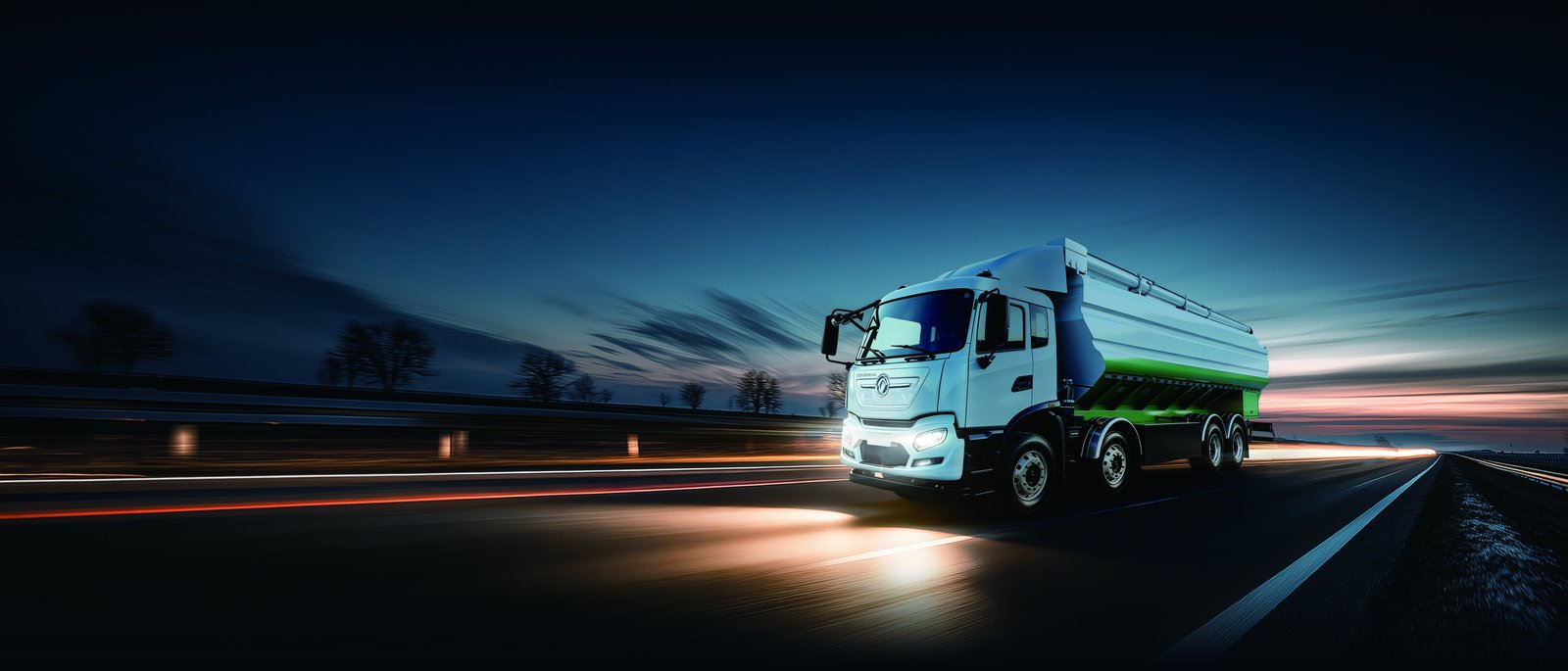
East Africa's single most important freight artery runs from the Indian Ocean port of Mombasa up to Nairobi and onward into Uganda, Rwanda and South Sudan. It is also one of the world's clearest cases for the electric truck. Kenya's grid is roughly 90% renewable — geothermal, hydro and wind — diesel at the pump costs USD 1.30–1.50 per litre, and the corridor's container flows are concentrated in predictable, return-to-base patterns around the Standard Gauge Railway (SGR) inland container depots. In this article we profile the duty cycle in detail and show how the Dongfeng TE46, a factory right-hand-drive 4x2 electric tractor with a CATL 400 kWh LFP battery and 42 t GCW rating, is purpose-matched to Mombasa–Nairobi shuttle and feeder work.
The Mombasa–Nairobi movement has reorganised itself around the SGR freight service. Most international containers now ride the railway between the port's terminals and the Nairobi Inland Container Depot (ICDN) at Embakasi, plus satellite depots at Athi River and (increasingly) Naivasha. What the railway does not solve is the last stretch: port yard shuttles, depot-to-warehouse drayage in both cities, and industrial distribution across Nairobi's vast metro. These road legs are short — typically 15–80 km per cycle — but they are relentless, running two or three shifts a day, and they concentrate in exactly the airsheds where Kenya's regulators and city counties are most vocal about emissions.
That creates a textbook EV truck niche. A tractor that runs 250–400 km per day within a 60 km radius of its depot, parks at the same yard every night, and idles for hours in port queues (where a diesel engine burns fuel for nothing and an electric drivetrain consumes almost nothing) is the ideal first electrification candidate. The idle advantage alone is worth 8–15% of total fuel on port duty — a saving that simply does not exist in the diesel operating model.
The TE46 was engineered around port and short-shuttle missions, which is why its specification reads like a description of Mombasa work. It is a 4x2 electric tractor — the correct configuration for terminal and urban drayage, where a single drive axle carries the traction duty and manoeuvrability matters more than twin-drive climbing ability. Its CATL 400 kWh LFP pack delivers 200–280 km of loaded range at 42 t GCW, comfortably covering a full day of depot–port–warehouse cycles with 20–40% margin. The LvKong drive motor (282–360 kW class in this application) provides the low-speed torque that gets a loaded container moving on port ramps, and regenerative braking recovers energy on the Mombasa Road descents back into Nairobi's depots. Charging is flexible: a 40-minute 20–80% DC session at a depot, or an overnight AC top-up using Kenya's off-peak tariff window.
| Parameter | Dongfeng TE46 (RHD) | Corridor relevance |
|---|---|---|
| Configuration | 4x2 electric tractor, RHD | Kenya/Uganda/Tanzania drive side |
| Battery | CATL 400 kWh LFP | Full shift + margin |
| GCW | 42 t | Standard container artic |
| Range (loaded) | 200–280 km | Depot radius duty |
| Idle consumption | Near zero | Port queue advantage |
| FOB price indication | USD 95,000–120,000 | Entry-level heavy EV |
Kenya Power's commercial tariffs for large consumers translate to roughly USD 0.10–0.15 per kWh depending on band and time of use; off-peak windows make overnight charging the default plan. Against Mombasa pump diesel of USD 1.30–1.50 per litre, a TE46 running 90,000 km per year at an average 42 t GCW consumes roughly 130–150 kWh per 100 km (USD 0.13–0.22/km in energy) versus a diesel tractor burning 38–45 L/100 km (USD 0.50–0.67/km). Annual energy saving per tractor: USD 33,000–40,000. Maintenance saving adds USD 4,000–6,000 — no engine oil, filters, turbo or aftertreatment, and regen braking roughly doubles brake life on stop-start drayage. Against a capital premium of roughly USD 35,000–50,000 over a used-import diesel tractor equivalent, payback lands inside 18 months on high-utilisation port duty.
There is also a softer commercial advantage that Kenyan fleet owners already understand: blue-chip cargo owners — global shipping lines, beverage companies, telecom distributors — are under their own Scope 3 reporting pressure and increasingly award logistics contracts to operators who can demonstrate emissions reductions per container moved. A dozen TE46 units with telemetry-verified kWh-per-TEU data is a sales document, not just a fleet.
The biggest East Africa misconception is that EV trucks need a national charging network first. They do not — they need a yard. The recommended Phase 1 build for a 6–10 unit TE46 fleet at one depot is modest:
Phase 2 scales by duplicating that block per 8–10 additional tractors. Public charging remains a bonus, not a dependency — a correctly designed depot operation never needs it.
Kenya's import regime for EVs is unusually favourable: battery-electric vehicles enjoy exemption from excise duty that applies to engine-displacement-based ICE imports, and VAT treatment for EVs has improved under the e-mobility policy direction spearheaded by the Energy and Petroleum Regulatory Authority and Kenya Bureau of Standards pre-export verification (PVOC). Practical steps for a TE46 order:
Uganda and Tanzania follow similar PVOC-style pre-export inspection regimes; both are RHD markets served by the same TE46 specification, which lets a regional operator standardise one tractor type across the northern and central corridors.
For a Nairobi-based container logistics operator converting eight high-utilisation diesel tractors to TE46 units, the eight-year fleet picture at Kenyan prices looks like this:
| 8-year total (8 tractors) | TE46 fleet | Diesel baseline |
|---|---|---|
| Capex incl. charging | ~USD 950,000 | ~USD 600,000 |
| Energy / fuel | ~USD 1,030,000 | ~USD 2,620,000 |
| Maintenance | ~USD 230,000 | ~USD 560,000 |
| Total | ~USD 2,210,000 | ~USD 3,780,000 |
A 41% total saving over eight years — before counting carbon-credit potential (each diesel tractor replaced in a 90%-renewable grid avoids roughly 70–90 tCO₂e per year, monetisable under voluntary carbon standards) or the contract-winning value of verified green logistics credentials.
The Mombasa–Nairobi corridor offers the rare combination of green grid, expensive diesel, RHD demand and return-to-base duty. The Dongfeng TE46 — factory RHD, CATL 400 kWh, 42 t GCW, near-zero idle consumption, FOB USD 95,000–120,000 — is the lowest-risk first step into heavy electrification for East African container operators. Shaanxi Fenghan Trading delivers with PVOC documentation, RORO shipping to Mombasa, and depot charging design support. Start with the yard, prove the numbers, scale with the corridor.
Ready to electrify your fleet? Contact Shaanxi Fenghan Trading — authorized Dongfeng EV truck exporter. WhatsApp: +86 153 1943 1311 | Email: sales@fenghan-trade.com | dongfengevtrucks.com
🌐 Our Network: Fenghan Trade (SAGMOTO/SHACMAN Truck Export) · 4x2 6x4 tractor truck prime mover