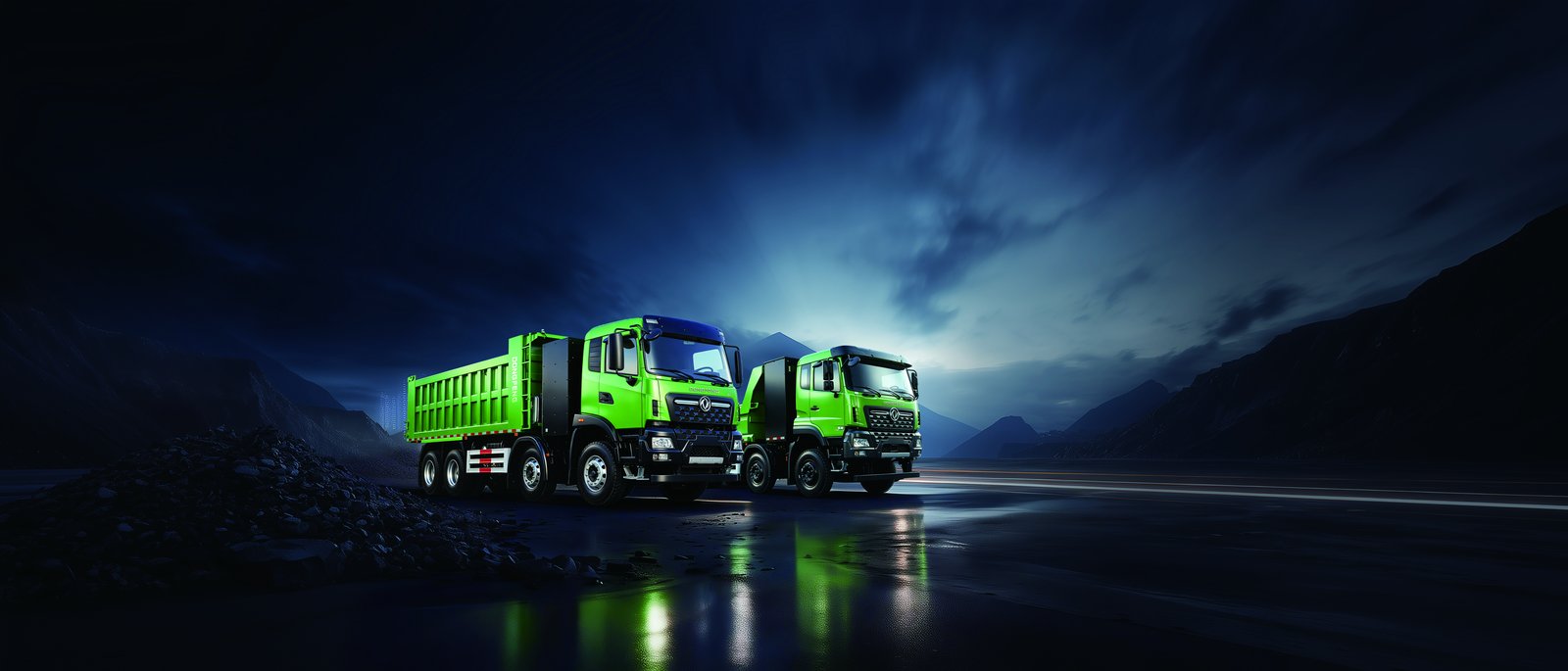
Ask a diesel fleet manager in Quito what altitude does to a truck and you will get a lecture: turbo lag on the avenidas, derated power on the Cumbayá climb, engines drinking fuel and running hot. At 2,850 m the air holds roughly 30% less oxygen than at sea level, and a diesel engine — fundamentally an air-breathing machine — feels every metre of it. An EV truck does not breathe. Its torque curve is a flat line from zero rpm to top speed whether the truck is in Shanghai or on the flanks of Pichincha. That physics fact is quietly turning Andean capitals into some of the most persuasive EV markets in Latin America, and Ecuador's construction boom — Quito Metro feeder works, the Pomasqui–Calderón housing belt, dozens of private towers — provides the demand. This article examines the TZ5E 6×4 electric dump truck in altitude duty, with the wider Andean context covered in our Colombia market guide.
A naturally-aspirated diesel loses roughly 1% of power for every 100 m above sea level; a turbocharged one derates less but still loses measurable output and efficiency at Andean elevations, and compensates by over-fueling, running hotter, and wearing faster. Cooling systems suffer too — thin air rejects heat less effectively — which is why high-altitude diesel fleets in Ecuador report disproportionate radiator, turbo, and head-gasket costs.
An electric drivetrain sidesteps all of it. The LvKong motor in the TZ5E delivers its rated torque regardless of ambient pressure. The inverter and battery cooling loop is sized for heat rejection in 45°C deserts; Quito's 10–22°C climate is, thermally speaking, a holiday. Regenerative braking — which recovers 15–25% of energy on hilly duty cycles — works identically at altitude, and Quito's terrain is nothing but hills. The one genuine altitude effect on an EV is on the high-voltage insulation and cooling-air density for the charger, both of which are engineered for far more extreme conditions than Ecuador offers.
| Parameter | TZ5E at ~2,850 m | Note |
|---|---|---|
| Power/torque delivery | 100% of rating | No altitude derate (vs ~10–15% diesel derate) |
| Battery | CATL LFP ~400 kWh | Cool, mild climate aids range consistency |
| Loaded range, urban Andes cycle | 180–220 km | Hilly terrain partly offset by regen |
| Energy consumption | 1.2–1.5 kWh/km loaded | ~USD 0.17–0.22/km at Ecuadorian tariffs |
| Cell warranty | 8 years / 4,500 cycles | Thermal stability of LFP suited to duty |
Meanwhile the diesel comparator is paying Quito's fuel price — diesel in Ecuador is subsidised at the pump for commercial users, which softens the gap, but subsidy reform has been repeatedly signalled by successive governments, and any movement toward import-parity pricing instantly widens the electric advantage. Fleet buyers who model fuel at both subsidised and parity prices are effectively stress-testing their next decade of operating cost. Under parity pricing, the TZ5E runs 40–55% cheaper per kilometre in energy; even at full subsidy, it still wins 20–30% once maintenance, brake wear, and idle fuel are counted.
Ecuadorian buyers typically ship to the Port of Guayaquil (35–40 days from China) and run units up the panamericana or, for the coast, clear directly into Guayaquil and Manta. Ecuador's tariff regime includes a temporary import framework for equipment attached to specific projects — construction fleets procured for a defined public works programme can sometimes defer duties for the project duration, a mechanism worth exploring with a Quito customs advisor. Spanish-language technical documentation is required; Fenghan provides the complete pack, plus remote diagnostic support and commissioning assistance for the first fleet.
Charging infrastructure at a Quito depot is a modest project: two 240 kW DC chargers or four 60 kW AC stalls on a 500 kVA connection serve a fleet of six to eight dump trucks on overnight cycles. Ecuador's grid is predominantly hydro, so the emissions case mirrors Costa Rica's — an electric construction fleet in Quito is close to genuinely zero-carbon, a fact that increasingly matters for contractors bidding on projects financed by multilateral development banks with Scope 3 requirements.
Altitude has spent a century taxing diesel trucks in the Andes. It taxes electric trucks not at all — and Quito, with its construction boom, subsidised-but-fragile fuel economics, clean grid, and relentlessly hilly duty cycles, is the city where that difference is most visible. A TZ5E working the Calderón circuit doesn't just match a diesel tipper in Quito; it out-pulls it off every stoplight, out-brakes it down every descent, and undercuts it on every line of the maintenance ledger. For operators ready to price that difference for their own circuits, we build altitude-adjusted energy and TCO models from your route data.
The single highest-return investment on an Andean electric dump fleet is not hardware; it is the driver training week. Quito-region duty gives regenerative braking its richest possible diet — the Cumbayá climb, the descent from the quarry plateaus, the constant speed modulation of valley traffic — and the spread between a trained and untrained driver on identical routes runs 18–25% of total energy. That is the difference between a one-charge day and a lunchtime stop, between the projected TCO and a worse one, and it is won entirely through technique. The curriculum we run at commissioning covers four habits: lifting early and letting the motor do the deceleration so the friction pads stay cold; selecting the regen level to match the road (strong around the city, light on the autopista so the truck rolls); arriving at descents with charge headroom so the ramp becomes range instead of brake heat; and reading the energy display so drivers see, in real time, what each habit is worth.
The competitive psychology deserves a paragraph because it is the cheapest retention tool in the industry. When the telematics dashboard ranks drivers by recovered energy per route — a number nobody can fake and everyone can improve — the league table does the coaching on its own. Quito fleets report the same pattern we see globally: within a month, drivers are comparing regen scores at the yard gate, the strongest performers are training the newest hires unprompted, and the fleet's average energy consumption drifts down quarter after quarter without a single memo. Diesel fleets cannot build this culture because there is no equivalent number; electric fleets get it for free and compound it forever.
The brake-worthiness dividend follows directly: Andes diesel fleets resign themselves to pad and drum replacements measured in tens of thousands of kilometres; the same duty on a trained electric fleet triples those intervals. Add the elimination of engine braking noise on night hauls through residential valleys — a genuine permit and community-relations asset on urban projects — and the training week pays back before the trucks' first scheduled service.
Ready to electrify your fleet? Contact Shaanxi Fenghan Trading — authorized Dongfeng EV truck exporter. WhatsApp: +86 153 1943 1311 | Email: sales@fenghan-trade.com | dongfengevtrucks.com
🌐 Our Network: Fenghan Trade (SAGMOTO/SHACMAN Truck Export) · heavy duty mining dump truck 6x4 8x4