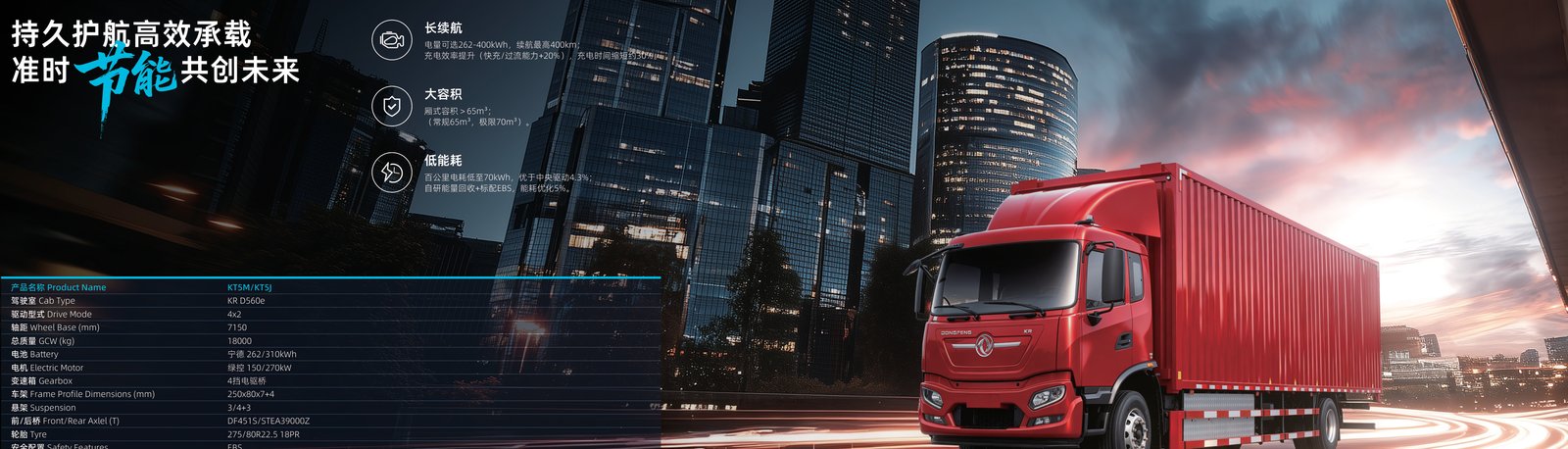
Battery chemistry gets the headlines, but the component that most determines how an EV truck actually drives — and how much of every kilowatt-hour reaches the road — is the electric drive unit: the motor, the power electronics that feed it, and the gearing that connects it to the wheels. Across the Dongfeng EV truck range (TE tractors, TZ tippers, KT cargo and specials), that role belongs to the LvKong electric drive family, spanning roughly 125 kW in the light delivery trucks to 510 kW in the heaviest mining configurations. This article opens the drive unit up the way an engineer would: the motor technology, the inverter, the integration, and why each choice matters on a ten-year trucking duty cycle.
The LvKong units across the range are permanent-magnet synchronous machines (PMSM) — the same architectural family used in the drivetrains of the world's leading electric commercial vehicles. The choice is about two numbers:
Inside the motor, the engineering that matters for truck duty is thermal. A truck motor must sustain near-rated output for hours — crawling a loaded tipper up a 7% ramp is not a "peak" event but a shift condition. LvKong units handle this with liquid cooling directly through the stator housing, holding winding temperatures inside the insulation class's continuous rating. The practical consequence for buyers: the continuous torque rating, not the peak figure, is the number to compare across manufacturers — and the one we publish per model because it's the one that survives a quarry.
Between the pack and the motor sits the inverter — the power-electronics stage that converts DC battery power to the precisely-timed three-phase AC the motor needs. This is the quiet high-technology component of the drivetrain, and the trend across heavy EV platforms, including the LvKong drive family, is the migration from silicon (IGBT) to silicon carbide (SiC) power switches. The physics:
| Inverter attribute | Silicon (IGBT) | Silicon carbide (MOSFET) |
|---|---|---|
| Switching losses | Baseline | ~50–80% lower |
| System efficiency gain | — | +1–3% across the drive cycle |
| Heat rejection | Baseline | Substantially reduced |
| Higher switching frequency benefits | Limited | Finer motor control, lower ripple losses |
One to three efficiency points sounds small; on a TE8M doing 200,000 km at 1.4 kWh/km, it is 2,800–8,400 kWh per truck per year — free kilometres, or a smaller pack for the same range. SiC also runs cooler, and cooler power electronics are more durable power electronics: the inverter's electrolytic capacitors and bond wires are the components whose life is most statistical at temperature. For buyers evaluating any electric truck, the question "SiC or IGBT in the traction inverter?" is a legitimate differentiator with a direct line to operating cost.
The LvKong drives in the Dongfeng EV range are integrated units — motor, reduction gearing and power electronics packaged as a compact assembly, in many configurations integrated into the axle itself (the e-axle pattern). The systems-engineering consequences run deeper than packaging:
What a driver experiences as "the truck feels strong off the line" is actually software. The drive's control maps shape torque delivery against throttle position, wheel slip, pack state and thermal headroom — and on the Dongfeng EV range these maps are tuned per application: a KT5J map optimises smoothness and regen recovery for 100-stop city days; a TZ5Y map holds continuous torque under sustained grade with thermal-model-based derating that protects the machine instead of surprising the driver. The creep and one-pedal behaviour that makes electric trucks pleasant in traffic — and regen-efficient in it — lives here too.
Over-the-air map updates let the fleet's drivetrain behaviour be refined across ownership — an efficiency or thermal-management improvement developed on one deployment can propagate across the range. This is the practical meaning of "software-defined truck" for fleet buyers: the drive unit improves after purchase, which no diesel powertrain ever did.
Truck drivetrains are judged in millions of kilometres. The electric drive's durability stack:
Net of all this: a drivetrain with roughly an order of magnitude fewer moving parts than a diesel equivalent, no oil circuit beyond cooling loops, and duty that is monitored continuously. The maintenance line in an electric truck TCO model is not small because electric trucks are magic; it is small because the machine that replaced the engine has almost nothing in it that wears the way combustion does.
Around the drive unit sits the high-voltage distribution network that delivers pack power to the machines — and on a decade-long fleet, its serviceability governs uptime as much as the drive itself. The architecture across the Dongfeng EV range follows the patterns that have proven out across heavy electric platforms: a power distribution unit (PDU) with individually protected HV circuits; short, routed HV cabling runs (the e-axle integration's benefit — fewer metres of orange cable to inspect, fewer joints to torque-check); a dedicated coolant loop serving drive, inverter and (in integrated designs) pack thermal exchange; and isolation monitoring that continuously verifies the HV network's insulation resistance, reporting degradation before it becomes a fault. The maintenance reality is refreshingly boring: coolant service on schedule, connector torque and inspection at the HV service interval, and condition data — temperatures, isolation trends, coolant health — flowing into the same telemetry stream as everything else. Fleets transitioning from diesel should note the workforce point: these are electrical-technician tasks, not mechanic tasks, and the depot's training plan should produce its first HV-qualified technicians before the first truck arrives.
Shaanxi Fenghan Trading is an authorised Dongfeng EV truck exporter. We publish per-model continuous ratings and thermal behaviour for the LvKong drive family, support fleet engineering reviews of drivetrain duty-fit against your route data, and maintain the HV spares channel — drives, inverters and cooling components — that keeps an electric fleet's most reliable component reliably supported.
Ready to electrify your fleet? Contact Shaanxi Fenghan Trading — authorized Dongfeng EV truck exporter. WhatsApp: +86 153 1943 1311 | Email: sales@fenghan-trade.com | dongfengevtrucks.com
🌐 Our Network: Fenghan Trade (SAGMOTO/SHACMAN Truck Export) · SAGMOTO heavy duty diesel trucks