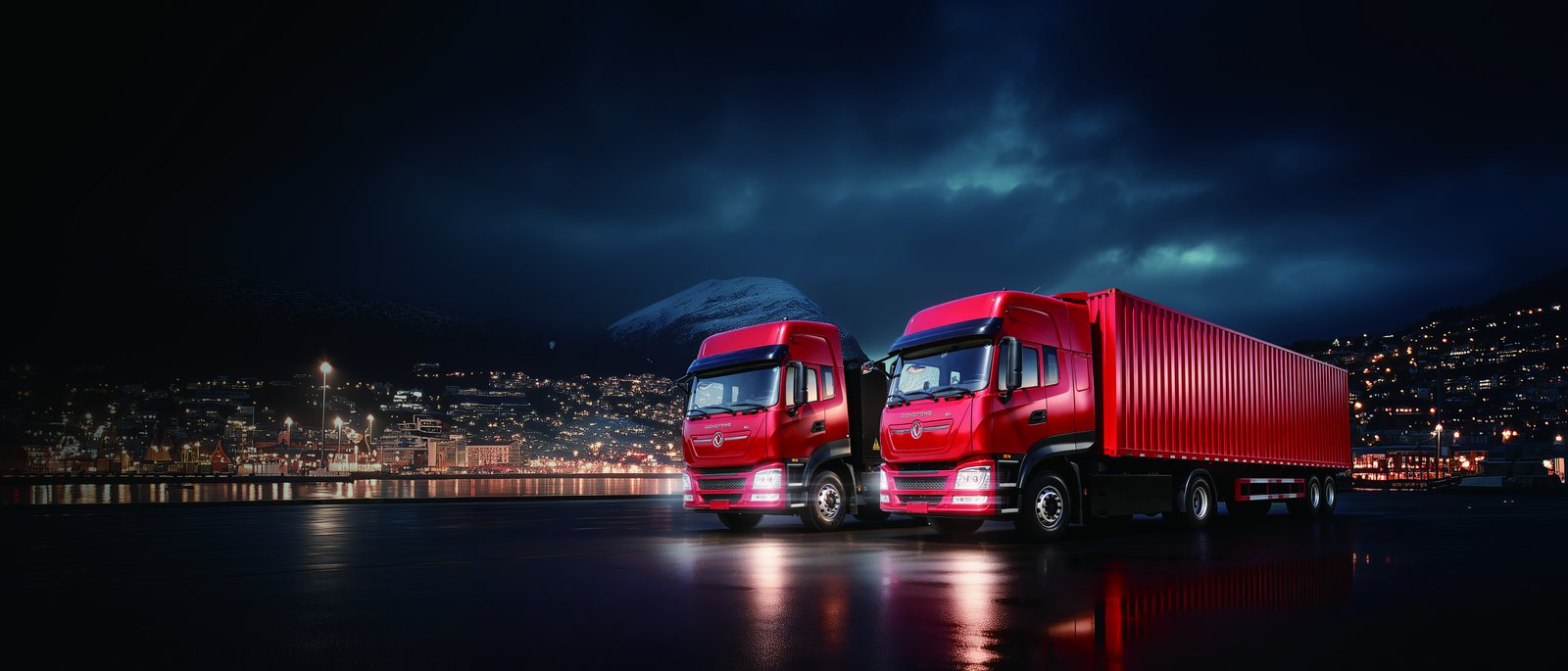
Lekki Deep Sea Port is Nigeria’s newest and deepest gateway, built to handle the larger vessels that older Lagos terminals cannot berth, and it is rapidly becoming the anchor of a modernised Lekki–Dangote logistics spine. For the terminal operators and drayage contractors who run it, the electric truck is the natural choice for yard and short-haul work — quiet, zero-tailpipe, and cheaper to run than diesel. This article shows how the Dongfeng TE46 terminal tractor fits Lekki, works the TCO against diesel, explains the swap-charging model, and sets a deployment path for Nigerian port operators.
Port drayage is stop-start, low-speed, high-tonnage work: yard shuffles, quay-to-stacking, and short highway legs to the inland container depot. The duty profile — frequent acceleration, regen on every stop, short distances — is the single most favourable case for an electric truck. Energy use is dominated by mass and starts, not by cruising, so regen recovers a large share and pack sizing is about cycle continuity, not range anxiety. Lekki’s modern layout also gives operators the land and power headroom to build depot charging that older Apapa terminals lack. Because the masses and lanes are known, the energy budget is forecastable.
The TE46 electric terminal tractor is purpose-built for yard and short-drayage duty with a swap pack. It pairs a CATL LFP battery with a permanent-magnet LvKong drive motor for high-cycle, thermally stable operation suited to daily port freight.
| Parameter | TE46 Specification |
|---|---|
| Configuration | 4x2 terminal tractor |
| Battery | CATL LFP, 210 – 262 kWh |
| Drive motor | LvKong permanent-magnet, 180 – 250 kW |
| GCW (typical) | Up to ~42 t |
| Battery swap time | 5 – 6 minutes |
| DC fast charge (20–80%) | 35 – 60 min |
| Battery warranty | 8 years / 4,500 cycles to 70% SOH |
| FOB price (China) | US$68,000 – 95,000 |
The 210–262 kWh LFP pack is sized for a full shift of yard shuffles and short drayage, with the option of 5–6 minute battery swap for continuous operation. The LvKong motor holds grade on the loaded climb out of the terminal, and LFP chemistry tolerates the deep, frequent discharge cycles port haulage demands. The 8-year warranty to 70% SOH means the pack outlasts the typical terminal finance horizon.
If you run a single shift and the tractor naturally idles at the depot for an hour at break or end-of-shift, DC charging the TE46 is simplest — no swap station capital. If you run two or three shifts, a 45-minute charge event removes a tractor from the haul road each cycle; the TE46’s 5–6 minute swap keeps every unit moving and is the lower-risk choice despite the higher infrastructure spend. Swap pays for itself once you operate four or more tractors across multiple shifts. The break-even is roughly four tractors: below that, the charger capex is lower; above it, the swap station pays back through avoided charger downtime.
A terminal tractor at Lekki burns ~18 l/hour over ~5,000 hours/year — 90,000 l. Nigerian diesel at ~US$1.20/l is ~US$108,000. The TE46 at ~1.6 kWh/km equivalent draws ~0.9 GWh; at terminal solar US$0.09/kWh that is US$81,000, saving ~US$27,000/year, plus ~US$4,000 maintenance — ~US$31,000 annual advantage. Payback is 30–44 months depending on shift count. On a four-tractor swap fleet the avoided charger downtime alone often closes the business case, because every minute a tractor waits on a charger is a container not moved.
The rollout is a pilot of four TE46 units plus one swap station on a single quay-and-yard lane for 120 days, with container-moved and kWh/container telemetry, then a scaled order. Build the swap station and solar first — that capex gates the trial, not the trucks. Once the lane proves out, replicate across quays; the spare-pack pool scales with the fleet. Fleets that scale in waves report the cleanest financial outcome.
Two risks shape the real return. First, the Nigerian diesel price is the swing variable and is also subject to supply shocks: a fleet that budgets only the average year understates the electric truck’s value, so we recommend running the TCO at +20% diesel and at rationing to see the resilience premium. Second, terminal power must be secured before the trucks arrive — a Lekki depot without a confirmed HV connection strands the unit on day one, so budget the charger and, where sensible, a small solar array on the same purchase order as the tractors. Operators who treat charging as someone else’s problem are the ones who report idle electric tractors; those who procure power with the truck report payback on schedule.
Currency is the third variable. The CIF, duty and charger spend are dollar-linked while freight revenue is naira-linked, so a weakening naira widens the payback gap even as energy savings accrue. Hedging the import invoice and billing the diesel-equivalent saving back as an internal electricity-versus-fuel line keeps the business case visible to finance. Finally, train two terminal crew per shift on high-voltage isolation before the first unit lands; the cost of a trained bay is trivial next to a week of downtime. Resale and residual value are the final piece — battery-electric tractors depreciate on pack health, not engine hours, so a documented 70% SOH warranty to 4,500 cycles is a bankable asset at trade-in.
Place the swap station at the yard, not the quay edge, so the empty return leg carries the depleted pack in and the full pack out — the tractor never detours. Train a two-person swap crew per shift; the 5–6 minute swap is a crane-and-latch routine, not a repair, so terminal crews pick it up in a day. Hold the spare packs on a slow-charge rack fed from solar, and the station becomes the terminal’s buffer store during grid dips. Siting and training, not the truck, decide whether the swap model pays.
Nigeria’s import process for fully-built EVs is workable via the SON conformity route, and the Nigeria electric truck market guide details Lagos/Apapa clearance, the SONCAP path, and depot charging layout. For Lekki operators, the TE46 is the EV truck that converts a fixed, dense port duty into a defensible low-carbon cost line.
Shaanxi Fenghan Trading supplies the TE46 with a terminal-grade build, swap-station engineering, and a Lekki-lane TCO model. Request a drayage proposal sized to your quay throughput.
Before issuing the purchase order, confirm three things: the GCW of your heaviest realistic load against the tractor’s rated envelope, the shift count that decides swap versus charge, and the terminal power that sets your energy cost. Match the TE46 to yard and short drayage and the swap model to the heavy multi-shift leg, and the fleet composition will be obvious from the lane profile. Order the chargers or swap station on the same PO as the tractors so the payback clock starts on arrival, and train the terminal crew on high-voltage isolation before the first unit lands. A spare motor and inverter module at the workshop keep a multi-tractor fleet above 95% availability, and the LFP pack’s 4,500-cycle warranty to 70% SOH is a bankable asset at trade-in.
Ready to electrify your fleet? Contact Shaanxi Fenghan Trading — authorized Dongfeng EV truck exporter. WhatsApp: +86 153 1943 1311 | Email: sales@fenghan-trade.com | dongfengevtrucks.com
🌐 Our Network: Fenghan Trade (SAGMOTO/SHACMAN Truck Export) · 4x2 6x4 tractor truck prime mover