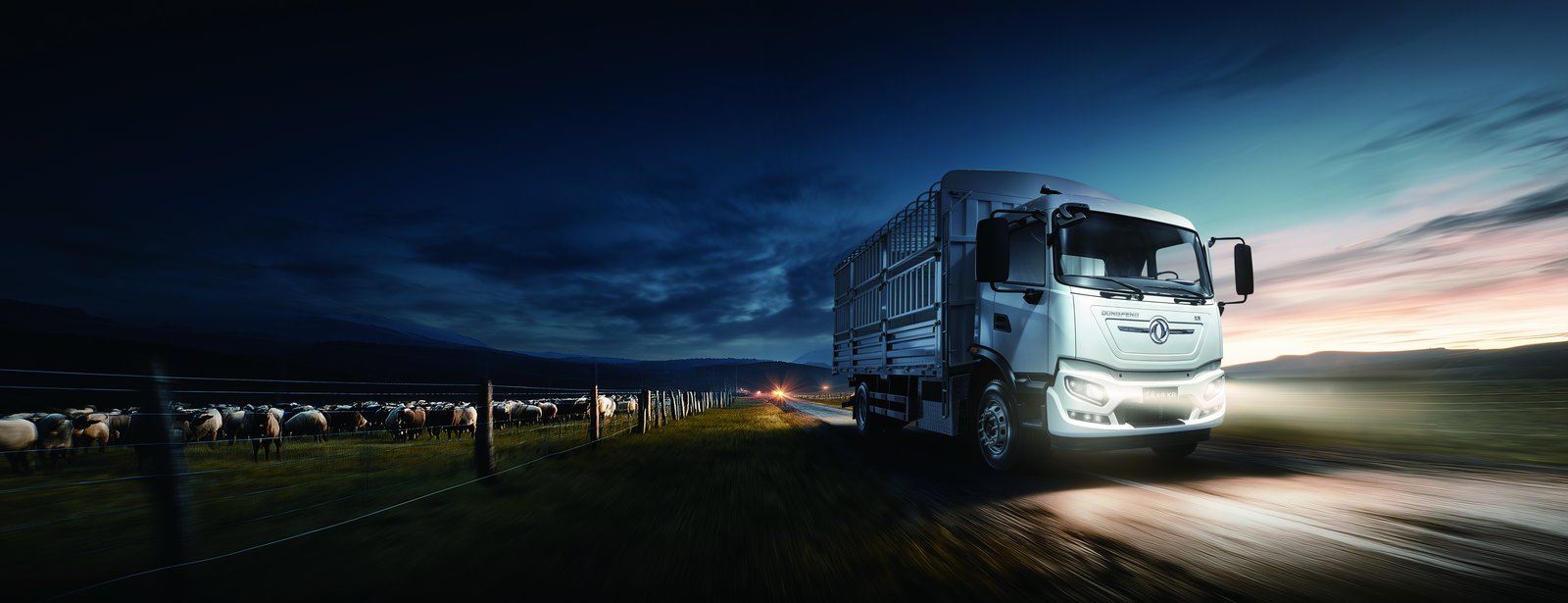
Leasing an electric truck is the fastest route for an Algerian logistics operator to deploy a KTH1 heavy cargo EV truck without committing $120,000 to $160,000 of FOB capital per chassis upfront. This guide explains how fleet leasing works for the 60 t GCW KTH1, the monthly figures a buyer should model, the import path from Oran or Algiers to a productive depot, charger planning, and where the KTH1 fits against lighter cargo alternatives.
Heavy cargo operators in Algeria run under tight letter-of-credit ceilings and unpredictable dinar liquidity. A 60 t GCW electric truck fitted with a 424 kWh CATL LFP pack and a 510 kW LvKong motor carries a FOB price of $120,000 to $160,000 before ocean freight and import duty. Spreading that sum across 36 to 60 equal monthly payments preserves cash for fuel, drivers, and warehouse expansion. Leasing also transfers battery-degradation exposure to the lessor, which is decisive because the pack dominates the lifetime cost of any EV truck. When the dinar weakens, a fixed-dollar lease payment is easier to hedge than a one-off capital outlay, and the operator keeps depreciation risk off its balance sheet.
| Parameter | KTH1 heavy cargo |
|---|---|
| Battery capacity | 424 kWh CATL LFP |
| Motor power | 510 kW LvKong |
| Gross combination weight | 60 t |
| Loaded range | 280-320 km |
| Thermal system | Liquid-cooled pack |
| DC fast charge | 120 / 240 / 360 kW (20-80% in 45-90 min) |
| Battery warranty | 8 years / 4,500 cycles |
| FOB price band | $120,000 - $160,000 |
A buyer should model the monthly lease against diesel displacement rather than against the sticker price alone. A 60 t diesel tractor in Algeria burns roughly 38 litres per 100 km; the KTH1's 280-320 km electric range per charge displaces a large share of that fuel on a typical port-to-warehouse loop. Add the 45-90 minute DC fast charge window, the liquid-cooled thermal system that protects range in 45 °C summer heat, and the 8-year / 4,500-cycle battery warranty, then compare the all-in monthly figure to a financed purchase plus fuel. Most operators reach breakeven inside 30 months when running two shifts, because the idle charging time at the depot costs nothing while drivers rest.
| Cost line (per 10,000 km) | Diesel 60 t tractor | KTH1 EV truck |
|---|---|---|
| Energy | 3,800 L x $0.35 = $1,330 | 14,000 kWh x $0.08 = $1,120 |
| Scheduled maintenance | $320 | $120 |
| Monthly lease equivalent (60 mo) | n/a | $2,200 - $2,950 |
| CO2 per km (grid mix) | ~1.0 kg | ~0.05 kg |
Figures are indicative and assume an off-peak industrial tariff; Algerian diesel is subsidized, so the largest saving comes from maintenance and two-shift uptime rather than energy alone. Confirm local rates before signing.
Plan the 240 kW or 360 kW depot charger before the KTH1 clears customs so the first week is productive. The CATL LFP pack accepts 120 kW, 240 kW, or 360 kW DC input and reaches 20-80% in 45-90 minutes depending on the charger rating. A 360 kW unit lets a night-shift truck complete two full cycles per day on the 280-320 km range, while a 240 kW unit suits single-shift fleets. Liquid cooling holds charge acceptance even when the Oran ambient temperature climbs past 40 °C, a constraint that strands air-cooled competitors.
The KTH1 arrives under FOB terms, then clears at Oran or Algiers. The buyer books a licensed customs broker, pays the applicable duty and VAT, and registers the EV truck for commercial plates. Because the KTH1 is a heavy cargo unit, the depot's 360 kW charger should be energised and tested before the truck lands. Importers can cross-check national demand signals in the Algeria electric truck market guide before signing a fleet contract, and compare chassis sizing against the KTH3 heavy electric cargo truck for lighter 6x4 duty cycles that may lower the monthly payment.
The weakest link in any heavy EV truck lease is residual value, which depends on pack state-of-health at return. The KTH1's 8-year / 4,500-cycle CATL LFP warranty gives the lessor a defensible floor, because LFP chemistry loses capacity far slower than NMC under high-temperature duty. Buyers should insist the lease states the acceptable end-of-term SOH threshold in writing, typically 70-80%, so there is no dispute at return. A clear SOH clause turns the battery from a risk into a scheduled cost.
To make the lease pay, run the KTH1 across two shifts. With a 360 kW charger the 424 kWh pack reaches 20-80% in 45-90 minutes, so an overnight plus a midday top-up supports two 280-320 km loops daily. Two-shift running roughly doubles the km over which the fixed monthly lease is spread, cutting the per-km financing cost in half and pulling breakeven forward. Drivers rotate while the truck charges, so the only added cost is a second operator and a second charging session priced at the depot off-peak rate.
Over a 60-month lease the KTH1's economics hinge on utilisation, not the purchase price. A buyer running 200 km per day covers roughly 60,000 km per year, so the 424 kWh pack cycles about 1.3 times daily and stays well inside the 4,500-cycle warranty. Energy at an off-peak Algerian industrial rate of $0.08/kWh costs about $1,120 per 10,000 km, against $1,330 of diesel for a comparable tractor, a $210 saving that compounds to more than $12,600 over five years on a single truck. Add $200 per 10,000 km of avoided diesel maintenance and the all-in monthly lease looks cheaper than the diesel it replaces once two-shift running is achieved.
Dongfeng's North Africa service network stocks the 510 kW LvKong motor's seals, the CATL LFP pack's contactors, and the 240-360 kW charging modules, so routine wear items ship from Oran or Algiers within days. Buyers should negotiate a spare-rotor and spare-charger clause into the lease so a fault never strands a heavy cargo unit beyond 48 hours. Because the KTH1 shares the CATL LFP platform with the lighter KTH3, commonising spares across a mixed fleet further cuts inventory cost.
Having these ready before quotation shortens the order-to-delivery window by two to three weeks and lets the lessor price the deal without contingency buffers.
Request a written lease quote that itemises the 424 kWh pack, the 510 kW motor, the charger provision, and the residual value. Ask the exporter for a delivery lead time to Oran and a recommended broker, and confirm whether the 360 kW charger is included or priced separately. With a transparent monthly model, a planned depot charger, and an SOH clause, a KTH1 heavy cargo EV truck fleet can enter Algerian service within a single importing season and start displacing diesel from day one.
Ready to electrify your fleet? Contact Shaanxi Fenghan Trading — authorized Dongfeng EV truck exporter. WhatsApp: +86 153 1943 1311 | Email: sales@fenghan-trade.com | dongfengevtrucks.com
🌐 Our Network: Fenghan Trade (SAGMOTO/SHACMAN Truck Export) · SAGMOTO cargo truck flatbed box stake