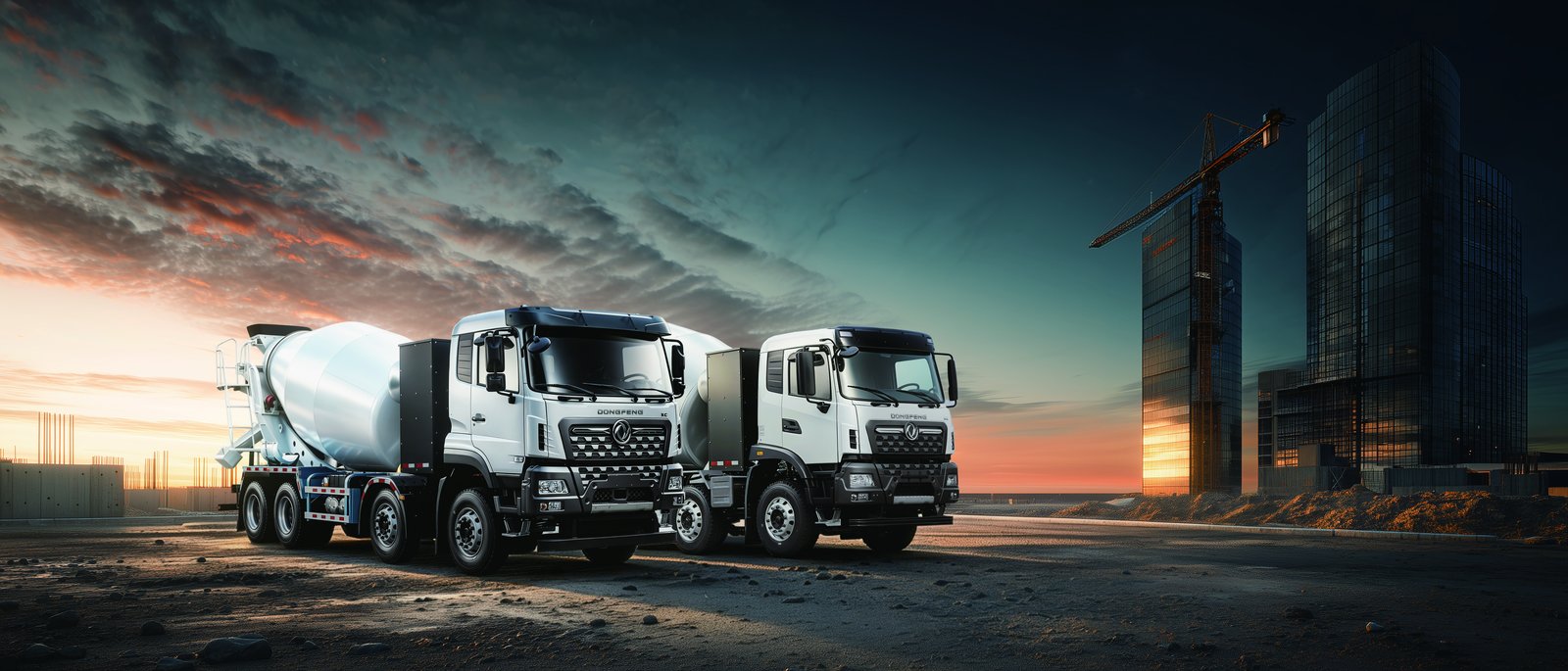
The European electric truck conversation and the emerging-market electric truck conversation rarely reference each other, which is strange because they are converging on the same job: zero-emission concrete delivery inside cities that are restricting diesel. Volvo's FM Electric is the benchmark European electric rigid platform — genuinely excellent engineering, deep dealer support across Europe, and a price to match. The Dongfeng KT9X is its export-market counterpart: an 8x4 electric mixer with CATL 410 kWh LFP, electric drum drive, CCS2 charging and full EU WVTA/GSR2 type approval, delivered at roughly a third to half the European price. This comparison is written for two readers: the European ready-mix operator wondering whether a WVTA-approved Chinese electric mixer is a credible alternative, and the emerging-market operator using the Volvo as the engineering reference point. Both deserve an honest answer.
| Dimension | Dongfeng KT9X | Volvo FM Electric (typical config) |
|---|---|---|
| Configuration | 8x4 electric mixer, EU type-approved | 4x2/6x4/8x4 electric rigid, mixer bodies via bodybuilders |
| Battery | CATL LFP 410 kWh, liquid-cooled | Up to ~540 kWh NMC depending on configuration |
| Drum drive | Electric PTO — no hydraulic/diesel donkey engine | Electric PTO via electromobility platform |
| Charging | CCS2, dual-gun DC | CCS2, up to ~250 kW |
| Safety systems | EBS + AEBS + ESC per GSR2 | Full European safety suite, mature ADAS options |
| Type approval | WVTA (EU whole-vehicle type approval) | Native European type approval |
| Indicative price | USD 100,000–130,000 FOB | Typically EUR 300,000–450,000+ depending on market and body |
Read the price line twice, because it organises everything else. The KT9X delivers the same regulatory approvals, the same charging standard, comparable range and payload class, and the same zero-emission mission at a capital cost that lets a fleet buy two to three KT9X units for one European-flag electric mixer.
Fairness first, and the list is real:
Concrete TCO is best expressed per cubic metre delivered. Modelling a 10-truck fleet, 8 m³ drum, 45,000 km/year each, ~28,000 m³ delivered per truck-year, electricity at USD 0.12/kWh (European depot tariffs) and diesel at USD 1.50/L:
| Cost per m³ (annualised, incl. capital amortisation over 8 yrs) | Diesel mixer | KT9X | Volvo FM Electric |
|---|---|---|---|
| Energy + drum PTO | USD 1.55–1.90 | USD 0.45–0.60 | USD 0.45–0.60 |
| Maintenance | USD 0.75–0.95 | USD 0.28–0.36 | USD 0.25–0.35 |
| Capital amortisation | USD 0.55–0.70 | USD 0.75–0.95 | USD 1.70–2.40 |
| Total | USD 2.85–3.55 | USD 1.48–1.91 | USD 2.40–3.35 |
The headline finding: on energy and maintenance the two electric platforms tie — zero tailpipe is zero tailpipe. The entire differentiation is capital. The KT9X lands a 45–50% per-m³ saving against diesel; the Volvo FM Electric's saving shrinks toward 15–30% at the top of its price band because amortisation eats the operating gain. European operators running Volvos cite ULEZ/ZFE compliance, brand requirements and driver factors as the justification — legitimate, but they are paying for them. An operator without those constraints gets the same operating economics at half the capital with the KT9X.
Can a European ready-mix operator actually register and run a KT9X? The truck carries full WVTA with GSR2-compliant safety systems (EBS, AEBS, ESC), CCS2 charging, and R1238/R10-type electrical approvals in its file — the registration pathway exists in EU member states, and several of our European-market KT9X units are in exactly this process. The honest caveats: national registration offices vary in their familiarity with Chinese type approvals (our documentation package is built for this), operator charge routines must be planned around CCS2 depot hardware (identical to what a Volvo would need), and the parts relationship is export-style rather than dealer-style. For an operator with two to five mixers in a mid-size city — the majority of European ready-mix companies — the capital arithmetic is increasingly worth that adjustment.
For buyers in Turkey, Morocco, Gulf states, Southeast Asia or Latin America, the comparison resolves differently: Volvo's European dealer advantage evaporates outside Europe, both products run on the same CCS2 depot infrastructure, and the price gap stands at full width. The KT9X isn't the budget alternative there — it is simply the rational choice, with the Volvo serving as the engineering reference that validated the concept.
The Volvo FM Electric is a superb electric mixer platform sold into a support ecosystem that justifies its price for European fleets prioritising dealer proximity and packaged financing. The KT9X delivers the same mission — WVTA-approved, CCS2, electric drum, CATL LFP — at a capital level that makes electrification profitable rather than merely compliant. Two budgets, two correct answers, and one convergence: every year, more of the world's concrete moves on batteries.
The comparison's least-discussed dimension decides financing terms: what the truck is worth at year eight. Both platforms carry battery packs that will retain 70-80% state of health at typical mixer duty — and that residual pack value is a tradeable asset. LFP second-life markets (telecom tower backup, microgrid storage, port equipment buffering) actively purchase retired packs by the kWh, which gives the KT9X's 410 kWh CATL unit a documented residual floor that our leasing and financing conversations increasingly build upon. The practical asymmetry: because the KT9X's purchase price is half the Volvo's, the residual value represents a far larger fraction of the original capital — the financing mathematics of a lower-ticket asset with a hard residual floor is simply friendlier. European banks lend against Volvo residuals through their captive structures; export-financed KT9X deals build the same protection at a third of the exposure. Whichever route a fleet takes, the lesson is uniform: an electric mixer's battery is not a depreciating cost — it is a depreciating asset with a documented second life.
Mixer duty is unusually charging-friendly, and the choreography is worth spelling out because it shapes infrastructure sizing. A ready-mix truck's day: load at the plant, deliver, wait, discharge, return — repeating with 30-90 minute cycles between plant visits. Every plant visit is a charging opportunity: a 120 kW charge during a 30-minute loading window restores 15-20% of the KT9X's 410 kWh pack, and overnight depot charging completes the picture. The result is that mixer fleets need fewer chargers per truck than distribution fleets — two dual-gun units at the plant plus overnight AC positions serve a 10-14 truck KT9X fleet comfortably. The KT9X's drum-drive energy budget folds into the same pack: mixing and agitating draw a steady 3-5 kW, queue-and-discharge duty another 2-4 kW — all absorbed within the daily charge plan with margin. Both electric platforms share this advantage over diesel; the KT9X delivers it at the capital level where mid-size operators can actually deploy it.
| Fleet profile | Recommended choice | Why |
|---|---|---|
| European major-city operator, 15+ mixers, ULEZ/ZFE core business | Either — decide on service-model preference | Compliance is existential; dealer proximity (Volvo) vs capital scale (KT9X) is a genuine trade |
| European mid-size operator, 2-8 mixers, price-competitive market | KT9X | Capital arithmetic dominates; WVTA registration pathway exists |
| Gulf, Turkey, North Africa, Southeast Asia, LatAm operators | KT9X | Volvo's dealer advantage evaporates outside Europe; price gap stands at full width |
| Fleet with strong captive financing / bank packages for European brands | Volvo (in Europe) | Captive lease instruments offset some capital premium |
| Fleet prioritising battery cycle life under high-cycle drum duty | KT9X | 4,500-cycle LFP term matched to mixer abuse profile |
The pattern under the table: geography decides more than spec. Inside Europe's dealer networks, the FM Electric is a real contender with real advantages; everywhere else our customers operate, the KT9X is not the alternative — it is the electric mixer market.
Ready to electrify your fleet? Contact Shaanxi Fenghan Trading — authorized Dongfeng EV truck exporter. WhatsApp: +86 153 1943 1311 | Email: sales@fenghan-trade.com | dongfengevtrucks.com
🌐 Our Network: Fenghan Trade (SAGMOTO/SHACMAN Truck Export) · heavy duty trucks export China