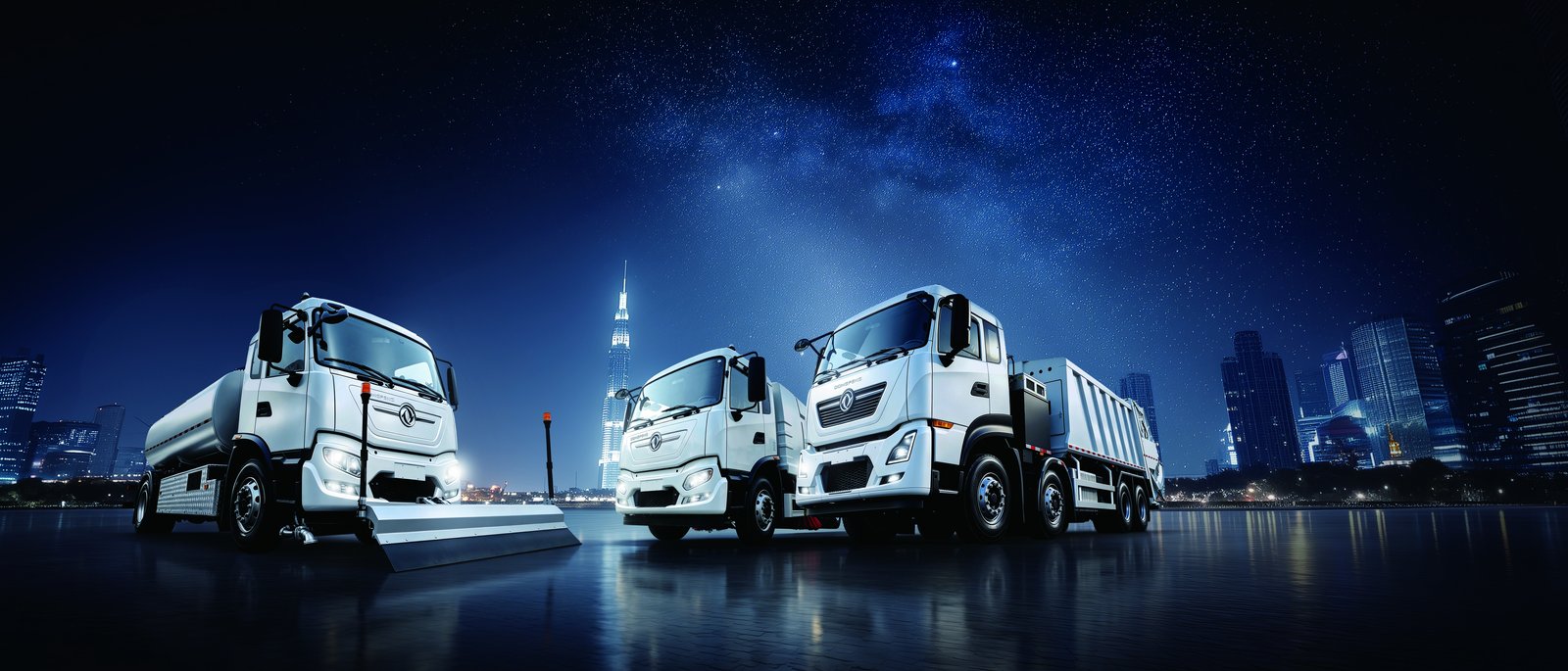
Water trucks are the quiet workhorses of dust control — highway medians, port stockyards, mine haul roads, city streets and construction sites all depend on them, often running long watering shifts at low speed with a pump spinning the whole time. That duty profile happens to be a diesel engine's nightmare (hours of PTO load at idle) and an electric drivetrain's best case. Dongfeng builds two sprinkler-class EV trucks for export: the KT3F, an 18 t GVW 4x2 with CATL 166/200 kWh options, and the KT7A, a 6x4 heavy-duty unit at 25 t GVW with CATL 232 kWh. This comparison breaks down which water truck EV belongs on which job, and what the operating economics look like on each.
| Specification | Dongfeng KT3F | Dongfeng KT7A |
|---|---|---|
| Configuration | 4x2 medium sprinkler | 6x4 heavy-duty sprinkler |
| GVW | 18 t | 25 t |
| Battery | CATL 166 / 200 kWh LFP | CATL 232 kWh LFP |
| Water capacity | ~10–12 m³ | ~15–18 m³ |
| Pump drive | Electric PTO | Electric PTO, heavy-duty |
| Watering width / reach | ~14–18 m spray arc | ~18–22 m arc, front/rear cannons |
| Range / watering endurance | ~200–250 km drive + pump duty | ~180–220 km under full watering duty |
| FOB price band | USD 80,000–100,000 | USD 95,000–115,000 |
The core trade is capacity against manoeuvrability and price. The KT7A carries roughly 50% more water per fill and is built on a 6x4 chassis whose axles and suspension shrug off mine-road and port-yard punishment all day. The KT3F is lighter, cheaper, narrower, and — in its smaller-battery option — the most affordable special-duty EV truck in the entire Dongfeng export range.
Understand one number and sprinkler electrification explains itself: a diesel water truck spends 40–60% of its fuel burn not moving. The PTO-driven pump runs while the vehicle crawls at 10–20 km/h or sits stationary at a stockyard face; a diesel engine at PTO idle burns 8–15 L/hour producing nothing but noise, heat and emissions. An electric PTO pump draws exactly the hydraulic power the nozzles need — 15–30 kW — from the same CATL pack that moves the truck, at 90%+ efficiency. The result is a 55–70% reduction in energy cost on typical watering shifts, plus the ability to work at night near residential zones (a KT-series sprinkler at working speed is quieter than a conversation at the loading face) and inside enclosed or semi-enclosed facilities where diesel exhaust is banned outright.
The KT3F's natural territory is the municipal and light-industrial watering mission: city streets and medians, township roads, small construction sites, landscaped corridors, and solar-farm access roads (where we have configured it with solar-hybrid charging for fully off-grid dust control). Its 4x2 format and compact footprint suit traffic-adjacent work; its 166 kWh base option is deliberately right-sized for the 80–150 km daily radii these routes run, keeping capital cost at the USD 80,000–100,000 floor. Municipal buyers also value the smallest-battery variant's faster payback: on a city street-watering contract of 280 shifts per year, the KT3F 166 kWh clears its diesel-comparator capex premium in 24–30 months.
The KT7A's territory is heavy watering: mine haul roads (where dust suppression is a safety compliance requirement, not a courtesy), port and terminal stockyards, large highway construction corridors, airport aprons and industrial estates. The 6x4 chassis carries the 15–18 m³ tank through the washboards and potholes of mine roads without the fatigue cracking that destroys lighter frames; the higher-capacity pump and cannon array water wider arcs per pass, cutting the passes per kilometre; and the 232 kWh pack sustains full-shift watering duty — drive plus pump — with the margin heavy operations need. On mine haul-road duty the KT7A replaces a 20,000–30,000 L-class diesel water truck burning 60–100 L per shift, saving USD 20,000–35,000 per year per unit and removing the exhaust stream from the dust-control loop entirely — a detail mine environmental officers increasingly audit.
| 8-year cost (300 shifts/yr) | KT3F | Diesel 4x2 water truck | KT7A | Diesel 6x4 water truck |
|---|---|---|---|---|
| Vehicle capex | ~USD 90,000 | ~USD 55,000 | ~USD 105,000 | ~USD 68,000 |
| Energy (8 yrs) | ~USD 43,000 | ~USD 150,000 | ~USD 58,000 | ~USD 195,000 |
| Maintenance | ~USD 32,000 | ~USD 78,000 | ~USD 38,000 | ~USD 95,000 |
| Total | ~USD 165,000 | ~USD 283,000 | ~USD 201,000 | ~USD 358,000 |
Both sprinkler EV trucks beat their diesel comparators by roughly 40–44% over eight years. Note also what is absent from the electric columns: engine air filters replaced monthly on dusty watering duty, PTO clutch repairs, and the turbo failures that high-idle hours induce. Sprinkler fleets have some of the highest diesel maintenance-per-hour figures of any special vehicle — electrification removes most of that structure.
Both KT-series trucks can be configured at origin with: stainless or epoxy-coated tanks for brackish or recycled water; front and rear spray cannons with joystick control; side spray bars for full-width road coverage; rear watering ports for tandem towed spraying; working lights and reversing cameras for night shifts; and telemetry integration so watering coverage (litres per km, arc coverage) can be reported to mine compliance or municipal contract managers. Charging follows the depot pattern — overnight AC at the water point or yard, with optional midday DC where shifts extend. For fully off-grid sites, the KT3F pairs naturally with solar-hybrid charging, a configuration we detail in a separate article.
Choose the KT3F (18 t, CATL 166/200 kWh, USD 80,000–100,000 FOB) for paved-network municipal and estate watering where capital efficiency rules. Choose the KT7A (25 t 6x4, CATL 232 kWh, USD 95,000–115,000 FOB) for mine haul roads, ports and heavy corridors where tank capacity and chassis durability carry the contract. Both convert watering's worst diesel cost — hours of PTO idle — into the electric fleet's best saving. Shaanxi Fenghan Trading configures tanks, spray systems and documentation to your site's specification; tell us your kilometres of road per shift and water source, and we will size the truck and the charger correctly the first time.
Ready to electrify your fleet? Contact Shaanxi Fenghan Trading — authorized Dongfeng EV truck exporter. WhatsApp: +86 153 1943 1311 | Email: sales@fenghan-trade.com | dongfengevtrucks.com
🌐 Our Network: Fenghan Trade (SAGMOTO/SHACMAN Truck Export) · SAGMOTO heavy duty diesel trucks