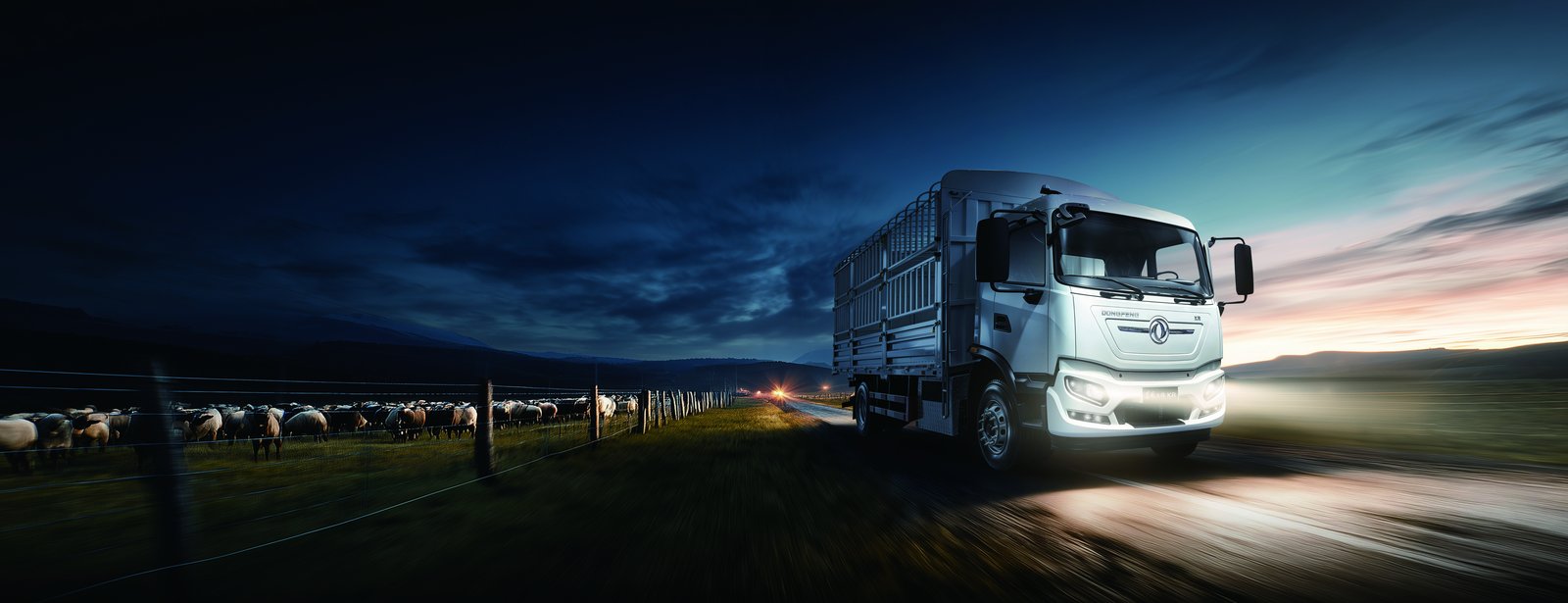
Lusail is the city Qatar built for the world to see: 38 km² of master-planned districts north of Doha, with boulevards, marinas and public realm maintained to a standard that requires daily mechanical washing across hundreds of lane-kilometres. The fleets doing that work — water tankers with spray bars and high-pressure lances — run fixed night and early-morning circuits from municipal depots, returning to base after every shift. It is municipal duty at its most electrifiable, in a country with cheap power, declared sustainability goals, and procurement that increasingly scores emissions. This article examines the Dongfeng KT7A electric washing truck in Lusail-scale service.
A street-washing truck’s day splits into two energy consumers: the traction drive covering the circuit (80-140 km per shift on Lusail’s district loops), and the water system — pumps driving the spray bar and lance at 15-25 kW during active washing. On a diesel truck, both draw from one engine that idles through the working cycle’s frequent stops; on the KT7A, an electric PTO drives the pumps directly from the 282 kWh CATL LFP pack, and the traction system draws nothing at standstill. The measured result on Gulf municipal duty: 5-7 hours of active washing per charge with the standard tank, or a full double-shift with a 45-minute midday DC charge. Range has never been the constraint on this duty; water capacity is — and that is true for the diesel variant too.
| Parameter | KT7A Electric Washing Truck |
|---|---|
| Water tank | 10-14 m³ stainless, anti-surge baffled |
| Battery | 282 kWh CATL LFP, liquid-cooled |
| Traction motor | LvKong 250 kW peak / 2,200 Nm |
| Pump drive | electric PTO, 15-25 kW, variable pressure |
| Active washing per charge | 5-7 hours |
| DC charge 20-80% | ~45 min at 240 kW |
| Ambient rating | to +50°C, liquid-cooled pack |
| FOB price band | US$88,000-105,000 |
The +50°C rating carries special weight in Qatar, where summer night temperatures stay above 35°C and the trucks work hardest in the pre-dawn hours that are still brutally hot. The liquid-cooled pack holds its thermal band through a Gulf August; the cab air conditioning runs at full capacity at standstill without burning diesel; and the pump system’s electric drive holds constant pressure regardless of engine speed — a wash-quality consistency advantage the hydraulic-drive diesel cannot match at idle.
Qatar’s electricity tariff for municipal and industrial consumers runs around US$0.04-0.06/kWh — among the world’s lowest — against diesel at US$0.55-0.65/L equivalent. A diesel washing truck consumes 35-45 L per shift on combined traction-and-pump duty: US$22-28 per shift. The KT7A consumes 90-120 kWh for the same shift: US$4-7. The energy saving exceeds 75%, and on a two-shift municipal calendar it compounds to US$13,000-18,000 per truck annually — before maintenance, where the deletion of engine, transmission and PTO hydraulics adds US$4,000-6,000 more. Payback against the purchase premium runs 30-42 months on a municipal replacement cycle of 8-10 years — comfortably positive, and that is before scoring the procurement points that zero-emission operation earns under Qatar’s tender frameworks.
Lusail’s advantage is that everything was designed recently: the municipal depots have modern medium-voltage service, and a ten-truck KT7A fleet’s 400-500 kVA managed-charging requirement is a routine connection. The fleet’s rhythm — trucks out 21:00-05:00, parked 06:00-20:00 — inverts the solar problem that complicates other fleets: daytime parking means daytime charging, and a depot solar canopy (Qatar’s irradiance is exceptional) directly serves the fleet’s actual charging window at peak output. Few municipal fleets anywhere align this well with solar; Lusail’s washing fleet charges when the sun shines because its working hours are dark.
Qatar’s municipal procurement runs through Ashghal and the relevant authorities with documentation requirements we supply as standard: Arabic/English technical files, UN R100 battery certification, and the conformity package. Trucks ship to Hamad Port in 26-32 days from China. Regional buyers can find the Gulf operating context on our Qatar market page, and municipal procurement teams evaluating sanitation-fleet electrification across the GCC will recognise the same platform’s deployments from Dubai’s street-cleaning programme to Kuwaiti municipal fleets — the KT7A works Gulf municipal duty with common support infrastructure.
Support for municipal fleets is structured for procurement accountability: commissioning and operator training at the depot, preventive-maintenance scheduling aligned to the municipal CMMS, parts kits sized for fleet self-sufficiency, and telemetry monitoring that reports availability and energy cost in the format municipal audits require. The drivetrain’s service calendar — brakes, coolant, pump wear parts — is a fraction of the diesel washing truck’s engine-and-hydraulics load.
Lusail’s maintenance standard is not optional — it is the city’s identity — and the washing fleets delivering it will run every night for decades. Electrifying them converts a fixed duty cycle on a planned grid into a 75% energy saving, a quieter city at 3 am, and procurement scores that align with the country’s declared direction. For a city built from scratch to showcase the future, washing its streets with last century’s drivetrain is the anomaly; the KT7A simply corrects it.
The Lusail deployment logic extends naturally across Qatar’s municipal geography, and fleet planners should read the capital’s washing requirements as one system. Doha’s own districts, the Pearl, Msheireb, the stadium precincts’ legacy maintenance, and the growing municipal areas to the north and west all run comparable washing circuits from municipal depots — each a KT7A fleet at the same ratios, sharing parts, training and the support structure. The fleet-level economics improve with scale: charger infrastructure amortises across more trucks, the HV-certified technician team covers multiple depots, and the procurement’s per-unit cost declines on volume. Qatar’s compact geography means a single support hub serves the entire national municipal fleet — a structural advantage few countries offer, and one that strengthens the already-favourable electrification case.
The reputational dimension carries specific weight in Qatar. The country’s global positioning — built through the World Cup and sustained through its National Vision programme — rests on demonstrating world-class urban management, and municipal fleets are visible daily proof. A washing truck working Lusail’s boulevards in silence at 3 am is a small thing; multiplied across the municipal network and documented in the sustainability reporting the state now publishes, it becomes evidence of the transition the country has promised. Municipal procurement in the Gulf increasingly reflects this: tenders ask for emissions performance, and the fleets that can demonstrate it score accordingly. For Qatar’s municipal operators, the KT7A fleet is thus simultaneously a cost decision, a service-quality decision, and a contribution to a national narrative — three justifications pointing at the same purchase order.
Ready to electrify your fleet? Contact Shaanxi Fenghan Trading — authorized Dongfeng EV truck exporter. WhatsApp: +86 153 1943 1311 | Email: sales@fenghan-trade.com | dongfengevtrucks.com
🌐 Our Network: Fenghan Trade (SAGMOTO/SHACMAN Truck Export) · SAGMOTO heavy duty diesel trucks