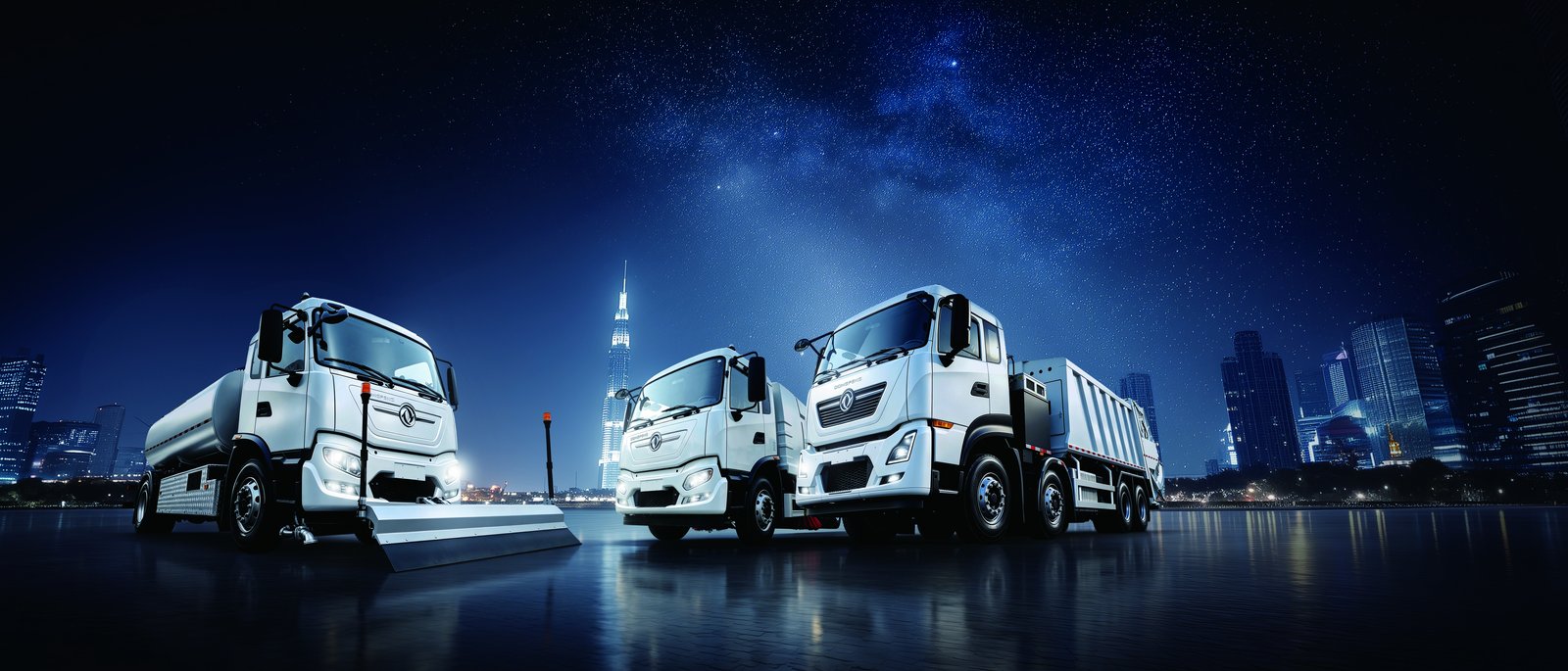
Lima has one of Latin America's most persistent urban air problems — a desert-coast megacity of nearly 10 million where fine dust, traffic emissions and the winter garúa haze combine into a public-health priority that appears in every municipal programme and most donor-financed urban projects. Street washing and flushing is part of the city's formal response: high-pressure washing of avenues and central reservations, dust suppression on the peri-urban access roads, and pre-dawn cleaning of the historic centre and Miraflores-San Isidro tourist corridors. We have covered Peru's mining corridors and fleet electrification; this piece is the municipal electric truck street-cleaning strategy — the KT7A electric washing truck on the heavy washing missions, supported by the KT3F electric sprinkler truck on dust-suppression routes. Country import context is in the Peru market guide.
Street cleaning splits into two distinct engineering problems, and the fleet should split with them:
| Mission | Vehicle | Configuration | Typical Lima route |
|---|---|---|---|
| High-pressure street washing | KT7A 6x4 | CATL 232 kWh, 25 t GVW, washing system with high-pressure bars | Avenidas and tourist corridors, pre-dawn |
| Dust suppression watering | KT3F | CATL 166/200 kWh, 18 t GVW, sprinkler system | Peri-urban access roads and construction corridors |
The KT7A is the heavy platform: 6x4 with a 25 t GVW carrying larger water capacity and the washing-system hydraulics for high-pressure jetting, which in a diesel truck means an engine running at governed speed for hours. Electrically driven, the washing pump draws exactly the power the job needs at zero engine idle — the same advantage we documented for Gulf street-washing fleets, now applied to a city that measures its air quality the way others measure traffic.
Peru's industrial electricity is competitively priced at roughly USD 0.10–0.14/kWh — substantially below the Latin American average — while diesel retails at market prices near USD 4.5–5 per gallon equivalent. For a washing truck on Lima duty:
Lima's street-cleaning procurement increasingly lives inside air-quality and climate programmes — municipal decarbonisation commitments, the national framework's clean-air initiatives, and donor-financed urban projects where emissions criteria score explicitly. The electric washing fleet answers on three lines:
A district-scale fleet — say eight KT7A and six KT3F — needs a modest depot: three 120 kW DC chargers on rotation for the fleet's daytime recharge (washing fleets charge between shifts and overnight, not during them), one 240 kW fast point for schedule flexibility, and rooftop solar of 60–100 kWp on the municipal depot — Lima's coastal desert location delivers one of the best solar yields of any capital city we serve, and a solar-fed cleaning fleet is a public programme with a visible centrepiece. Total infrastructure budget near USD 200,000–250,000, with the fuel savings of the fourteen-truck fleet repaying it in under two years.
Peruvian municipal procurement scores cost per kilometre cleaned and increasingly environmental criteria; the electric bid converts its operating advantage into the price line and its emissions into the score line. Two structural recommendations from our tender practice: bid the charging infrastructure and its solar centrepiece into the proposal as programme infrastructure (evaluators fund what they can see), and structure the fleet delivery in phases matched to the contract's route-expansion schedule — our staged delivery practice — so the programme's cash flow matches the municipality's. Districts in the Lima metro can start with a three-truck KT7A pilot on the tourist and historic corridors, where the visibility of the programme is highest and the route lengths are shortest.
Peru-bound units ship to Callao 32–38 days from China, RoRo standard, with the Peruvian package: SUNAT customs entry, conformity documentation, LHD as national standard, Spanish-language manuals and crew training. The washing-system specification for Lima adds the dust-package sealing for the desert environment and a water-conservation mode — Lima is one of the world's driest capitals, and the washing fleet's water budget is as politically sensitive as its fuel budget, a constraint our spray-control calibration addresses directly.
Lima washes its streets because the air demands it. Doing that work on electricity — cheap Peruvian electrons, desert solar, silent pre-dawn shifts — turns a municipal obligation into the cleanest programme the city runs. The district that bids it first will set the example the rest of the metro follows.
Ready to electrify your fleet? Contact Shaanxi Fenghan Trading — authorized Dongfeng EV truck exporter. WhatsApp: +86 153 1943 1311 | Email: sales@fenghan-trade.com | dongfengevtrucks.com
🌐 Our Network: Fenghan Trade (SAGMOTO/SHACMAN Truck Export) · SAGMOTO heavy duty diesel trucks