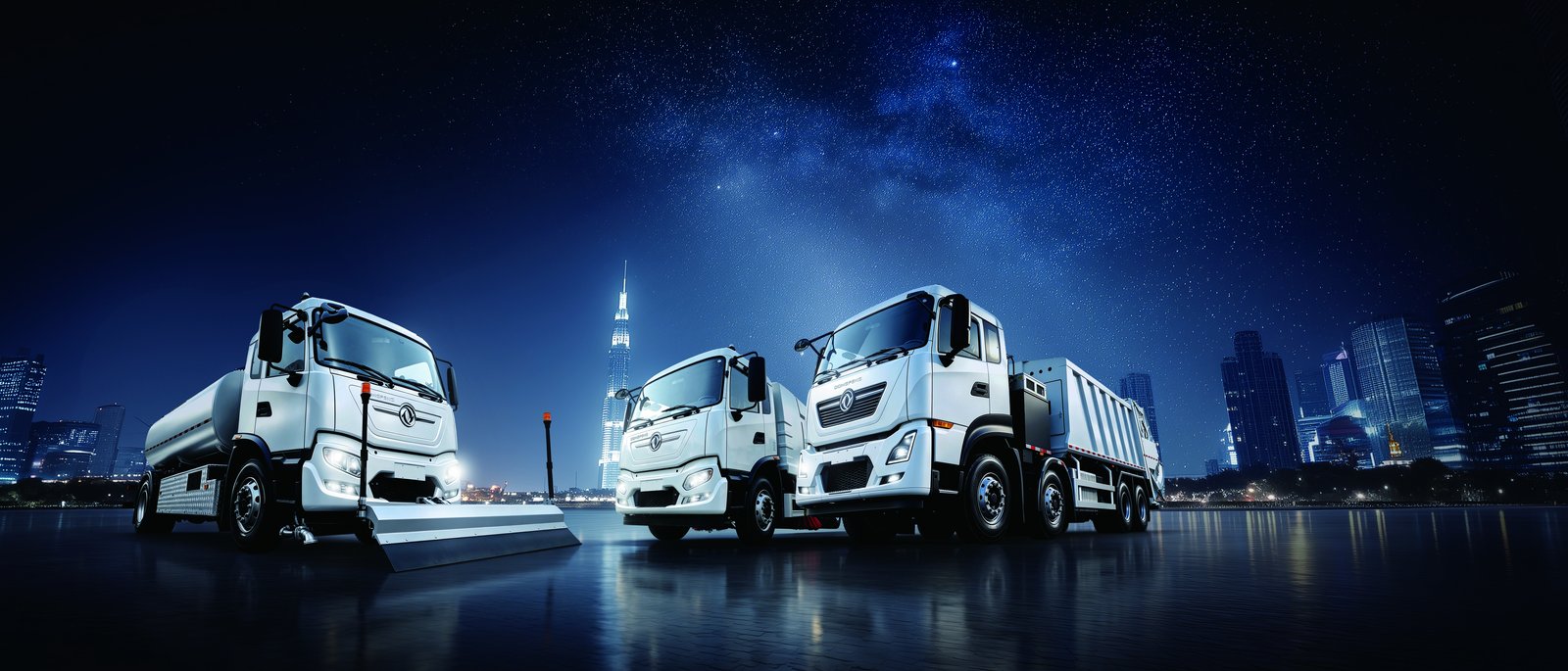
Few cities on earth clean as visibly as Dubai. The municipality's street-flushing and washing programmes run nightly across Sheikh Zayed Road's service lanes, the Deira and Bur Dubai districts, beachfront promenades and the palm-shaped developments — an around-the-clock logistics operation whose measure is whether the city looks immaculate at 6 a.m. It is also an operation with an emissions profile, a diesel bill at full commercial pricing, and a client — Dubai's government — that has publicly anchored its identity to sustainability targets and clean-mobility deployment. Street cleaning is therefore one of the first municipal fleets any ambitious city electrifies, and Dubai is exactly that city. This article sets out the deployment logic for the KT7A electric washing truck — the 6x4, 25 t-class platform for high-pressure flushing, road washing and dust-control duty — as the fleet-focused companion to our UAE electric truck market guide.
Municipal washing duty is the least demanding road-freight mission to electrify, on every axis:
Dubai's cleaning duty combines three stresses: 45 °C+ summer nights, corrosive coastal humidity and salt, and the finest drifting desert dust in the region. The KT7A's Gulf specification addresses each:
| Stress | Engineering response |
|---|---|
| 45 °C nights, pump under sustained load | Liquid-cooled CATL LFP pack with chiller circuit; pump inverter rated for continuous Gulf-summer duty |
| Salt and humidity | Full e-coat chassis, stainless tank hardware options, sealed connectors throughout |
| Fine dust ingress | IP68 battery enclosures, filtered cooling intakes with serviceable pre-filters, sealed low-voltage looms |
| Daily wash-down | HV compartments rated for pressure washing; the tank and pump hardware is daily-wash duty by design |
| Water chemistry | Treated (TSE/desalinated) municipal water as standard; brackish-water tank options for site duty |
A KT7A running two-shift flushing (traction plus pump, 300 days) at UAE prices — commercial diesel around USD 0.82/litre, municipal electricity near USD 0.04–0.06/kWh:
Dubai's cleaning operations live under a second sustainability constraint — water. The city's treated-sewage-effluent reuse programme supplies municipal flushing, and the operating pressure is to wash more road with less water. Electric pump drives contribute here in ways diesel PTOs cannot: precise pressure and flow control at the nozzle, programmable dosing matched to road surface and dust loading, and the ability to hold optimal pump efficiency at any road speed — because the pump does not share an engine with the wheels. Fleets working with our body partners specify front spray bars with variable-geometry nozzles and the pump-map calibration for their actual road inventory, converting water use from a fixed habit into a managed resource. Combined with our tank engineering guide's baffle and venting discipline, the water system's efficiency compounds with the driveline's.
Delivery runs 45–60 days from order with 22–28 days ocean transit to Jebel Ali; LHD, GCC-spec equipment, and Arabic/English documentation as standard. For contractors and municipalities fielding their first electric washing fleet, our commissioning includes pump-system training — the electric PTO's control logic is genuinely different from a hydraulic diesel PTO, and the two-day operator familiarisation is the difference between a good month one and a frustrating one.
The deployment patterns that follow Gulf cleaning-fleet electrification carry a consistent set of operational notes worth capturing before a first order. On scheduling: the night-flushing window is where the electric fleet's quiet operation earns its keep, and the dispatch design should lean into it — earlier start times in residential districts that diesel units could not work without complaint files, and the beachfront promenade rounds that public-event calendars constrain to pre-dawn. On water discipline: the electric pump's programmable dosing rewards the depot that assigns a staff member to own the water-per-kilometre figure — the fleets that track it actively (nozzle configuration by road class, pump-speed presets by district, the wash-down versus dust-suppression modes actually used as designed) report measurable water savings against their diesel-era baseline, in a city where every cubic metre carries an accounting weight. On the summer trough: July and August's overnight lows near 35 °C are the fleet's hardest duty, and the two disciplines that matter are the charging schedule (finishing the overnight cycle before the grid's cooling peak stacks on the same hours) and the pack's thermal telemetry (watched, in practice, mostly by nobody — which is the point: the system manages it, and the annual maintenance pull confirms it managed it well).
On procurement sequencing: the fleets that convert one depot's beat structure first, then replicate district by district, carry both the evaluation data and the institutional learning into each subsequent order — and the second depot's approval is, in our experience of Gulf municipal programmes, a fraction of the first's effort. The washing fleet is rarely a municipality's first electrification; it is, reliably, its most replicable.
Ready to electrify your cleaning fleet? Contact Shaanxi Fenghan Trading — authorized Dongfeng EV truck exporter. WhatsApp: +86 153 1943 1311 | Email: sales@fenghan-trade.com | dongfengevtrucks.com
🌐 Our Network: Fenghan Trade (SAGMOTO/SHACMAN Truck Export) · SAGMOTO heavy duty diesel trucks