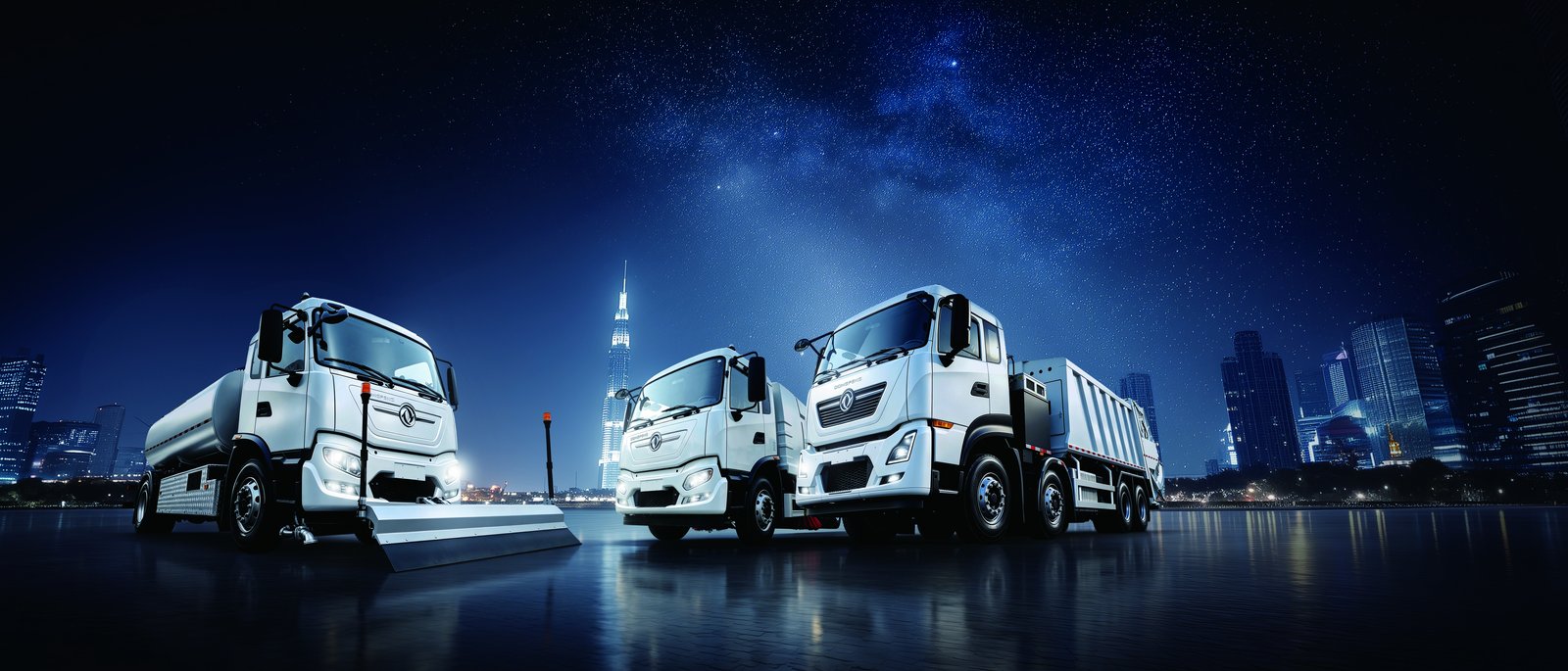
Airports are unusual truck customers. They run around the clock, they police their own ground with a severity no city matches (foreign object debris — FOD — is a safety-of-flight issue, and everything that moves airside is inspected, permitted and audited), and their two great dust problems sit at opposite ends of the same property: the operating airfield itself, where dust and blowing debris threaten aircraft engines and runway friction standards, and the perpetual expansion earthworks beyond the fence, where new runways and terminals are carved out of dry land. Both duties belong to the water truck — and both are quietly perfect for electric. The Dongfeng KT7A electric sprinkler truck — heavy-duty chassis, CATL LFP energy, electric pump drive — answers airfield duty in a way diesel never did: zero exhaust near intake-sensitive jet operations, near-silent night work under flight-curfew rules, and a water-pumping duty cycle where electric drive saves the most. This article covers the airfield case: the two dust problems, the operational rules, the machine specification and the fleet economics. For the market context, see our UAE electric truck market guide — the Gulf's continuous airport expansion is the world's densest concentration of this exact duty.
The dust and debris risk around an operating runway is a flight-safety discipline:
Airside operating rules make electric trucks unusually welcome: the diesel engine's exhaust near jet bridges and stand areas is an emissions and safety annoyance that airports actively police, and engine idling on an apron during a flight turnaround is precisely what an electric chassis eliminates. Several airport authorities now write emissions preferences directly into ground-support and airside-service vehicle policies — the direction of travel is unambiguous.
The expansion side is construction-logistics dust control at scale:
| Parameter | Typical airfield expansion duty | Notes |
|---|---|---|
| Daily water volume per truck | 80,000–150,000 L | 20–35 refill cycles in dry-season duty |
| Daily distance | 120–220 km | Slow-speed watering passes; low kWh/km |
| Pump duty | 6–10 hours/day continuous | Electric pump drive at 15–25 kW — the diesel unit burns 8–12 L/h for the same work |
| Refill sources | Site hydrants, stormwater ponds, treated effluent | Airports increasingly mandate recycled water on expansion works |
The pump line is the economics of the whole article: a diesel sprinkler truck spends most of its fuel not moving but spraying — engine at high idle driving the PTO pump for hours. The KT7A's electric pump draws 15–25 kW from the pack, precision-variable by spray mode, and the truck's total daily energy (driving plus pumping) of 150–260 kWh recharges overnight or between shifts at the site's own power.
A worked model for an airport operator (or expansion contractor) running 6 KT7A units on mixed apron and earthworks duty — 170 km/day average, 8 pumping hours, 340 days (airfields don't close), electricity at USD 0.09/kWh, diesel at USD 1.05/L:
| Annual item (6 trucks) | Diesel fleet | KT7A electric fleet |
|---|---|---|
| Fuel / energy (drive + pump) | USD 215,000–270,000 | USD 28,000–34,000 |
| Maintenance | USD 58,000 | USD 21,000 |
| Charging infrastructure (annualised) | — | USD 12,000 |
| Total annual operating | USD 300,000 | USD 65,000 |
A USD 235,000 annual advantage on 6 trucks, against an incremental capital cost of USD 200,000–260,000 — payback in about 12 months, the fastest sanitation-and-special duty in the range, driven by the pump-dominated energy profile and the 340-day airfield utilisation. The KT7A's FOB runs USD 85,000–105,000 depending on tank and spray configuration; its smaller sibling the KT3F covers lighter duty.
Airports are the most rule-bound truck operating environment in the world, and every one of their rules — noise, emissions, debris, timing — happens to be a rule an electric sprinkler truck passes by construction. The airfield operators who have run the comparison find the KT7A is not a compromise between capability and compliance; it is the first water truck that was ever both at once.
The entry point we recommend for airport operators and expansion contractors alike is a two-unit trial on the least contentious duty: one KT7A on apron and stand-cleaning rounds, one on the earthworks haul-road circuit. The pair shares one 120 kW charger at the maintenance compound, costs under USD 200,000 landed in most markets, and produces ninety days of the three numbers that decide the scale-up: litres of diesel displaced per day (both the truck's own and, on the night shift, the genset's), water coverage per pass from the telemetry log, and — the number airport management actually reads — noise complaints per month before and after. When the trial file reaches the operations committee, the expansion conversation is usually short, because the airport has already decided its ground fleet is going electric and is only choosing the pace.
Airfield duty is a niche of maybe a few thousand trucks worldwide — but it is a niche where every operating rule already favours the electric machine, the utilisation is ferocious, and the buyer is an institution that buys in decades. Those are the best customers we have.
Ready to electrify your fleet? Contact Shaanxi Fenghan Trading — authorized Dongfeng EV truck exporter. WhatsApp: +86 153 1943 1311 | Email: sales@fenghan-trade.com | dongfengevtrucks.com
🌐 Our Network: Fenghan Trade (SAGMOTO/SHACMAN Truck Export) · SAGMOTO heavy duty diesel trucks