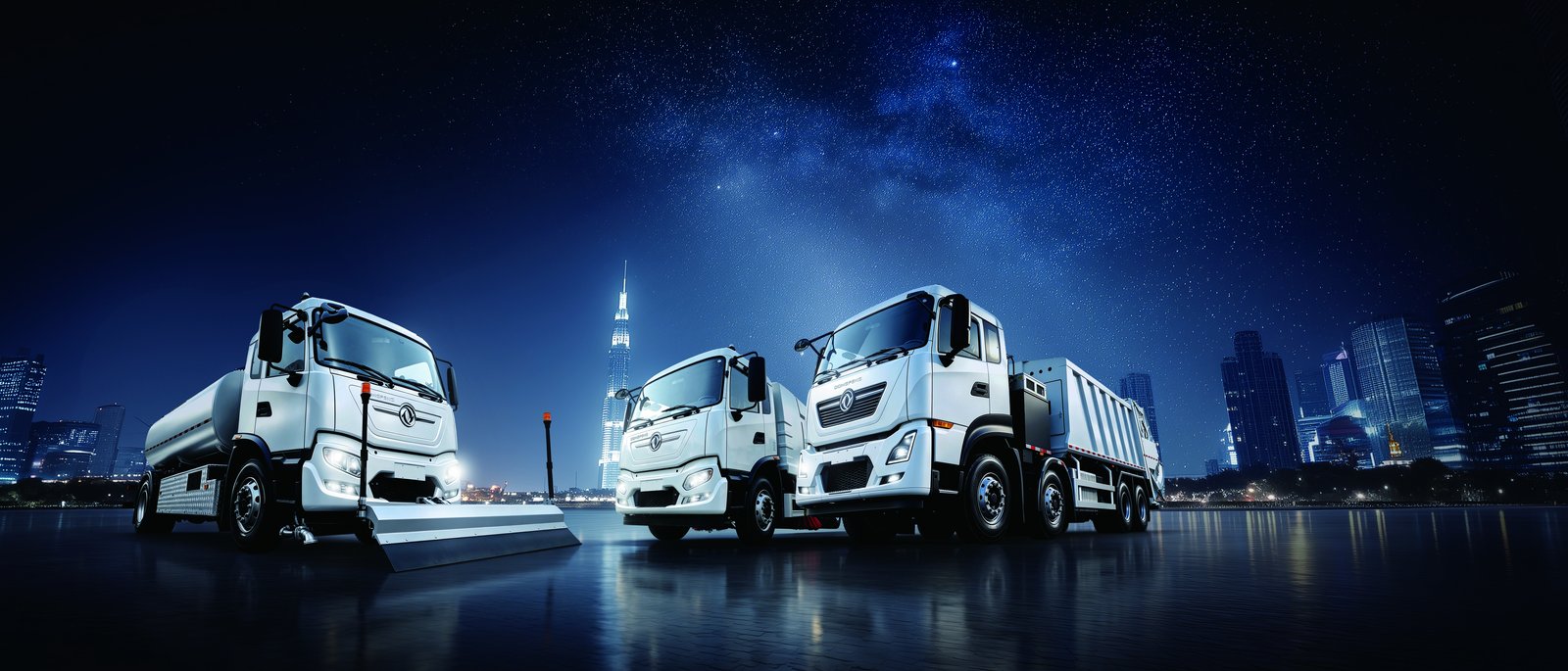
Every dry bulk terminal fights the same invisible battle. Coal, iron ore, mineral concentrates, clinker and grain all dust — when the shiploader drops a pour, when the stacker builds a pile, when the wind crosses an uncovered stockyard face — and the dust clouds drift over the terminal fence into the neighbourhood, the environmental regulator's monitoring station, and increasingly the news. Terminal dust management is simultaneously an environmental licence condition, an occupational-health obligation and a community-relations war, and its frontline weapon is prosaic: the water truck, circling the stockyard and conveyor corridors all day, every day. It is also one of the most wasteful diesel applications in freight — a sprinkler truck spends 70–80% of its fuel running a PTO pump at engine idle while crawling at 5 km/h, hour after hour. The Dongfeng KT3F electric sprinkler truck replaces that with a 15–25 kW electric pump on a CATL LFP pack, and this article covers the terminal case: the compliance stakes, the duty cycle, the solar-charging synergy and the fleet economics. For the market context, see our Tanzania electric truck market guide — East Africa's fast-growing dry bulk ports are where this duty is being electrified first in our portfolio.
| Stake | What the terminal risks | The water truck's role |
|---|---|---|
| Environmental licence | PM10 exceedances at the boundary monitor mean citations, licence conditions, or shutdown of specific berths | Continuous stockyard and haul-road watering is usually a named licence condition |
| Community relations | Dust on the neighbouring settlement drives complaints, politics and compensation claims | Visible watering rounds are the terminal's public evidence of effort |
| Occupational health | Coal and mineral dust exposure inside the fence | Suppression at transfer points and working faces |
| Cargo quality (grain) | Moisture and contamination control on food cargoes | Controlled, metered spraying — the electric pump's precision advantage |
What this table means commercially: the water truck fleet is not a cost centre that can be cut when times are lean — it is the licence to operate. Terminals therefore buy these trucks for reliability and compliance first, and an electric fleet that cuts the fuel line by 80% while improving spray precision is a licence manager's natural upgrade.
Every one of those features — fixed loops, terminal-owned power, all-shift pump duty, night and weekend alignment — is an electric-fleet feature. And the KT3F's pump precision matters in a way diesel never delivered: metered flow by spray mode means the right water volume on the right surface, no over-watering that turns haul roads into mud and no under-watering that shows up on the monitor.
Dry bulk terminals are ideal solar sites — large, unshaded roofs over warehouses and conveyor galleries, and land that often carries no better use than a ground array. The natural architecture:
Our dedicated analysis of solar-hybrid charging covers the engineering; the terminal case is its most natural home.
A worked model for a mid-size dry bulk terminal running 5 KT3F units on two-shift dust duty — 160 km/day average at watering speeds, 9 pump-hours/day, 340 days (terminals work ships continuously), electricity at USD 0.10/kWh, diesel at USD 1.10/L:
| Annual item (5 trucks) | Diesel fleet | KT3F electric fleet |
|---|---|---|
| Fuel / energy (drive + pump) | USD 185,000–230,000 | USD 22,000–28,000 |
| Maintenance | USD 44,000 | USD 16,500 |
| Charging infrastructure (annualised) | — | USD 10,000 |
| Total annual operating | USD 236,000 | USD 52,000 |
A USD 184,000 annual advantage on 5 trucks against an incremental capital cost of USD 160,000–210,000 — roughly a 13-month payback, with the 340-day terminal utilisation doing most of the work. And the compliance upside is worth restating: the electric fleet's spray precision and telemetry-logged coverage are the difference between arguing with a regulator and showing them the record.
Dust suppression is the unglamorous job that keeps dry bulk terminals licensed, and it is being electrified fast for the least glamorous reason: it is simply the cheapest way to do it. The terminal that runs its water trucks on solar-charged batteries pays a quarter of the diesel cost to keep the neighbourhood clean — and writes the single best paragraph in its annual environmental report while doing it.
There is a final argument for the electric water truck that terminal managers understand instantly: the annual environmental report. Every dry bulk terminal produces one — for the regulator, the community liaison committee, the insurer and increasingly the international customers whose own supply-chain standards are auditing their suppliers' ports. A diesel dust-suppression fleet appears in that report as a line item being managed; an electric fleet charged from the terminal's own solar appears as a paragraph being celebrated. One terminal customer summarised it best after their first year electric: the dust trucks used to be the part of the environmental file they defended, and now they are the part they lead with. In a business where the licence to operate is renegotiated annually with a community watching the fence line, that narrative position is worth more than the fuel savings — and the fuel savings alone paid for the fleet inside eighteen months.
The technology is proven, the economics clear, the solar synergy natural. The only question left for a terminal is whether its neighbours hear the electric trucks coming — and the honest answer is no, they do not.
Ready to electrify your fleet? Contact Shaanxi Fenghan Trading — authorized Dongfeng EV truck exporter. WhatsApp: +86 153 1943 1311 | Email: sales@fenghan-trade.com | dongfengevtrucks.com
🌐 Our Network: Fenghan Trade (SAGMOTO/SHACMAN Truck Export) · heavy duty trucks export China