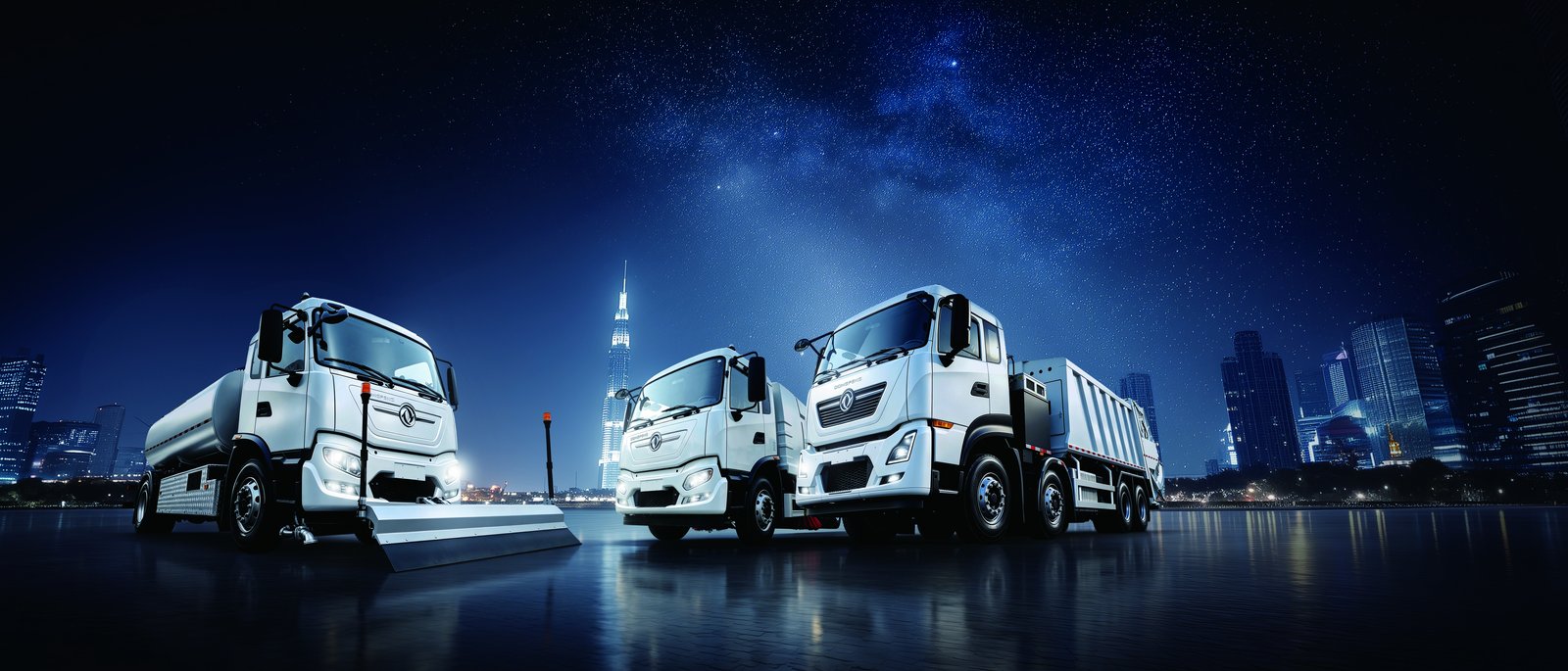
On a typical open-pit mine, the haul-road fleet burns a quiet fortune that never appears in the mine plan: water trucks. Dust suppression is a regulatory obligation, a safety system (visibility on haul roads is a fatality-prevention control) and a productivity input (dust-charged air filters and radiators shorten haul-truck engine life measurably). A mid-size mine runs 2–6 water trucks continuously — 12 to 20 hours a day of slow passes along the same haul loops, with the spray pump running nearly the whole time. As mines electrify their haul fleets, the water truck is usually the last vehicle anyone thinks about and the easiest one to convert. The Dongfeng KT3F — a 4x2 electric sprinkler truck at 18 t GVW with CATL 166 or 200 kWh LFP and an electric PTO pump — is the compact unit we deliver for haul-road duty, and this article builds the complete cost model for mine operators planning an electrified site.
Mine water trucks combine every diesel-unfriendly duty in one machine:
The result: a diesel water truck on haul-road duty burns 30–40 L of diesel per operating hour including PTO — a fuel bill of USD 25–35 per hour at typical mine diesel landed costs (blending pump price, haulage to site and storage). Over 3,500 annual hours, one diesel water truck burns USD 90,000–120,000 of fuel per year. That is the number mine planners repeatedly rediscover when they finally instrument the water fleet.
| Parameter | KT3F Specification |
|---|---|
| Configuration | 4x2 electric sprinkler truck |
| GVW | 18 t |
| Tank | ~10,000–12,000 L class, front spray cannon, rear banks, side nozzles |
| Battery | CATL LFP 166 or 200 kWh, liquid thermal management |
| Drive | Central motor, ~167 kW class |
| PTO | Electric spray pump with variable-rate control |
| Range (watering duty) | 150–200 km of passes per charge |
| Charging | Overnight depot; opportunity DC at the pit water station |
| Warranty | 8 years / 4,500 cycles (pack) |
| Indicative FOB | USD 60,000–85,000 |
Sizing guidance: the 166 kWh pack serves compact sites with short haul loops (under 8 km circuits); the 200 kWh pack covers long-haul-road mines with 10–20 km haul circuits and double-shift watering. Where a mine's dust programme demands heavy-pass frequency on long roads, the 6x4 KT7A with a larger tank joins the fleet — the KT3F is the manoeuvrable workhorse; the KT7A the corridor specialist.
Assumptions: 4 KT3F units, 3,200 operating hours each per year; watering passes averaging 15 km/h; mine power at USD 0.06–0.09/kWh; mine diesel landed cost at USD 0.85/L; one dual-gun 240 kW charger at the pit water station plus overnight charging at the maintenance depot:
| Annual cost per truck | Diesel water truck | KT3F |
|---|---|---|
| Fuel / energy (incl. PTO) | USD 82,000–107,000 | USD 9,000–13,500 |
| Engine, PTO, transmission maintenance | USD 9,000–12,000 | USD 2,000–2,800 |
| Annual saving per truck | — | USD 75,000–100,000 |
| 4-truck annual fleet saving | — | USD 300,000–400,000 |
| 8-year fleet saving | — | USD 2.4–3.2 million |
Read the top row again, because it is the whole story: a diesel water truck's annual energy bill is comparable to a KT3F's purchase price. Fleet conversion payback at these duty levels runs 12–18 months — the fastest heavy-truck electrification payback we model anywhere, faster than mining tippers, port tractors or any line-haul application. The infrastructure requirement is correspondingly small: one 240 kW dual-gun charger at the water station (USD 60,000–90,000 installed) covers the whole fleet's opportunity charging between passes.
Mines converting their tippers to electric — our TZ-series fleet deployments across Africa and Asia — gain a specific bonus when the water truck converts too: the charging infrastructure is shared. The pit-side 240–360 kW chargers specified for the dump-truck fleet serve the KT3F between watering passes with zero incremental infrastructure. In reverse, a mine starting its electrification with the water fleet builds the charging habit and technician competence on the least critical vehicle, then scales to haul trucks. Either sequencing works; the mistake is treating dust suppression as a diesel forever-thing while electrifying everything around it.
Pit water stations — where the trucks refill tanks — are already pumping stations with power supply. Adding a 200–500 kW solar array with battery buffering at the water station turns refill stops into solar charge stops: the truck draws water and kilowatt-hours at the same pause. In high-irradiance mining belts (Sahel, Andes, Australian outback equivalents, GCC-backed projects), this solar-hybrid pattern covers 40–60% of water-truck energy at a levelised cost near USD 0.03–0.04/kWh, and we size the array with the fleet order as a single engineering package.
Modern mine permitting reads dust control as an air-quality obligation with monitoring data; several of our mining clients now report the electric water fleet's kWh telemetry as part of their environmental compliance files — quantified energy displaced, CO2 avoided, and zero on-road emissions during suppression passes. As global miners' Scope 3 and site-ESG reporting tightens, the water fleet converts from a cost centre into an auditable sustainability data point. That a regulatory necessity also carries the fastest electrification payback of any heavy vehicle on site is one of the industry's better-kept secrets — and the KT3F is the unit that exploits it.
Progressive mines are moving beyond water-only dust control toward engineered suppressants — hygroscopic salts, polymer binders, lignosulfonate-type products — that hold haul-road surfaces for days rather than hours. The economics of suppressant programmes are dominated by precise application: too little and the road reverts between passes, too much and the product budget doubles. This is where the KT3F's variable-rate electric PTO earns a second dividend beyond energy cost: application rate control at the nozzle is exact and repeatable, independent of engine rpm (the Diesel truck's pump speed wanders with traction demand and gear selection). Mines running suppressant programmes with electric water trucks report 20-30% lower product consumption at equal dust-spec compliance — a saving that can exceed the energy saving in the total dust-control budget. The two technologies are, in effect, made for each other: chemistry that stretches watering intervals, applied by a truck that stretches the chemistry budget.
The pit water station is becoming the mine's quiet infrastructure hub. In the designs we now build with clients, one node combines:
One location, one electrical and plumbing infrastructure project, serving every function the dust-control fleet needs. Mines that build the node once discover that every subsequent electric vehicle — the next water truck, the light service fleet, eventually the haul trucks themselves — plugs into capability that already exists.
Mines asking us to specify the dust-control fleet get the same structured answer:
| Site profile | Fleet mix |
|---|---|
| Compact pit, haul circuits under 8 km, moderate watering frequency | 2-3 KT3F — manoeuvrability and capital efficiency dominate |
| Long haul roads (10-20 km circuits), heavy pass frequency | KT7A 6x4 corridor units + 1 KT3F for bench and tight-area work |
| Multi-pit operations with connecting public-road segments | Mixed fleet; road-legal configuration required for the connectors |
| Continuous double-shift watering on short circuits | KT3F with the 200 kWh pack and station charging between every pass cycle |
The dust-control fleet is the mine's lowest-risk electrification entry — smallest capital, fastest payback, shared infrastructure with every future electric vehicle. The mine that starts there is not experimenting; it is sequencing.
Ready to electrify your fleet? Contact Shaanxi Fenghan Trading — authorized Dongfeng EV truck exporter. WhatsApp: +86 153 1943 1311 | Email: sales@fenghan-trade.com | dongfengevtrucks.com
🌐 Our Network: Fenghan Trade (SAGMOTO/SHACMAN Truck Export) · heavy duty mining dump truck 6x4 8x4