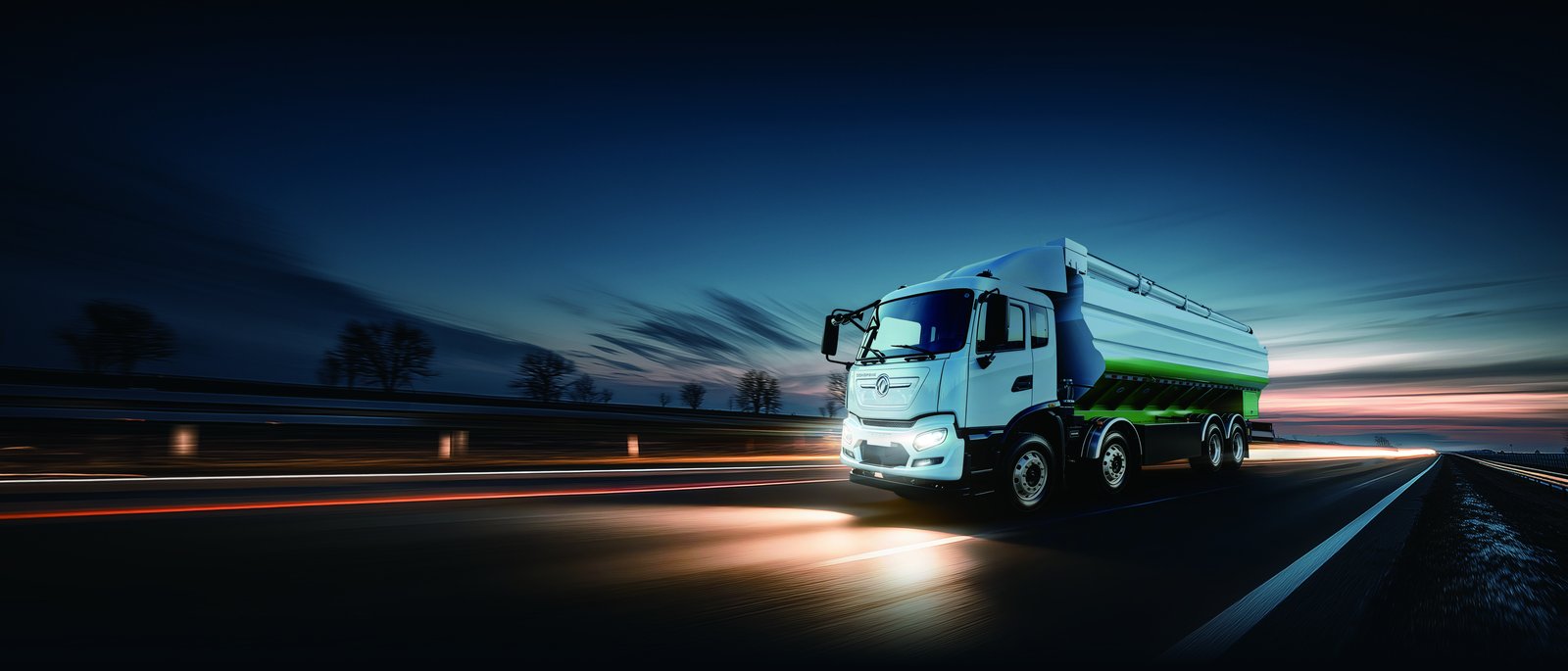
Nairobi County's push to modernize solid-waste collection has opened municipal tenders for low-emission collection vehicles that can operate quietly in dense estates. For contractors bidding those tenders, a battery-electric EV truck is now the strongest technical score on both emissions and noise. The Dongfeng KT3E electric garbage compactor carries a 140 kWh CATL LFP pack, a rear-loading compaction body holding 10 to 12 cubic meters, and is priced at USD 60,000 to 78,000 FOB China.
Waste collection runs early, often before 06:00, through residential areas where diesel rumble and exhaust draw complaints. An electric truck produces near-zero noise at idle and no tailpipe smoke, directly addressing the community-relations clause that Nairobi County writes into collection contracts. The stop-start nature of collection also plays to the electric drivetrain: every braking event between bins recharges the pack, and the compactor hydraulic pump runs off the traction battery rather than a separate engine.
| Parameter | KT3E Electric Garbage Truck |
|---|---|
| Battery capacity | 140 kWh CATL LFP |
| Chassis | 4x2 rear-loader |
| Compaction body | 10 to 12 cubic meters |
| Compaction ratio | up to 1:4 |
| Motor power | LvKong 200 kW peak |
| Route range | 150 to 200 km per charge |
| DC fast charge | 20 to 80 percent in 60 to 90 minutes |
| Battery warranty | 8 years / 4500 cycles |
| FOB China price | USD 60,000 to 78,000 |
The 140 kWh pack covers a full Nairobi collection route of 120 to 180 km, including the energy to run the compaction cycle 400 to 600 times per shift. A 1:4 compaction ratio means each 12 cubic meter body carries the equivalent of 48 cubic meters of loose waste, cutting the number of trips to the Dandora dumpsite.
A standard county route begins at the depot near Industrial Area, loops through Estate, Kilimani and Langata collection points, compacts at each stop, and ends at Dandora. The KT3E draws about 0.8 kWh per kilometer of driving plus 0.4 kWh per compaction cycle. Over a 160 km route with 500 cycles, total draw is near 128 kWh, leaving reserve in the 140 kWh pack for traffic delays on Langata Road.
A county contractor can install two 60 kW DC chargers at the depot for about USD 30,000 and charge the fleet on off-peak tariff at USD 0.11 per kWh. A full 140 kWh charge costs roughly USD 15, against USD 45 to 60 of diesel for an equivalent diesel compactor shift. Fleets already operating the Dongfeng KT3E electric garbage truck report the quiet operation alone improved their tender evaluation score on community impact.
Nairobi County tender documents typically weight emissions, noise, reliability and after-sales support. The KT3E's zero tailpipe emissions and sub-70 dB curb noise satisfy the environmental criterion, while the 8-year battery warranty and regional parts stock satisfy the durability criterion. The wider electric truck market in Kenya already supports Dongfeng chassis through established service channels, which strengthens the local-content and maintenance-plan sections of any bid.
A diesel compactor covering 160 km and 500 cycles per day burns about 38 liters at USD 1.20, equal to USD 46 in fuel, plus USD 18 of diesel for the compaction engine, totaling USD 64 daily. The KT3E draws 128 kWh at USD 0.11, equal to USD 14, saving USD 50 per day, plus USD 7,000 annual maintenance per truck. Over a 3-year contract that is USD 55,000 saved per vehicle, enough to offset the purchase premium and improve tender margin. Contact Shaanxi Fenghan Trading for a tender-ready specification sheet and reference deployments.
| Item | Specification |
|---|---|
| Battery | CATL LFP 262 kWh, swap-ready architecture |
| Traction motor | LvKong permanent-magnet motor, 250 kW peak |
| Real-world range | 240 km fully loaded, duty-cycle dependent |
| Charging | DC fast charge 20-80% in 45-90 min; battery swap in 5-6 min where stations exist |
| Battery warranty | 8 years or 4,500 cycles, 70% state-of-health guarantee |
| FOB price guide | $90,000-$115,000 depending on specification and options |
Charging an electric truck is a depot discipline, not a public-network gamble. A 262 kWh pack working a 240 km day typically returns with 25 to 35 percent in reserve, so overnight demand is about 157 kWh per truck. On a 120 kW DC charger the pack climbs from 20 to 80 percent in roughly 79 minutes; on 240 kW that falls to about 39 minutes, which lets two trucks share one charger on staggered shifts.
Size the site transformer for your busiest shift plus 30 percent headroom, keep cable runs under 30 metres to limit voltage drop, and meter each charger separately so energy cost per truck stays visible. In Kenya, grid connection lead times of three to nine months are common, so apply for the connection the day you sign the truck order, not the day the ship arrives. Shaanxi Fenghan Trading includes a charger layout drawing and load calculation with every EV truck quotation, so your electrician can price the civil works before the truck lands.
A comparable diesel garbage truck burns about 0.38 litres per kilometre in mixed duty; at $0.95 per litre that is roughly $0.36 per km. The electric equivalent consumes about 1.15 kWh per km fully loaded; at an industrial tariff of $0.10 per kWh the cost is near $0.12 per km, and overnight or solar-coupled charging can push it below $0.08. Over 70,000 km a year the saving is about $17,000 per truck, before any carbon or low-emission-zone benefit.
The gap widens in stop-start duty, where regenerative braking returns 15 to 25 percent of traction energy instead of burning it as brake dust. In Kenya, where diesel quality and price both fluctuate, locking in an electricity tariff also removes a major budgeting variable from the fleet P&L.
The KT3E has roughly one moving drivetrain part where a diesel has hundreds: no engine oil, no DPF, no turbocharger, no clutch, no multi-gear transmission service. Scheduled maintenance lands near $0.035 per km against $0.11 per km for a diesel equivalent, a saving of more than $5,000 a year at typical utilisation. Brake pads last two to three times longer because the motor does most of the deceleration.
Uptime matters more than parts cost. Fleet data from Chinese operators running the same e-axle platform shows 96 to 98 percent availability once drivers are trained, versus 92 to 94 percent for diesel trucks of the same age. Keep a small stock of filters, coolant, brake pads and 12V batteries on site; Shaanxi Fenghan Trading quotes a two-year consumables kit with every truck so the first service interval never waits on freight.
Ready to electrify your fleet? Contact Shaanxi Fenghan Trading — authorized Dongfeng EV truck exporter. WhatsApp: +86 153 1943 1311 | Email: sales@fenghan-trade.com | dongfengevtrucks.com
🌐 Our Network: Fenghan Trade (SAGMOTO/SHACMAN Truck Export) · SAGMOTO cargo truck flatbed box stake