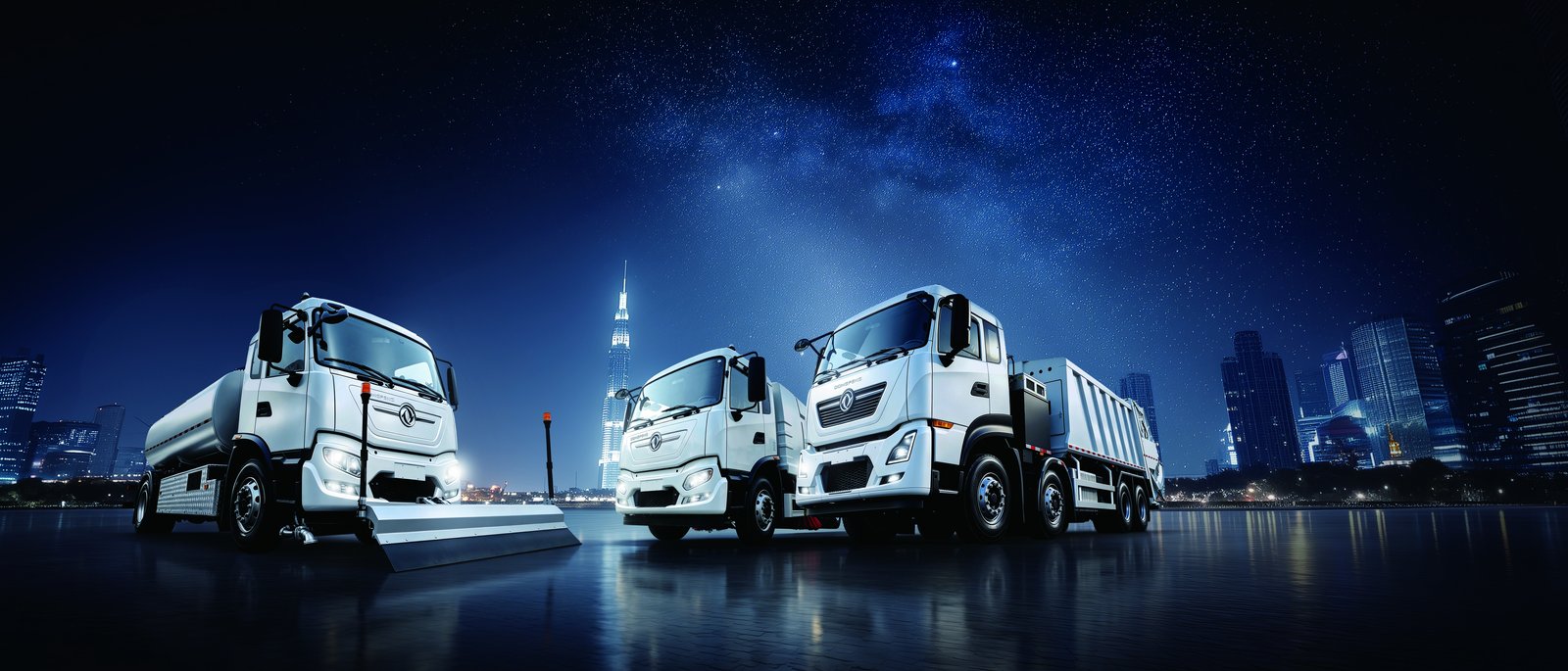
There is a quiet absurdity at the heart of diesel street sweeping: the machine sent out to remove pollution from the road spends its shift adding pollution to the air it is cleaning. A diesel sweeper working a kerbline crawls at 5–12 km/h with its engine at high idle to drive the suction fan and brush hydraulics — emitting PM2.5, NOx and noise within metres of pedestrians, cyclists and shopfronts, exactly where the city is trying to reduce them. The World Health Organization estimates 99% of the world's urban population breathes air exceeding its guideline limits, and road dust resuspension is among the largest contributors to PM10 in the developing-city air quality inventories we review. The Dongfeng KT3E electric road sweeper attacks both sides of that equation at once: its electric fan and brush drives make the sweeping itself radically more energy-efficient, and its zero-emission drivetrain means the cleaning machine stops being a pollution source. This article covers the air-quality case for electric sweeping, the KT3E's engineering, the operational economics, and how cities are beginning to specify sweepers as air-quality infrastructure. For the market context of one of the fastest-adopting sanitation-electrification regions, see our Philippines electric truck market guide.
In most developing-city PM10 inventories, road dust resuspension contributes 20–35% of ambient concentrations — more than industry in many cities, and second only to vehicles and construction. The mechanism matters for sweeper design: dust settles on the carriageway, and every passing vehicle re-suspends it in the breathing zone. Conventional mechanical sweepers agitate that dust with side brushes and pick it up through an open suction nozzle — but at diesel-fan speeds and with water spray as the only suppression, a meaningful fraction of the PM they disturb escapes capture and re-enters the air. The engineering answer is what the KT3E delivers:
The KT3E is Dongfeng's purpose-built electric sweeper: a 4x2 sanitation platform at 18,000 kg GVW with a CATL LFP battery pack in the 200 kWh class, LvKong electric drive for propulsion, and — the core of the machine — independent electric drives for the suction fan and each brush. Sweeping width runs up to about 3.2 m with dual side brushes, hopper capacity is sized for a full shift, and the cab is engineered for the 8-hour low-speed crawl with proper filtration for the operator. The specification that matters most to air quality is the fan control: stepless electric speed matching to load, which is why electric sweepers measurably out-perform diesel ones on pick-up efficiency at the same pass speed.
| Parameter | KT3E electric sweeper | Diesel sweeper |
|---|---|---|
| Energy per 8-hour shift | 70–95 kWh (USD 7–10) | 32–45 L (USD 37–52) |
| Noise at working speed | Low — electric fan and brushes, night-shift capable | High diesel idle — restricted hours |
| Fan control | Stepless electric, load-matched | Engine-rpm dependent |
| Local PM/NOx emissions | Zero | Continuous at street level |
| Water use (dry mode available) | Optional dry sweeping with filtration | 3–6 m³ per shift typical |
Consider a district running 10 sweepers over 200 km of arterial kerbline daily. The diesel fleet burns roughly 380 L of fuel a day in the pedestrian zone and re-suspends a fraction of what it collects. Converting to KT3E units eliminates the exhaust line entirely — about 1,000 tonnes of CO2 and, more relevantly for health-based policy, roughly 1.2–1.8 tonnes per year of street-level NOx and PM from the fleet's own exhaust. That matters because it stacks with the sweeping improvement: better fine-dust capture means less resuspended PM10 from all the other traffic. Cities that have electrified sweeping report the double dividend in exactly those terms — the fleet's contribution disappears while its capture efficiency rises.
Two policy instruments increasingly monetise this. Air-quality action plans under national clean-air programmes in India, the Philippines, Indonesia and much of Latin America now fund zero-emission municipal fleets directly. And CDM/Gold-Standard-style city air programmes, while hard to monetise at PM level, count the CO2 line cleanly — an electric sweeper fleet of 10 units avoids roughly 1,000 t CO2/year versus diesel, a creditable sustainability line in any municipal report.
Because the KT3E is quiet, cities can sweep at night. That single operational change transforms sweeping effectiveness: daytime sweeping works against full traffic, capturing a fraction of the surface load; night sweeping on empty arterials collects multiples of the debris per pass. Diesel sweepers are often restricted to early-morning windows by noise ordinances — the electric sweeper escapes the restriction, collects more dust per shift, and therefore removes more PM from tomorrow's resuspension cycle. The air-quality return compounds through operations, not just equipment.
At a FOB of roughly USD 82,000–98,000 and an eight-year life, the KT3E's operating savings versus a diesel sweeper — fuel minus electricity, halved brake and hydraulic service, and the avoided water cost in dry-mode cities — run USD 8,500–12,000 per truck-year. Capital recovery lands the pair close to parity by year two and decisively ahead by year four; beyond economics, the tender and public-health arguments are increasingly the deciding factor. Full duty-cycle economics are covered in our KT1D per-tonne analysis; the sweeper follows the same electric-sanitation logic at similar intensity.
Clean air policy is moving from paper to procurement, and the sweeper is the first municipal vehicle where the air-quality case and the cost case point the same direction. The cities that specify electric sweeping now are not buying a truck — they are buying a measurable line in their next air-quality report.
Ready to electrify your fleet? Contact Shaanxi Fenghan Trading — authorized Dongfeng EV truck exporter. WhatsApp: +86 153 1943 1311 | Email: sales@fenghan-trade.com | dongfengevtrucks.com
🌐 Our Network: Fenghan Trade (SAGMOTO/SHACMAN Truck Export) · SAGMOTO heavy duty diesel trucks