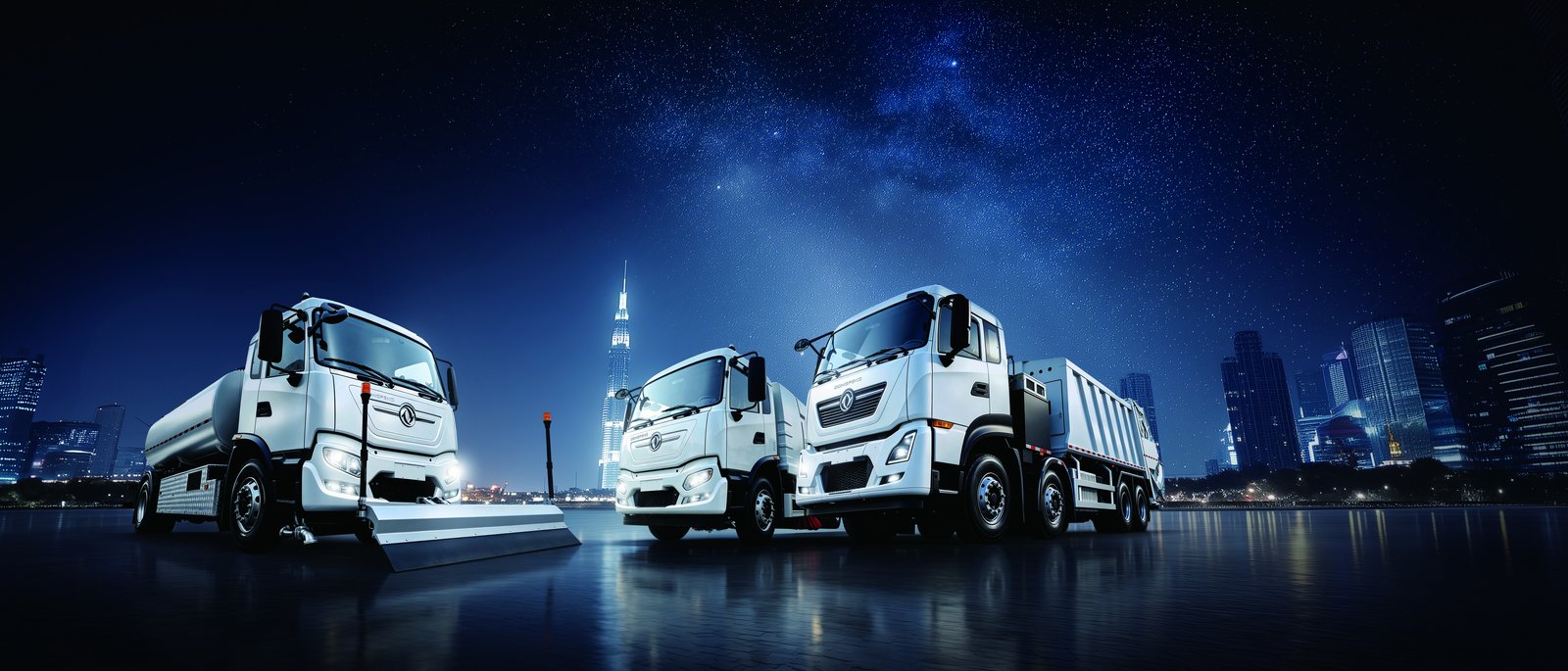
The KT3E electric truck is a rear-loading refuse collector built for Hanoi's dense urban collection rounds, where hundreds of stops per shift, constant low-speed running, and politically sensitive noise and air quality make diesel compaction an expensive contradiction. Vietnam's capital is tightening environmental standards while its waste volumes grow with the economy, and an EV truck that collects silently at night answers both pressures. This review covers the KT3E's compactor specs, range, charging plan, and tender guidance for Vietnamese operators.
Refuse collection is stop-start work at walking pace, the single best duty cycle for regenerative braking, and the worst possible use of a diesel engine, which idles and smokes its way through the round. Hanoi's narrow residential streets and night collection windows amplify the noise advantage: the KT3E works at a fraction of a diesel's noise level, which cuts complaints and lets districts extend collection hours. For full specs, see the KT3E electric garbage truck page.
Vietnam's EV incentives extend to municipal equipment, and Hanoi has piloted electric public-service vehicles. Our Vietnam electric truck market guide covers the import pathway and the procurement structures districts use.
The table lists production data for the standard rear-loader from Shaanxi Fenghan Trading Co., Ltd.
| Parameter | KT3E Value | Note |
|---|---|---|
| Compactor body | 14 cubic meters | rear loader |
| Payload | 8,000 kg | packed refuse |
| Battery capacity | 350 kWh | CATL LFP |
| Motor power | 360 kW | LvKong drive |
| Compaction ratio | up to 4 to 1 | fewer tip runs |
| Range per charge | 200 to 240 km | loaded collection round |
| DC fast charge | 240 kW | 20 to 80 percent in 90 min |
| FOB price | $95,000 to $130,000 | depending on body |
The KT3E's 14 cubic meter compactor with a 4-to-1 ratio halves the tip runs a district round requires, which directly cuts the kilometers and energy per tonne collected. The electric PTO drives the compactor hydraulics without a second engine, so the whole body works silently at the kerb, and crews report lower fatigue on night rounds because there is no diesel vibration or exhaust at the loading position.
The bin lift services 120, 240, and 1,100 liter containers, covering Hanoi's mixed residential and commercial stock without modification, and the smooth electric torque reduces spillage on the district's steep alley ramps.
A loaded Hanoi collection round returns 200 to 240 kilometers per charge, comfortably covering a district loop with margin, and the 350 kWh pack recharges from 20 to 80 percent in about 90 minutes on a 240 kW depot charger. Because the trucks return to the depot every shift, overnight charging alone covers daily operation, with fast charging reserved for double-shift peaks during holiday waste surges.
Vietnamese municipal tenders should specify body volume, compaction ratio, noise limit, and battery warranty, all areas where the KT3E is strong: the 8-year or 4,500-cycle pack warranty and the near-silent electric PTO satisfy the livability clauses districts now write into collection contracts. On lifecycle cost the KT3E runs roughly 55 to 60 percent cheaper per shift than a diesel compactor once energy and maintenance are included, and evaluation committees should score that gap explicitly.
Shaanxi Fenghan Trading Co., Ltd. supports bidders with datasheets, conformity certificates, and a first-year parts kit including compactor pins, seals, and lift components pre-positioned in the region.
Start with the Vietnam market guide for the procurement pathway, then confirm body options on the KT3E electric garbage truck page. For Hanoi's districts, the KT3E electric truck delivers cleaner air and quieter nights on the same budget line.
The KT3E electric truck is delivered with a high-voltage isolation monitor, automatic battery pack disconnect on collision, and the multi-layer thermal barrier built into every CATL LFP pack, a chemistry chosen for its stability in hot, dusty, high-utilization duty. Shaanxi Fenghan Trading Co., Ltd. includes a structured operator course with every fleet order, covering regenerative braking technique, state-of-charge planning, charging procedure, and high-voltage shutdown. Fleets that complete the training typically improve real-world range by 6 to 10 percent within the first month, because smooth throttle application and anticipatory regen recover energy that untrained drivers waste as heat. The course also covers daily inspection of tires, coolant, and charging connectors, which catches small faults before they become downtime.
Compliance documentation travels with the truck. Conformity certificates, battery warranty terms of 8 years or 4,500 cycles, and the telematics export of energy and emissions data give fleet managers the evidence base that tenders, insurers, and sustainability auditors increasingly require. For export buyers, that documentation package is as much a part of the product as the steel and the cells.
The battery warranty is the foundation of the ownership case: 8 years or 4,500 cycles on the CATL LFP pack, transferable to a second owner, which means the truck can be sold or refinanced mid-life with a factory guarantee still running. No diesel powertrain offers anything comparable, and that difference shows up in residual value, where documented, warranted electric trucks are clearing stronger percentages of original price than worn diesel equivalents. Fleets that keep disciplined charging habits, staying between 20 and 90 percent state of charge in daily operation, routinely show 85 to 90 percent pack capacity after five years, and the telematics health report converts that directly into resale price.
Maintenance economics reinforce the point. The sealed LvKong motor has roughly one-third the moving parts of a diesel powertrain, with no oil, injectors, turbocharger, clutch, or exhaust aftertreatment to service, and regenerative braking cuts friction brake wear by an estimated 40 percent. The parts that remain are conventional wear items, tires, suspension bushings, filters, and body-specific consumables, all pre-stocked in the Fenghan regional parts buffer for the first year of operation.
From order confirmation to delivery, most export market buyers take delivery in 45 to 60 days, with Shaanxi Fenghan Trading Co., Ltd. preparing the certification file, the drive configuration, and a first-year spare parts kit in parallel so the truck arrives work-ready. The recommended first step is a route and duty-cycle review: share your daily kilometers, payloads, shift pattern, and depot power capacity, and the team will model range, charging windows, and total cost against your actual operation rather than brochure numbers. That model becomes the backbone of the financing conversation, because banks and lessors lend against documented operating savings far more readily than against projections.
Fleets new to electric trucks should start with two to five units on the most predictable route, instrument everything, and scale after the first quarter of data. Every fleet that has followed that path has expanded its electric share in the second order, because the operating numbers made the argument internally without any further persuasion. Contact the Fenghan export team to begin the route review for your operation.
Ready to electrify your fleet? Contact Shaanxi Fenghan Trading — authorized Dongfeng EV truck exporter. WhatsApp: +86 153 1943 1311 | Email: sales@fenghan-trade.com | dongfengevtrucks.com
🌐 Our Network: Fenghan Trade (SAGMOTO/SHACMAN Truck Export) · SAGMOTO heavy duty diesel trucks