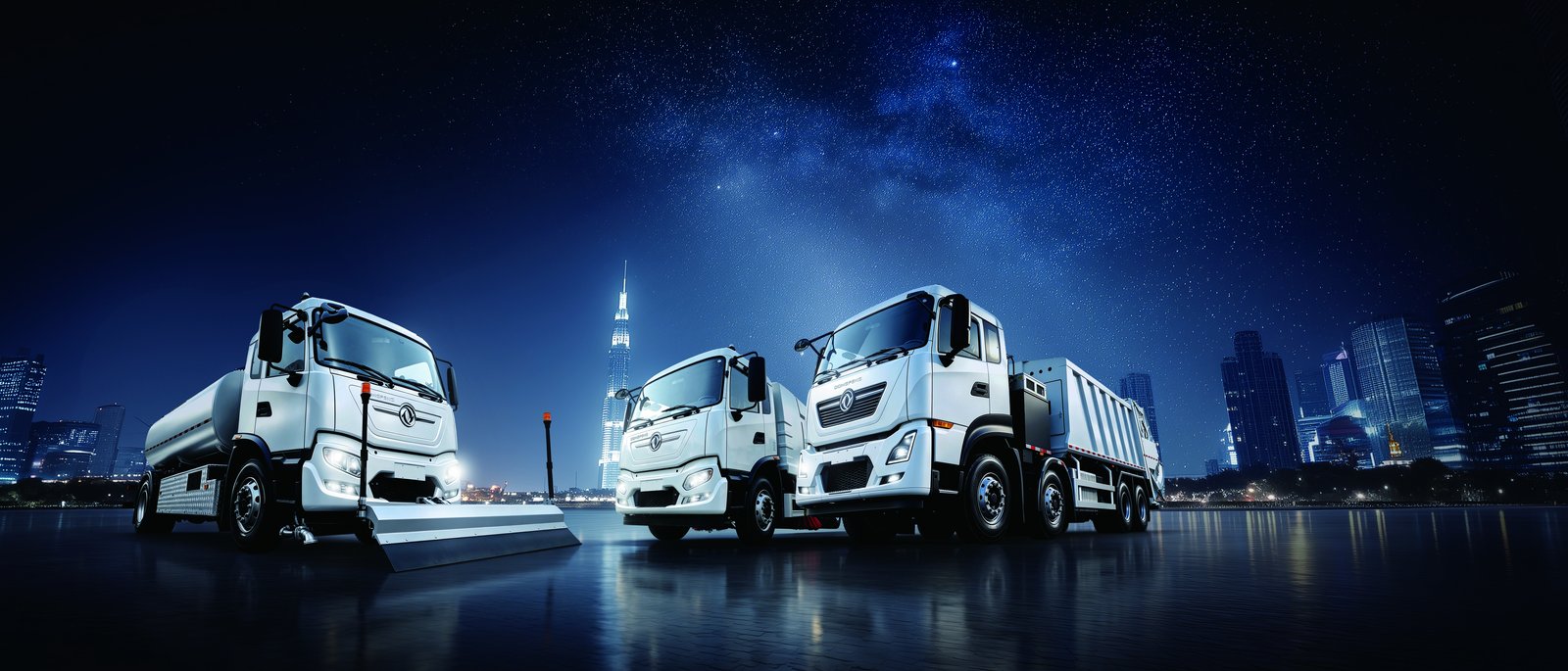
Waste management is the one trucking business where the invoice is written per tonne. Concession contracts, municipal budgets and PPP waste deals all price the service in currency per tonne collected and delivered — which means every procurement decision eventually converts into one number: the operator's cost per tonne. That makes refuse collection the most honest arena for an electric truck to prove itself, because there is nowhere to hide a bad TCO. In this article we run the full per-tonne analysis for the Dongfeng KT1D electric garbage truck — the 4x2 rear-loading compactor on a CATL LFP pack — against its diesel equivalent across three representative developing-city duty profiles. The short version: on dense urban routes the KT1D lands at USD 11–16 per tonne of collected waste including capital recovery, where a diesel compactor lands at USD 19–27 — and the gap is structural, not promotional. For the wider East African municipal market context, see our Kenya electric truck market guide, where several sanitation concessions are being re-tendered on exactly these numbers.
Four features of waste collection make it uniquely electric-friendly, and they compound:
We model three city archetypes from our export deployments:
| Profile | Dense core | Mixed metro | Peri-urban spread |
|---|---|---|---|
| Route distance / day | 28 km | 38 km | 52 km |
| Bin lifts / day | 820 | 610 | 420 |
| Waste collected / day | 7.5–9 t | 8.5–10.5 t | 7–8.5 t |
| KT1D energy / day | 95–115 kWh | 110–130 kWh | 125–150 kWh |
| Diesel equivalent / day | 48–58 L | 50–62 L | 55–68 L |
The KT1D's 200 kWh-class pack covers even the peri-urban profile with margin, charging overnight on a 60 kW unit in under three hours. The diesel's fuel line is dominated not by distance but by hours — the compactor and lift duty at high idle is where 55–65 L/day goes.
Using the mixed-metro profile, a 300-day operating year, diesel at USD 1.15/L and depot electricity at USD 0.10/kWh, here is the full cost stack per tonne for a 20-truck fleet with an eight-year capital horizon:
| Cost line (per tonne) | Diesel compactor | KT1D electric |
|---|---|---|
| Fuel / energy | USD 6.30 | USD 1.35 |
| Maintenance & consumables | USD 3.80 | USD 1.60 |
| Driver & crew | USD 5.20 | USD 5.20 |
| Capital recovery (8-year) | USD 3.60 | USD 6.40 |
| Charging infrastructure | — | USD 0.45 |
| Total per tonne | USD 18.90 | USD 15.00 |
A 20–26% per-tonne cost advantage. In a competitive waste concession that margin is the whole game: an operator bidding USD 21/tonne against a competitor's USD 23/tonne wins the tender while retaining a better return than the diesel operator achieves at the higher price. And the advantage widens with diesel price — at West African fuel prices (USD 1.35–1.50/L), the gap stretches past 30%.
Three cost lines routinely omitted from tender models that further favour the KT1D:
The KT1D is a purpose-built electric sanitation platform, not a converted diesel: 4x2 rigid at 18,000 kg GVW, CATL LFP battery in the 200 kWh class, LvKong electric drive, and a rear-loading compactor body rated for 10–12 m³ with electric-PTO hydraulics. Continuous compaction pressure and cycle time are tuned for high-density urban waste. The 8-year / 4,500-cycle CATL warranty on the pack covers the full municipal amortisation horizon — meaning battery replacement risk, the line every municipal treasurer worries about, is contractually bounded.
Most of our municipal and PPP customers fund the first KT1D batch through one of three structures: direct municipal capital budget with an 8-year amortisation matching the warranty; a concession operator capex line repaid from per-tonne revenue; or increasingly a green municipal credit line from development banks, for which electric waste fleets qualify comfortably. In each structure the same per-tonne table above drives the credit case: the savings line services the capital line. A phased rollout — 10–20% of the fleet in year one, the balance as diesel units age out — keeps capital within annual budget envelopes and lets driver training and depot charging scale with experience.
Where the KT1D is not yet the right answer: transfer-station haulage beyond 80 km each way (buy a TE-class electric tractor instead); cities with no reliable overnight depot power (add solar-buffer charging, but check first); and compaction duty above 12 m³ per body (spec the heavier KTA1-based compactor). Within its design envelope — dense and mixed urban collection — the per-tonne arithmetic is decisive, which is why waste concessions are where electrification is spreading fastest in our municipal portfolio.
Procurement officers in cities from Nairobi to Cebu are re-running their concession models on exactly this math. The operators who run it first get the tender; the ones who wait get to bid against it.
Every waste-market operator already holds most of the inputs this model needs, scattered across systems that do not talk to each other: route logs from the tracking system, fuel card data from finance, tonnage from the transfer-station weighbridge, maintenance invoices from the workshop. The per-tonne analysis begins with nothing more exotic than putting those four datasets on one spreadsheet for one quarter and dividing honestly. The operators who run it for the first time reliably discover three things: their fuel per tonne is worse than they assumed (congestion and idle), their payload factor is worse than they assumed (partial loads on far routes), and the two worst routes concentrate an outsized share of both — and those routes are usually the first ones the KT1D's energy arithmetic rescues. The electric decision is often made in that spreadsheet before anyone ever drives a truck.
The tonne is the industry's honest unit. Price your next fleet decision in it, and the technology chooses itself.
Ready to electrify your fleet? Contact Shaanxi Fenghan Trading — authorized Dongfeng EV truck exporter. WhatsApp: +86 153 1943 1311 | Email: sales@fenghan-trade.com | dongfengevtrucks.com
🌐 Our Network: Fenghan Trade (SAGMOTO/SHACMAN Truck Export) · heavy duty trucks export China