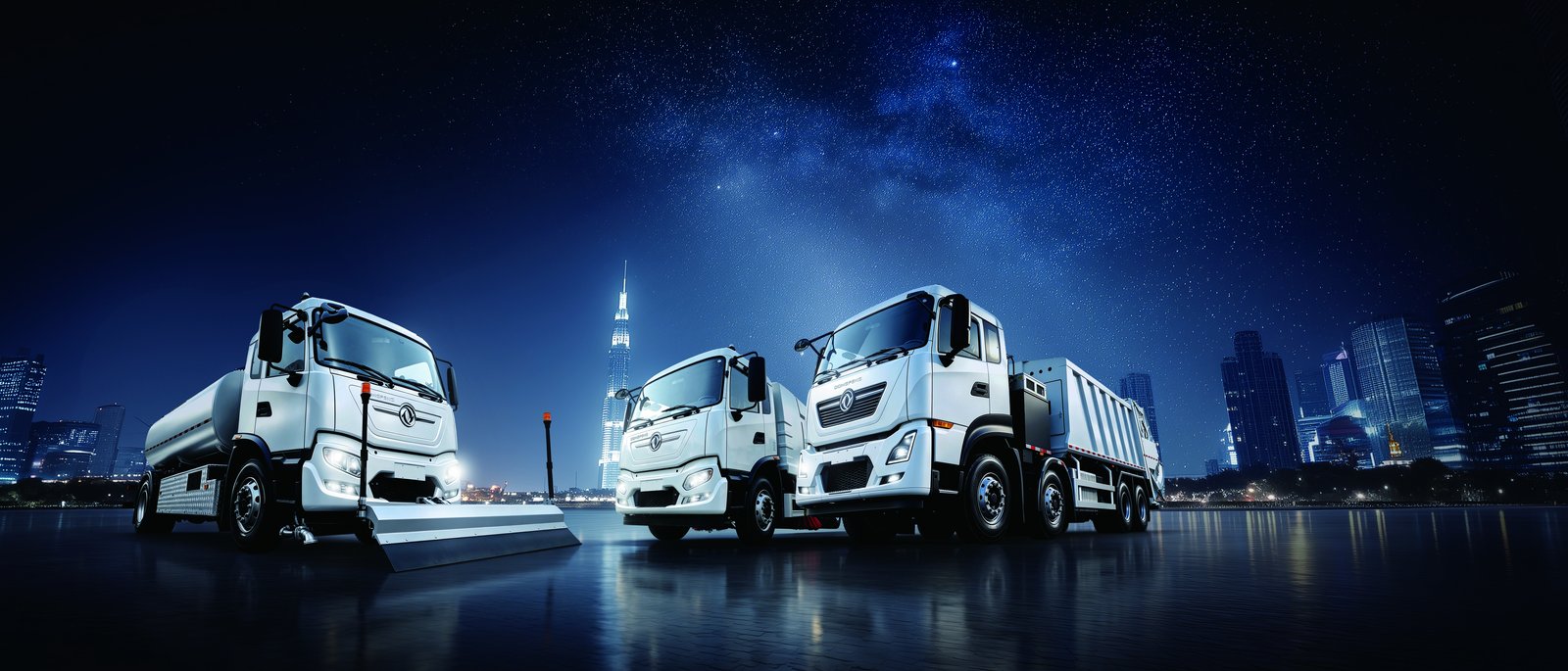
Waste collection is the most brutal duty cycle in municipal fleet operations — and, paradoxically, one of the easiest to electrify. A refuse truck averages just 25–40 km per shift, but its engine runs 6–8 hours a day to power the compactor, lift bins and crawl between stops at walking pace. In diesel form that means fuel burned at idle for 70% of engine hours. The Dongfeng KT1D electric garbage truck attacks exactly this inefficiency: a CATL LFP battery powers both the driveline and the compaction body, eliminating the diesel engine that spends most of its life doing nothing but polluting a residential street. This deep dive covers the KT1D's specification, its real duty-cycle behaviour, the economics that make it one of the fastest-payback EV truck types we export, and the questions municipal buyers should ask before committing.
The KT1D sits in the Dongfeng new-energy sanitation family alongside the KT3F and KT7A sprinklers and the KT3E sweeper, sharing the same electrified chassis philosophy: a proven diesel-range cab and running gear, a CATL lithium-iron-phosphate pack in the frame, and an electric power take-off (e-PTO) architecture that replaces the hydraulic pump drive of a diesel compactor.
| Specification | Dongfeng KT1D | Diesel equivalent |
|---|---|---|
| Configuration | 4x2 rigid, rear-loader compactor body | 4x2 rigid, 6-cylinder diesel |
| GVW | 18,000 kg | 18,000 kg |
| Battery | CATL LFP, 200 kWh (optional 232 kWh) | — |
| Drive motor | LvKong PMSM, 282 kW peak | ~220 kW diesel engine |
| Compactor body | 14–18 m³ rear loader, e-PTO driven | Hydraulic PTO from engine |
| Shift range | 180–220 km (loaded cycle) | n/a |
| Charging | CCS2 DC 120–240 kW, 1–1.5 h opportunity charge | — |
| Battery warranty | 8 years / 4,500 cycles to 70% SoH | Typical 2-year engine warranty |
| FOB price band | USD 95,000–125,000 | USD 65,000–80,000 |
When fleet managers first hear "electric garbage truck," the reaction is usually scepticism: surely a compactor crushing a tonne of waste per stop needs enormous energy? The data says otherwise. Over a typical 350-stop residential shift, the KT1D consumes energy in three streams, and none of them is dominant:
Total shift consumption lands around 130–170 kWh against the 200 kWh pack, which is why the KT1D comfortably completes a full residential route with 15–25% state of charge in reserve. The optional 232 kWh pack is for cities with longer trunk hauls to transfer stations — at 55–60 km/h a loaded KT1D draws 95–115 kWh/100 km, so a route that ends 30 km from the depot still finishes the day inside the usable window.
The compactor is where the KT1D genuinely outperforms its diesel predecessor rather than merely matching it. A diesel PTO drives the pack hydraulics at fixed engine speed — typically 1,200–1,500 rpm — regardless of whether the stroke needs full flow. The KT1D's electric PTO delivers flow on demand: the system can run a slow, quiet compaction stroke at a nursing-home stop at 6 a.m. and full-pressure strokes on a commercial route in the same shift, with energy drawn proportional to the work done.
Operators report three practical consequences. First, noise: at 68–72 dB(A) at 7 m, an electric compactor can legally work routes and hours where diesel trucks are restricted — pre-6 a.m. collections that shorten the working day, and collection in hospital and school zones. Second, consistency: pack pressure does not sag when the driver lifts off the throttle, so compaction ratios stay at the rated 3:1 to 4:1 (roughly 6–8 tonnes of loose domestic waste per 14–18 m³ body). Third, maintenance: no engine-driven PTO clutch, no hydraulic pump timed to engine hours, and roughly 40% fewer hydraulic service events in the first two years of operation in the fleets we have supplied.
Municipal buyers rightly interrogate battery longevity, because a garbage truck works every working day of the year. The KT1D's CATL LFP pack is rated at 4,500 full-equivalent cycles to 70% state of health. A one-cycle-per-working-day duty profile — one full charge per shift, 300 shifts a year — consumes 300 cycles annually. Even at 350 shifts, the pack reaches the 4,500-cycle threshold in year 13; in practice, LFP degradation is not linear, and packs typically sit at 82–88% SoH after eight years of municipal duty. That is why CATL and Dongfeng can offer the 8-year/4,500-cycle warranty on this application: the chemistry has headroom.
Thermal management is liquid-cooled on the KT1D, and this matters more for a garbage truck than for any other EV truck type, because compactor duty generates chassis heat and the truck often parks in enclosed depots. The pack maintains 15–35 °C cell temperature across ambient conditions from −20 °C to +45 °C, and charging is derated automatically outside that window. For Gulf and Sahel cities we specify the higher-specification cooling map, which has performed without pack replacements in 50 °C ambient trials on the sister KT7A sprinkler platform.
The purchase premium over a diesel compactor is real — USD 25,000–45,000 depending on body specification — but the daily cost gap runs the other way with unusual force, because refuse duty is the worst-case diesel profile.
| Cost line (annual, 300 shifts) | KT1D electric | Diesel compactor |
|---|---|---|
| Fuel / energy | ~USD 4,600 (48,000 kWh @ ~USD 0.10) | ~USD 21,000 (14,000 L @ USD 1.50) |
| Maintenance & parts | ~USD 3,200 | ~USD 7,500 |
| AdBlue, filters, exhaust service | — | ~USD 1,800 |
| Annual operating advantage | ≈ USD 22,500 in favour of the KT1D | |
Against a USD 30,000 average premium, simple payback arrives inside 18 months; over an eight-year life the KT1D returns roughly USD 150,000–180,000 per truck against its diesel equivalent, before counting any green-tender scoring value. Municipal contracts in Europe, the GCC and increasingly Latin America now award points for zero-emission collection fleets — several of our clients have won contracts specifically because a diesel bid scored zero on the emissions criterion.
We export the KT1D with three body families: a 14–16 m³ standard rear loader with 240 L bin lift for residential duty; an 18 m³ high-compaction body for dense urban cores; and a side-loader variant with automated arm for single-operator suburban routes. Chassis-mounted options include a 6 m³ to 10 m³ split-body for source-separated recycling, onboard weighing (accurate to ±2 kg, valuable for pay-as-you-throw billing), and a washdown system powered from the traction battery. Right-hand-drive is available from the factory — critical for municipalities in East and Southern Africa, Southeast Asia and Oceania.
Export logistics follow the standard Dongfeng EV truck path: UN 38.3 test summary, IMDG-compliant battery declaration, state-of-charge set to 30–40% for sea freight, and pre-shipment inspection at the body-builder's yard so the compactor mechanism is verified before shipping. Delivery lead time is typically 60–90 days including body build, and we ship KT1Ds either as completed units on RORO or in containers for markets with port-draught constraints.
Every KT1D we export ships with a structured commissioning programme, because the first quarter of operation decides whether a fleet's electrification story succeeds. The handover covers four blocks: HV safety familiarisation for drivers and yard staff, compactor operation on the electric PTO (the control differences from diesel PTO units take most operators two shifts to internalise), the daily vehicle check with its battery-specific items, and the depot charging routine including plug discipline and pre-conditioning in cold months. We also leave a commissioning engineer's checklist with the fleet supervisor and review the first month of telemetry together — kWh per shift, pack temperature behaviour, and any fault codes — so that anomalies are caught while they are still warranty conversations rather than downtime events. Fleets that run this disciplined first-90-days programme consistently report the smoothest transitions; the few operators who skip training and discover the compactor's economy mode three months late are always the ones who complain the electric truck 'feels different'. It is different — measurably cheaper, quieter and cleaner — and the difference is exactly what the programme teaches.
Ready to electrify your fleet? Contact Shaanxi Fenghan Trading — authorized Dongfeng EV truck exporter. WhatsApp: +86 153 1943 1311 | Email: sales@fenghan-trade.com | dongfengevtrucks.com
🌐 Our Network: Fenghan Trade (SAGMOTO/SHACMAN Truck Export) · SAGMOTO heavy duty diesel trucks