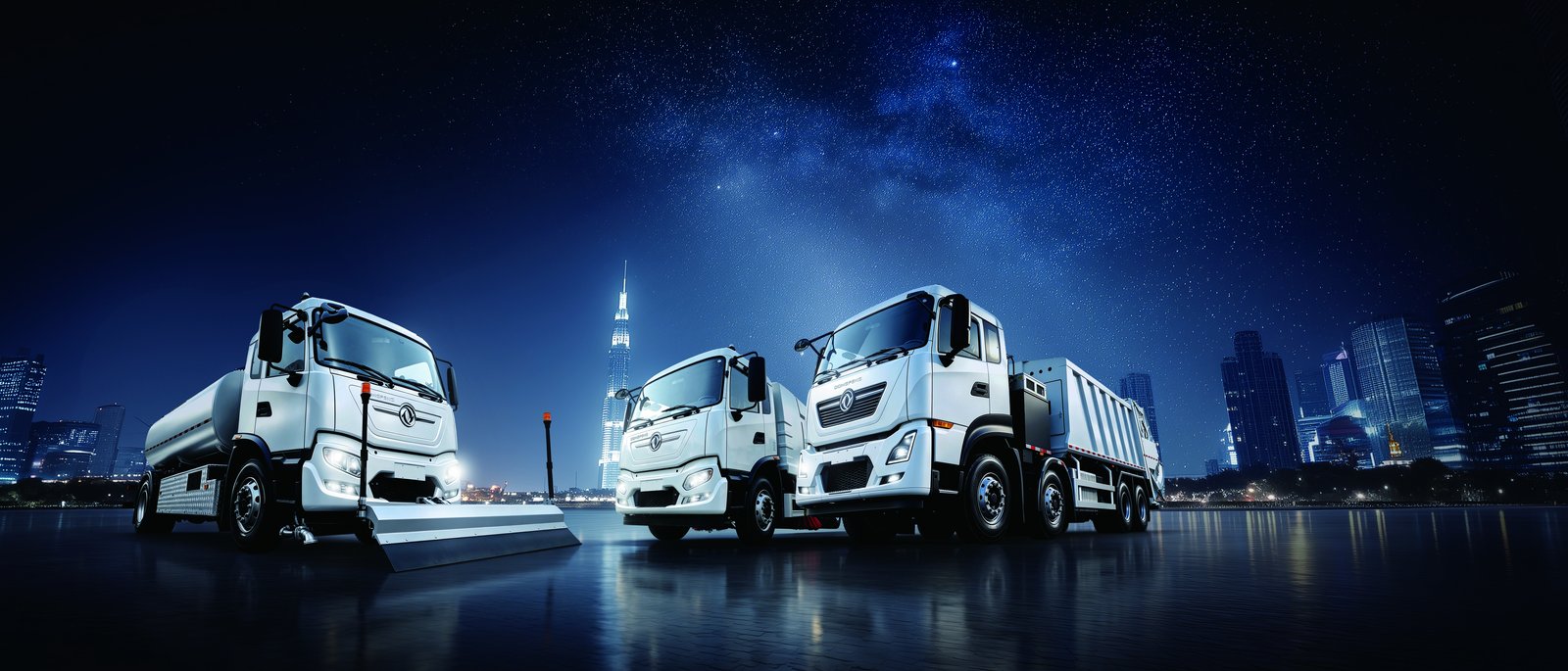
Dhaka is one of the most demanding waste-collection environments on earth: more than 20 million people in the metro area generating thousands of tonnes of household waste daily, collected through dense traffic by fleets of compactor trucks that idle at every holding point, crawl through lanes a truck barely fits, and work in air that the world's air-quality indexes treat as a permanent emergency. For this duty, an EV truck is not a luxury statement — it is the only configuration that removes both the fuel cost of stop-start compactor work and the curbside emissions of a diesel engine running six hours a day beside the residents it serves. The KT1D electric garbage truck was built for exactly this city shape. This article covers the machine, the economics, and the municipal procurement pattern for Dhaka and the wider Bangladesh market covered in our Bangladesh guide.
A Dhaka City compactor route runs 40–70 km of collection per shift, but the truck spends 60–70% of its shift stationary or crawling: at community waste bins, at secondary transfer points, in traffic that moves at walking pace. Diesel economics on this profile are ruinous — 25–35 L/100 km effective driving consumption plus 3–4 L/h of compactor-and-idle burn — and the health cost lands on the collection crews who stand beside a running diesel engine all shift. The KT1D's answer is architectural: a CATL LFP pack (~100–160 kWh class) feeding both the traction motor and the electric compactor body, zero idle burn at the bin points, and full torque for the loaded climbs out of Dhaka's low-lying wards. A full shift of Dhaka collection duty fits comfortably within the pack's 150–200 km real-world envelope, with overnight charging at the ward depot.
| Monthly cost line (per truck, 26 shifts) | Diesel compactor | KT1D electric |
|---|---|---|
| Fuel / energy | USD 900–1,100 | USD 180–260 |
| Engine + compactor hydraulics service | USD 150–220 | USD 25–40 |
| Overhaul reserve | USD 140–180 | 0 |
| Monthly total | USD 1,190–1,500 | USD 205–300 |
Against KT1D FOB pricing in the USD 55,000–80,000 range (body configuration dependent), the operating differential of roughly USD 1,000–1,200 per truck per month clears the electric premium in 24–30 months for a city authority — and faster for private waste concessionaires running two shifts. Bangladesh's diesel price has been on a managed upward path for years with periodic adjustments; each step widens the case. The 8-year cell warranty matters doubly in municipal service, where asset horizons are long and budget cycles punishing.
Municipal waste depots are structurally good charging hosts: fenced yards, trucks home by mid-afternoon, and a 200–400 kVA connection covering eight to twelve trucks on AC stalls with one DC unit for the runners. Bangladesh's grid in urban Dhaka is equal to the load; where reliability is a concern, the solar-plus-buffer pattern used by our municipal customers elsewhere — a 200–300 kWh second-life battery smoothing the peaks and bridging outages — costs a fraction of what it saves in route continuity. Collection is a service the city cannot suspend, so resilience is not an upgrade; it is the design.
Bangladesh municipal procurement runs through city-corporation tenders and, at scale, through government-to-government or development-bank-financed programmes — and this is where electric waste fleets find their financing: Dhaka's air-quality crisis has made clean municipal fleets a named category in urban-development lending, and electrified waste collection scores precisely the ESG boxes those programmes weigh. Private concessionaires and zone operators can move faster on straight commercial terms. Import runs through Chattogram port, 22–30 days from China, LHD matching local convention; Bangladesh's import duty treatment of EVs continues to evolve in the EVs' favour at the national-policy level, and the current tariff position on electric commercial vehicles should be confirmed with a C&F agent at tender stage. Fenghan supplies the full technical dossier in English plus conformity documentation, and supports tender bids with lifecycle-cost models in the format municipal evaluation committees expect — because in public procurement, the model on paper is half the battle.
There is one more reason Dhaka specifically is the right city for this truck: waste collection is the most visible municipal service that exists. Every resident sees the truck, every morning, at close range. A diesel compactor communicates the city's problems at 60 decibels and a plume of exhaust; an electric one communicates its solutions silently. Cities that have electrified collection fleets — from Shenzhen to Santiago — consistently report the same intangible return: the fleet becomes the most photographed proof of the city's modernisation. For a metro fighting an air-quality emergency on the world's stage, the KT1D is not just a cost decision; it is a statement with a warranty. We prepare ward-level fleet models and tender documentation for Bangladesh municipal and private-sector buyers on request.
Dhaka's waste tenders — whether the city corporations' own procurement or the development-bank programmes that finance fleet modernisation — score price, but they score it in the way that matters: lifecycle, not sticker. This is the KT1D's structural advantage in Bangladeshi municipal bidding, and it deserves its own arithmetic. A diesel compactor at USD 55,000 FOB and the KT1D at USD 68,000 differ by USD 13,000 at acquisition. The operating ledger then moves USD 1,000–1,200 per truck per month in the electric truck's favour at Dhaka fuel prices and duty cycles. Over an eight-year municipal service life, the electric truck's total cost of ownership runs USD 80,000–100,000 below the diesel — the acquisition premium repaid four to seven times over. When a tender's evaluation formula weights eight-year lifecycle cost at even modest weight, that differential dominates the scoring; when it weights emissions and air quality — as the development-bank programmes increasingly do — the KT1D's advantage becomes categorical, because the diesel bid has no line item that answers it.
The tender preparation follows: the lifecycle model in the evaluation committee's format (we build these with bidding customers as standard support), the conformity and type-approval documents ready in Bangla and English, the parts-availability schedule with local pricing, and the training-and-commissioning plan with named days. Bangladeshi procurement is document-driven and deadline-forgiving to no one; the file that arrives complete wins the calm way.
The private-sector variant of the same maths runs faster: waste concessionaires, zone operators, and industrial-park facilities companies in Bangladesh buy on commercial cycles measured in months, not tender years, and their quick calculations — one month of diesel saving per truck against the financing instalment — close sales that municipal processes take a fiscal year to reach. Both doors open into the same market, and the fleet economics are identical behind each. The Dhaka fleets that electrify first, through whichever door, will set the reference costs the city corporations' next tenders cite — and being the benchmark, in municipal waste, is a durable commercial position.
Ready to electrify your fleet? Contact Shaanxi Fenghan Trading — authorized Dongfeng EV truck exporter. WhatsApp: +86 153 1943 1311 | Email: sales@fenghan-trade.com | dongfengevtrucks.com
🌐 Our Network: Fenghan Trade (SAGMOTO/SHACMAN Truck Export) · SAGMOTO heavy duty diesel trucks