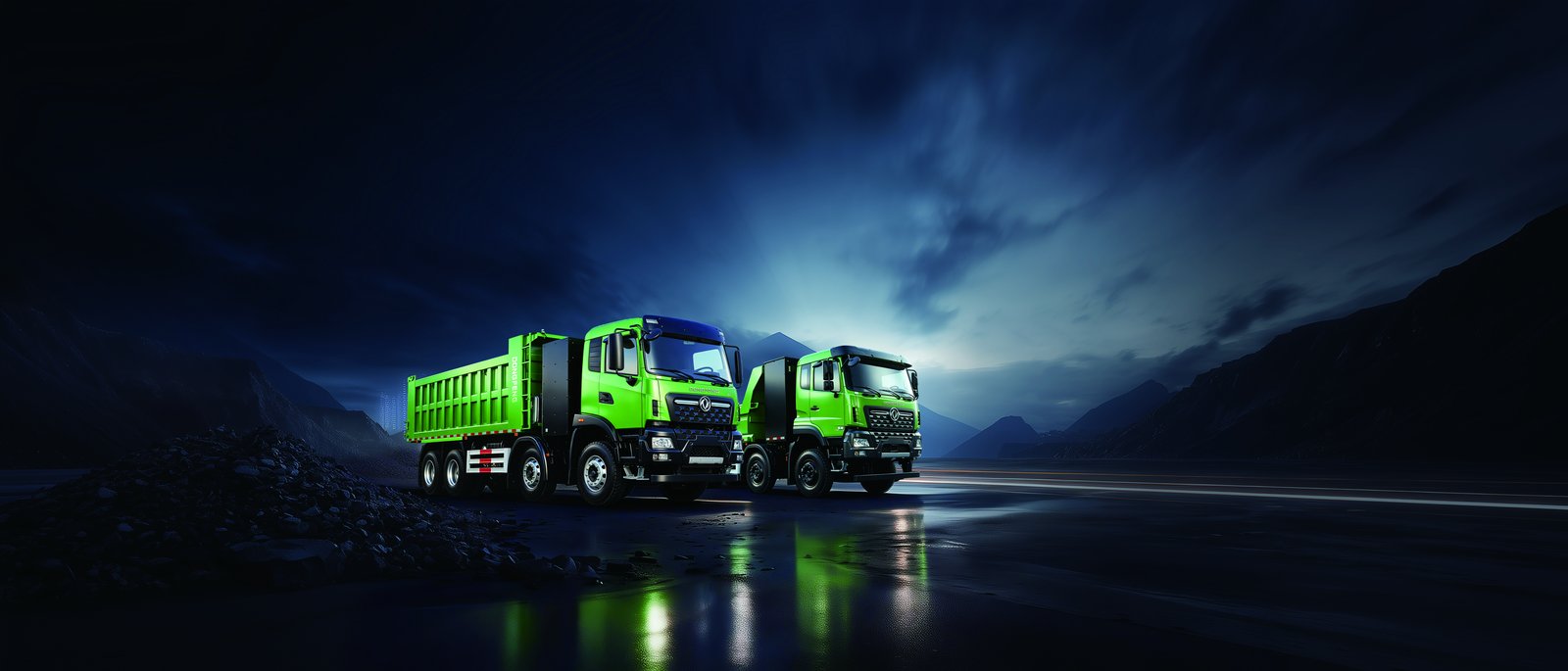
Iraq is building again at a scale the region has not seen in a generation. The Reconstruction and Development Framework counts hundreds of billions in planned housing, transport and industrial projects; the Grand Faw port at the mouth of the Gulf is rising toward one of the region's largest container capacities; and the Development Road project — the 1,200 km corridor from Basra to the Turkish border — aims to make Iraq the land bridge between Asia and Europe. Beneath the mega-projects runs the everyday reconstruction economy: cement, aggregates, steel and materials moving between Basra, Baghdad, the southern oil provinces and the industrial zones. That freight economy runs almost entirely on diesel in a country where fuel is subsidised but unreliable, grid power is famously intermittent, and the summer file hits 50 °C. It is the hardest market in our portfolio — and one where the KTH3 electric rigid and the TZ3Z electric tipper have a more specific case than it first appears. This article covers where electric trucks fit in Iraq today, the honest constraints, the engineering file for extreme heat and weak grids, and the fleet economics when the pieces align. For the wider market context, see our Iraq electric truck market guide.
Three structural facts argue for electric trucks in Iraq, and three argue for caution — a fair assessment weighs both:
| For | Against (and the mitigation) |
|---|---|
| Fuel logistics risk: diesel queues and supply disruptions are an institutional memory; electricity, once generated, is domestic | Grid unreliability: mitigate with solar-hybrid depot charging — Iraq's solar resource is among the best on Earth |
| Generator-parity pricing: much of Iraq already runs on private diesel generation at USD 0.25–0.45/kWh — solar-hybrid EV charging undercuts that decisively | 50 °C summers: mitigate with the full liquid-cooled thermal file (standard on our export units) and summer-rated battery sizing |
| Fixed-corridor freight: Basra–Baghdad, Faw–Um Qasr, the refinery loops — fixed, return-to-base duty ideal for depot charging | Service ecosystem youth: mitigate with first-year spares consignments, remote diagnostics and technician training in the order package |
The pattern that works in Iraq is the self-sufficient electric island: a fleet, a depot, a solar array and buffer storage — operating inside a perimeter where none of the national grid's problems reach it. Iraq's import structure is moderately open (a flat 5% duty on trucks plus 15% GST), and the Development Road's industrial zones are being built with modern power infrastructure from day one — which is exactly where first deployments belong.
Southern Iraq is one of the hottest sustained-duty environments on the planet. The Dongfeng EV truck file for it:
Ranking the Iraqi duty cycles by electric readiness:
Assumptions: 10 TZ3Z tippers on a fixed aggregate loop (130 km/day, loaded 55%) serving a Development Road works package, plus a 400 kWp solar array with 1.5 MWh buffer at the site depot; 300 operating days; the alternative priced at true operator cost — subsidised diesel at the pump plus queue time, or market diesel at USD 1.05/L:
| Annual item (10 trucks) | Diesel fleet | Electric fleet (solar-hybrid) |
|---|---|---|
| Fuel / energy | USD 320,000–410,000 | USD 45,000–60,000 (solar share ~60%) |
| Maintenance | USD 110,000 | USD 40,000 |
| Charging/solar infrastructure (annualised) | — | USD 68,000 |
| Total annual operating | USD 430,000–520,000 | USD 155,000–170,000 |
Annual savings of roughly USD 280,000–350,000 against an incremental capital cost of USD 550,000–700,000 (trucks plus the solar-hybrid depot) — payback around the two-year mark, with the solar asset carrying a 20+ year life far beyond the trucks. The model's strength is its independence: the fleet runs whether or not the national grid, the fuel queue or the subsidy policy cooperate.
The Development Road is, at its core, a bet on Iraq as infrastructure rather than obstacle — and every serious version of that bet includes modern power along the corridor. The trucking groups that build electric operating capability inside the first industrial zones and mega-project sites now will be the natural operators of the corridor fleets later. Iraq will not electrify from the national grid outward; it will electrify from the self-powered island inward — the port shuttle, the project depot, the solar-backed works fleet. That is not the hardest version of the market; that is the first-mover version of it.
Ready to electrify your fleet? Contact Shaanxi Fenghan Trading — authorized Dongfeng EV truck exporter. WhatsApp: +86 153 1943 1311 | Email: sales@fenghan-trade.com | dongfengevtrucks.com
🌐 Our Network: Fenghan Trade (SAGMOTO/SHACMAN Truck Export) · heavy duty mining dump truck 6x4 8x4