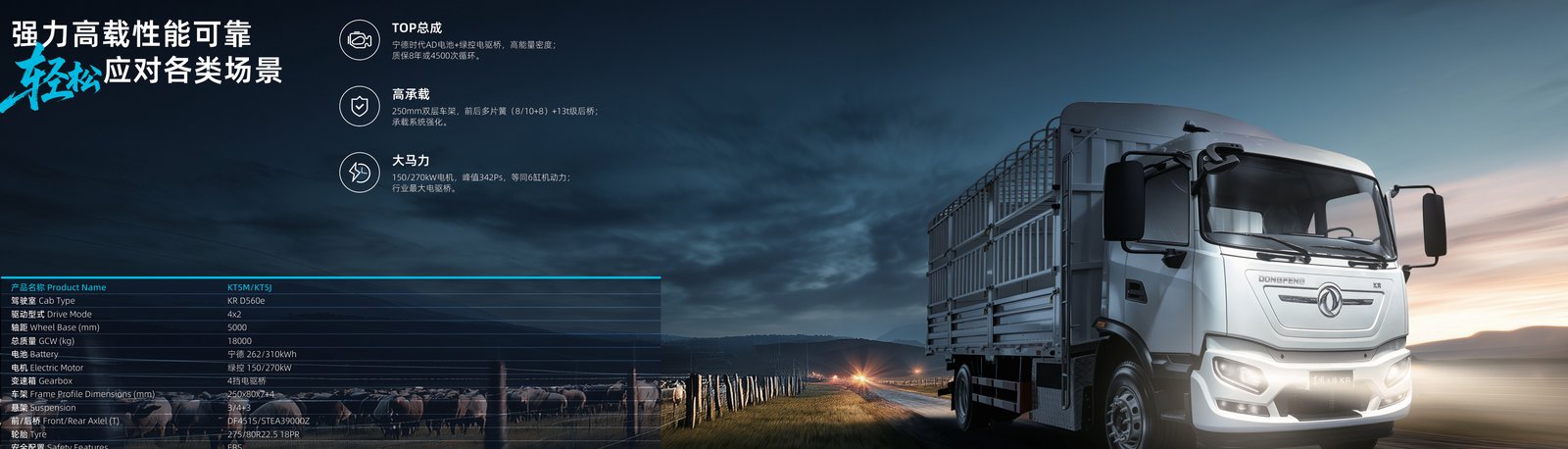
The most common technical objection we hear from fleet buyers in hot countries is some version of: "batteries die in this heat." It is a reasonable concern — it contains a real physics truth. Lithium battery degradation is strongly temperature-dependent, and sustained high cell temperatures shorten life. What the objection usually misses is that the truth is about cell temperature, not ambient temperature, and that a properly engineered thermal management system holds the first almost independent of the second. The Dongfeng electric trucks we export — powered by CATL LFP packs with liquid thermal management — run daily through Gulf summers at 50 °C, Sahel heat, Southeast Asian humidity and Andean altitude-sun combinations. This article explains, in plain engineering terms, how that works and what fleet operators should actually do about heat.
Battery heat tolerance begins with chemistry. The lithium iron phosphate (LFP) cathode in our CATL packs holds a strong phosphate-oxygen bond that does not release oxygen under thermal abuse the way metal-oxide chemistries (NMC/NCA) can. Practically, this means:
Chemistry buys the margin; thermal management spends it well.
The pack in every Dongfeng EV truck we ship is actively liquid-cooled. The architecture, simplified:
| Component | Function |
|---|---|
| Coolant circuit through the pack | A glycol loop passes cold plates between cell modules, carrying heat away from every module — not just from the pack's exterior |
| Chiller / heat exchanger | The loop exchanges heat with the vehicle's refrigerant circuit or ambient radiator depending on mode, actively pulling cell temperature down when ambient is above target |
| Heating mode | The same loop warms cells in cold climates (pre-conditioning before fast charge, and before regen-heavy descent cycles) — thermal management is bidirectional by design |
| Cell-level temperature sensing | Distributed sensors feed the battery management system (BMS), which modulates charge rates, regen limits and cooling power cell-temperature-first |
| Insulated, sealed enclosure | The pack housing slows ambient heat soak and seals the HV interior (IP68) against dust and water |
The operational result: on a 48 °C Gulf afternoon, with the pack working a loaded haul, cell temperatures hold within the band the chemistry was rated for — roughly 20–40 °C class — rather than drifting toward ambient. The cooling system's capacity is sized against exactly this worst case: full load, full heat, full charge acceptance. That sizing exercise is done against GCC deployment conditions because those are the hardest in our export map.
Three heat-related mechanisms matter in fleet operation, and the BMS manages each:
Fleets should track one metric as the single health gauge: State of Health (SoH) — the pack's present usable capacity as a percentage of new. Our telematics expose SoH continuously, and here is what the data shows across hot-climate deployments: CATL LFP packs under desert duty with disciplined charging typically hold 95–98% SoH at two years and 88–93% at five years — comfortably tracking the warranty curve (which guarantees a floor in the 70–80% band at the 8-year/4,500-cycle term). The packs that underperform that curve almost always share one cause: chronic abuse — sustained charging at peak heat of day, deep-discharge storage, or charge-holding at 100% for days — all behaviours our commissioning training addresses directly.
Twenty years of lead-acid desert fleets trained the industry's intuition: heat destroyed those batteries because they had no active thermal management and a chemistry with no margin. The objection is an artefact of that history. A liquid-cooled LFP pack in a Dongfeng EV truck is a different category of engineering: chemistry with thermal margin, active cooling sized for the worst market on the map, a BMS that trades minor performance for longevity automatically, and an 8-year warranty that puts the manufacturer's money behind the arithmetic. The fleets running our trucks through their third Gulf summer are the operational proof — and their SoH curves, not the folklore, are what your fleet planning should be built on.
Heat gets the objections; cold does the quieter damage. LFP cells charge poorly below ~5-10 °C — lithium plating risk forces the BMS to restrict charge rates severely — and a fleet that ignores this in winter markets confuses a chemistry limit with a truck defect. The thermal management system answers it the same way it answers heat, in reverse: the coolant loop warms the pack (drawing modest energy from itself or shore power) before and during charging. Our Central Asian deployments — TE-series tractors running Almaty-Tashkent corridors at −30 °C ambient — validated the full cold chain: plug-in pre-conditioning at depot before departure, heat-pump cab heating that does not raid the traction budget the way resistive heaters do, and charge scheduling that warms cells before high-power sessions. The operational rule we teach: in cold seasons, charge immediately on return to depot (pack is warm from duty) rather than leaving the truck parked cold and charging at midnight. One scheduling habit eliminates most cold-weather charging friction.
High-altitude deployments add a third variable that interacts favourably with everything above. Solar load at altitude is intense (UV-driven radiant heating of dark pack casings), but air density is low — convective heat loss falls too, roughly balancing. Our Andean and Ethiopian Highland deployments show the liquid-cooled architecture indifferent to altitude in a way diesel never was: no turbocharger, no derating, no altitude-specific power loss. The BMS thermal budget at 3,000 m looks like the budget at sea level for the same duty. For mines and highland corridors — a large share of our Latin American and East African client geography — this is a quiet structural advantage: the electric truck that arrives at altitude with full capability, towing full loads up highland grades, while diesel fleets fuel and derate around it.
Fleet technicians new to electric trucks often assume the thermal system is exotic. It is not — it is the most familiar subsystem on the vehicle:
The net effect across our supported fleets: thermal-system maintenance is a small, predictable, conventional line item — not the mystery line the objection "batteries die in heat" imagines. The engineering has been boring in the best sense for years.
Ready to electrify your fleet? Contact Shaanxi Fenghan Trading — authorized Dongfeng EV truck exporter. WhatsApp: +86 153 1943 1311 | Email: sales@fenghan-trade.com | dongfengevtrucks.com
🌐 Our Network: Fenghan Trade (SAGMOTO/SHACMAN Truck Export) · heavy duty trucks export China