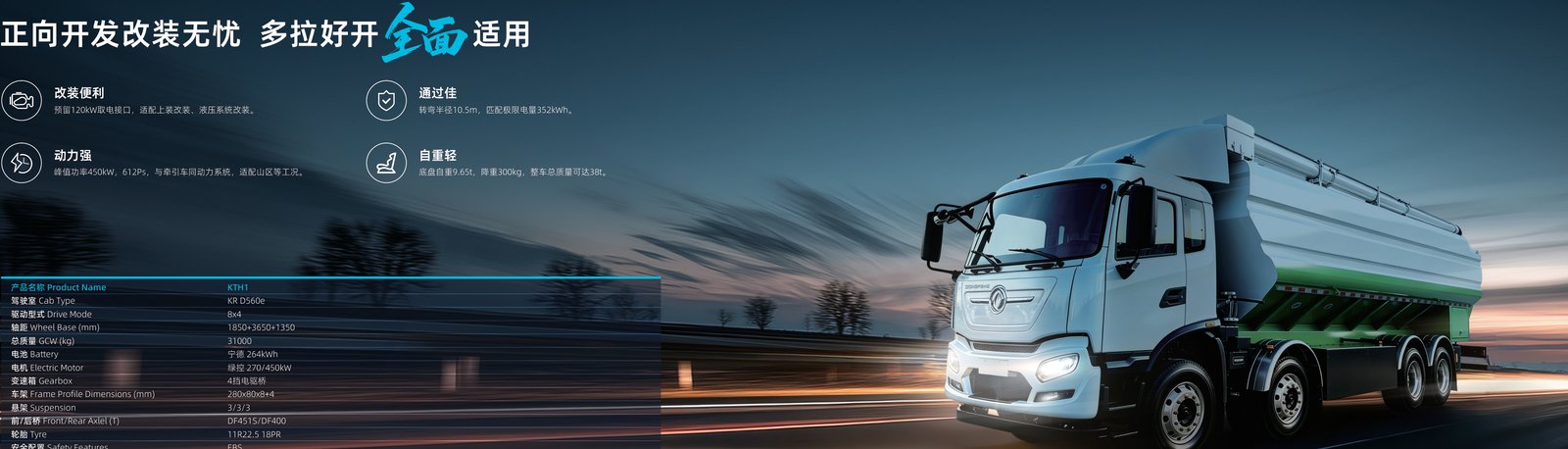
The Dongfeng EV truck range carries battery packs from 262 kWh in the city delivery trucks to 600 kWh in the long-haul tractors and 80-tonne mining machines — and behind that span sits a manufacturing technology that quietly reshaped the economics of heavy electric vehicles: cell-to-pack, or CTP, construction, pioneered at scale by CATL, the cell supplier behind the range's LFP packs. CTP is why a 600 kWh pack fits in a tractor chassis at a price a fleet can finance. It is also one of those terms every brochure now uses and almost no buyer can define. This article explains what cell-to-pack actually is, why it matters more in trucks than in cars, and what it changes for the fleet owner across an eight-year ownership.
A conventional battery pack is built like a bureaucracy: cells are grouped into modules (sealed sub-assemblies with their own housing, sensing and wiring), and modules are bolted into the pack's frame. Each layer of organisation adds structure, cabling, connectors and labour — and every gram of it is mass that doesn't store energy. In a passenger car the module tax is an inefficiency; in a truck it is a business problem, because trucks need the largest packs and pay the highest price per wasted kilogram: every kilo of packaging is a kilo of payload not carried, and trucks are paid by the tonne.
Cell-to-pack construction removes the middle layer. Cells are assembled directly into the pack structure, which itself becomes a structural element of the vehicle frame — the cells, the frame, and the thermal system engineered as one object rather than three. The measurable consequences:
| Pack attribute | Module-based pack | CTP pack |
|---|---|---|
| Volumetric efficiency | Baseline | ~15–20% more energy in the same envelope |
| Pack part count | High (module housings, cross-connects) | Substantially reduced |
| Energy density (pack level) | Baseline | Meaningfully higher at pack level, not just cell level |
| Cost per kWh | Baseline | Lower — fewer components, less assembly labour |
For the Dongfeng EV range the translation is direct: CTP is a large part of how the TZ3V fits up to 600 kWh inside an 8x4 tipper's frame rails, and how the KT5J carries a 262 kWh pack at a delivery-truck price point. More energy per litre of chassis is the difference between a pack that fits the duty and a compromise that doesn't.
Cell-to-pack rewards chemistries that tolerate tight packing — and LFP is exactly that chemistry. The pairing matters for three reasons:
Every point of pack-level density is payload or range. For a tipper or mixer, the recovered mass goes straight to payload; for a tractor it goes to range without chassis extension. When comparing electric trucks, compare installed energy per kilogram of pack and per litre of chassis envelope — not just headline kWh, which can hide a packaging generation gap.
Cell-level cooling in CTP packs narrows the temperature spread across the pack. Why an owner cares: capacity fade is temperature-statistical, and a pack with hot and cold regions ages at the pace of its hottest region. Uniform cooling means the whole 4,500-cycle warranty headroom is actually available — and summer duty in Gulf or Sahel markets costs less of it.
A CTP pack that doubles as a structural frame member stiffens the chassis — welcome in heavy duty where torsional rigidity governs how a loaded 8x4 behaves on a ramp. The battery stops being cargo bolted to the frame and becomes part of the frame.
CTP's one genuine compromise: module-level replacement disappears. A conventional pack could swap a failed module; a CTP pack is engineered as one thermal and structural object. In practice, cell-level failures in mature LFP production are rare, and the failure modes that matter shift to the pack's periphery (sensing, connectors, cooling interfaces) — which remain serviceable. The warranty structure is the buyer's protection here, and its mechanics (SOH thresholds, cycle counting, diagnostic authority) deserve the same scrutiny as the spec sheet.
Dense, structural packs make the swap-station economics work: a CTP pack's higher energy per exchange means each 5–6 minute swap delivers more kilometres — fewer spare packs floating in the station for the same fleet duty. Across the Dongfeng range, swap-compatible CTP packs are what make the swap option a later add-on rather than a different truck.
A composite from fleet programmes we support: a construction fleet specifying electric tippers initially budgeted for a mid-size pack on its 45 km quarry-to-plant circuits, assuming the larger pack wouldn't fit without sacrificing payload. The CTP generation's density changed the arithmetic: the larger pack's envelope fit within the frame rails with no measurable payload penalty, buying winter-range margin and, more importantly, the option to add a second shift later without a charging-window rework. The fleet's own conclusion generalises: with dense packs, over-provisioning stops being expensive and starts being strategy — because the cheapest flexibility a fleet can buy is energy it already carries.
Cell-to-pack is a manufacturing discipline as much as an architecture, and its quality rests on three production-stage controls buyers should understand. The first is cell sorting: in a module-based pack, the module boundary absorbs cell variation; in a CTP pack, cells must be binned tightly by capacity and internal resistance so the large series strings stay balanced — mature cell production with statistical process control is what makes CTP viable, and CATL's scale is precisely why its CTP generations deliver the reliability the architecture promises. The second is joining: module-free assembly uses advanced interconnection (laser-welded busbars and structural bonding) whose weld quality and bond integrity are the pack's mechanical and electrical backbone — every joint is inspected, and traceability records tie each connection to its production cell. The third is pack-level validation: CTP packs undergo full thermal-cycling, vibration and abuse testing as complete assemblies, because with no module boundary to localise a fault, the whole-pack test regime is the guarantee that a fault never has to be localised in the field. For buyers, the translation is simple: CTP from a tier-one cell maker with integrated pack production is proven technology; "CTP" from a pack assembler buying commodity cells is a phrase. Ask who makes the cells, who builds the pack, and what the traceability chain looks like — the answer is the reliability prediction.
A closing thought on scale: CTP's benefits compound with pack size. In a passenger car, the module tax was a few per cent of a modest pack; in a 600 kWh mining or tractor pack, the same percentage points translate into tens of kilowatt-hours recovered per vehicle — energy worth real kilometres and real payload on every day of a truck's working life. That is why the technology's centre of gravity sits in commercial vehicles, and why the heaviest electric trucks benefit first and most: the bigger the pack, the more the packaging generation matters.
Shaanxi Fenghan Trading is an authorised Dongfeng EV truck exporter. We publish pack-level (not just cell-level) specifications for the CATL LFP CTP packs across the Dongfeng EV range, provide the full documentation set (UN 38.3, MSDS, traceable provenance) with every shipment, and help buyers right-size packs against real route data — because the technology only pays when the kilowatt-hours meet the duty.
Ready to electrify your fleet? Contact Shaanxi Fenghan Trading — authorized Dongfeng EV truck exporter. WhatsApp: +86 153 1943 1311 | Email: sales@fenghan-trade.com | dongfengevtrucks.com
🌐 Our Network: Fenghan Trade (SAGMOTO/SHACMAN Truck Export) · SAGMOTO heavy duty diesel trucks