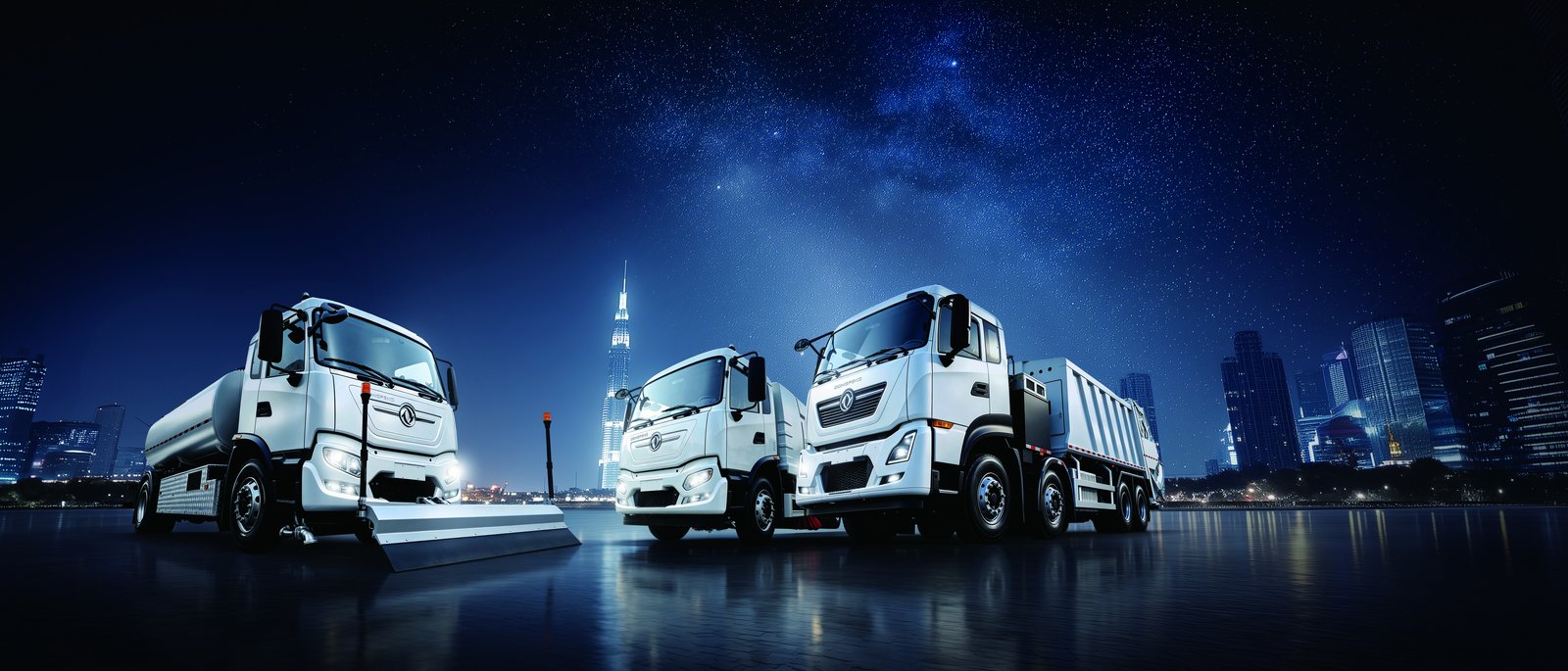
Qatar's logistics planners face a rare luxury problem: the country sits on abundant natural gas and has publicly backed both battery-electric and hydrogen fuel-cell freight as paths to a lower-carbon economy. For a heavy-haul operator choosing between the EV truck and a hydrogen fuel-cell tractor, the debate is not ideological, it is thermodynamic. This article puts the Dongfeng TE9L long-range electric tractor next to a hydrogen fuel-cell (FCEV) tractor and measures well-to-wheel efficiency, station capital cost, and five-year operating reality for Qatar's port and industrial corridors.
Qatar's National Vision 2030 and its LNG-led economy make it a natural hydrogen producer, yet the same grid that can electrolyze water is also the grid that charges trucks. That dual potential is why fleet buyers are asked to pick a side before the infrastructure map is finished. The pragmatic answer is to separate the technologies by duty cycle: battery-electric for the predictable, high-utilization lanes that dominate Qatari freight, and hydrogen only where range and refill speed cannot be met any other way. The TE9L is purpose-built for the first category.
With a 600 kWh CATL LFP pack and a 510 kW peak motor, the TE9L delivers up to 350 km of range and a 40 t gross combination weight rating suited to container moves between Hamad Port, Mesaieed, and Doha. That single corridor accounts for the majority of heavy freight in the country, which is exactly the profile where charging beats hydrogen on cost.
The cleanest way to compare the two powertrains is well-to-wheel efficiency — how much of the original energy reaches the wheels. A battery-electric drivetrain converts roughly 75-80 percent of grid electricity into motion. A hydrogen fuel-cell system must first make hydrogen (electrolysis at 60-70 percent), compress and store it (losses), then convert it back to power in a fuel cell (50-60 percent), landing at a well-to-wheel figure of only 25-35 percent. In plain terms, moving the same cargo the same distance with hydrogen consumes two to three times more primary energy than with batteries.
| Stage | Battery-electric (TE9L) | Hydrogen fuel-cell |
|---|---|---|
| Primary energy to wheels | 75-80 percent | 25-35 percent |
| Onboard storage | 600 kWh LFP battery | High-pressure H2 tanks |
| Refill / recharge | 45-90 min (DC fast) | 10-15 min (H2 pump) |
| Energy cost per km | USD 0.14-0.22 | USD 0.35-0.55 (green H2) |
| CO2 per km (well-to-wheel) | ~0.04 kg (grid mix) | ~0.10-0.18 kg |
The infrastructure math is the second reason battery-electric wins today. A single public hydrogen refueling station with electrolysis, compression, and storage carries a capital cost of roughly USD 2 million or more, before the cost of trucking hydrogen to sites that cannot make it on site. By contrast, a 360 kW DC depot charger for the TE9L costs a fraction of that, uses existing three-phase supply, and scales one charger at a time as the fleet grows. For a fleet operator, that difference is not a rounding error; it is the difference between a two-year and a ten-year payback on the energy side of the business.
On a 120,000 km per year duty cycle, the TE9L consumes about 1.7 kWh per kilometer from its 600 kWh pack. At Qatar's commercial electricity rate of roughly USD 0.08-0.13 per kWh, that is USD 0.14-0.22 per kilometer. A hydrogen tractor burning green H2 at USD 6-9 per kg and consuming about 0.06-0.08 kg per kilometer lands at USD 0.35-0.55 per kilometer — two to three times higher before maintenance. The battery truck also has fewer failure points: no fuel cell stack, no high-pressure plumbing, no humidification system to maintain.
| 5-year operating item | TE9L EV | H2 fuel-cell |
|---|---|---|
| Energy (600,000 km) | USD 84,000-132,000 | USD 210,000-330,000 |
| Annual maintenance | USD 1,400-2,000 | USD 4,000-6,000 |
| Energy infrastructure | Per-truck charger | Shared USD 2M station |
| Driver refuel routine | Depot plug-in | Specialized H2 pump |
Honesty matters for a fleet CFO: hydrogen is not worthless. For 24/7 cross-border lanes where a 10-minute refill and 600+ km range are non-negotiable, and where a shared H2 station can be amortized across hundreds of trucks, the fuel cell remains a credible tool. Qatar's own hydrogen export ambitions may eventually lower green H2 cost enough to change the curve. But for the dominant pattern — repetitive port and industrial loops — the efficiency penalty and station cost make hydrogen the more expensive choice for the foreseeable decade.
Heat is the one local variable. Summer ambient temperatures above 45°C demand liquid-cooled battery packs and shaded, ventilated charging bays, both of which the TE9L's liquid-cooled CATL LFP system is designed for. Smart charge scheduling that shifts bulk charging to cooler night hours protects pack life and avoids peak demand charges. Fleets that plan the depot before the trucks arrive avoid the single biggest cause of poor electric-truck ROI: charging chaos.
The verdict between battery and hydrogen is not fixed; it moves with two inputs that fleet planners should model explicitly. The first is the green-hydrogen price: if Qatar's abundant natural gas is electrolyzed at scale and H2 falls below USD 4 per kg, the fuel-cell case strengthens, though it still fights the well-to-wheel efficiency penalty of 25-35 percent versus 75-80 percent for batteries. The second input is the electricity tariff and the share of solar in the grid; a depot that charges mostly from its own photovoltaic array pushes TE9L energy cost toward USD 0.08 per kilometer and widens the gap further. Running the five-year model at both optimistic and pessimistic inputs still leaves the battery-electric TE9L cheaper on every realistic case for repetitive heavy haul, with hydrogen only competitive on sparse 600+ km lanes where charging simply does not exist yet.
Hydrogen refueling demands high-pressure handling certification and gas-detection systems at every station, adding recurring compliance cost and specialist training that battery depots avoid. The TE9L's high-voltage system is sealed and serviced only by certified technicians, but day-to-day fueling is a simple plug with no flammable gas on site, which simplifies site insurance, fire-safety briefings, and employee onboarding. For Qatari fleets scaling quickly, the lower specialist-headcount requirement of electric depots is a quiet but real advantage that rarely appears in the headline comparison yet shows up in the operating budget every month, especially as workforce costs rise across the Gulf logistics sector.
Much of the hydrogen enthusiasm rests on future projections of cheap green H2 and a dense refueling network that does not yet exist in Qatar or the wider Gulf for heavy freight. A fleet operator must plan against the depot they can build today, not the one in a press release. The TE9L runs on a connection already in the building, charges while the truck would otherwise be parked, and scales one charger at a time. Hydrogen, by contrast, asks the operator to co-invest in station capex of USD 2 million or more before a single truck benefits, then hope utilization justifies it. For a pragmatic heavy-haul manager, the technology that needs less new infrastructure almost always wins the first deployment, and battery-electric is that technology here.
For Qatar's high-utilization heavy haul, the TE9L long-range electric tractor is the lower-risk, lower-cost decision on every metric that touches the P&L: efficiency, energy price, maintenance, and infrastructure spend. Hydrogen should be watched, not bet on, for the lanes it uniquely serves. Importers tracking tenders and incentives should follow the Qatar electric truck market as charging corridors expand around Doha and the industrial cities. Charge what you can control; reserve hydrogen for the lanes that truly need it.
Ready to electrify your fleet? Contact Shaanxi Fenghan Trading — authorized Dongfeng EV truck exporter. WhatsApp: +86 153 1943 1311 | Email: sales@fenghan-trade.com | dongfengevtrucks.com
🌐 Our Network: Fenghan Trade (SAGMOTO/SHACMAN Truck Export) · 4x2 6x4 tractor truck prime mover