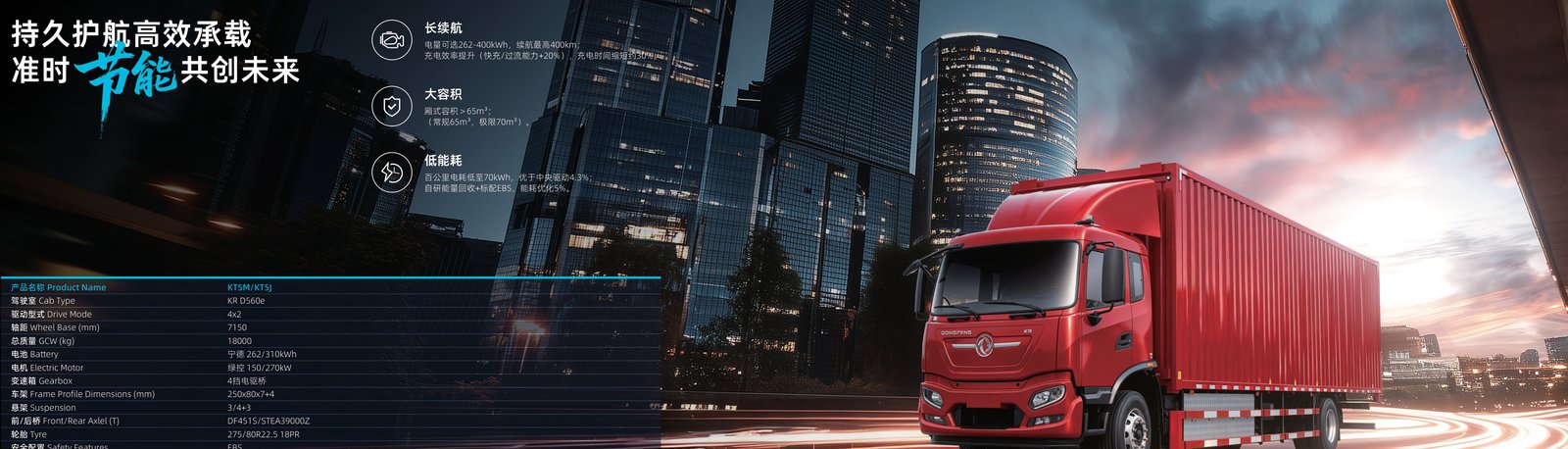
Electric truck platooning uses vehicle-to-vehicle radio links to let two or three trucks run in a tightly spaced convoy, with the trailing units riding in the slipstream of the leader to cut aerodynamic drag. For a Dongfeng TE9L long-haul electric tractor, a well-managed convoy can return 4 to 10 percent lower energy use on flat highway legs, and on a 466 to 600 kWh pack that saving becomes real extra range between charges. This guide explains how platooning works, what published corridor trials actually showed, what a fleet must put in place, how the economics look for overseas buyers in 2026, and where the technology realistically stands today.
The lead truck broadcasts its speed, throttle, brake and steering state over a low-latency wireless link, usually cellular V2X or a dedicated short-range radio channel. The following trucks run automated longitudinal control that maintains a gap as small as 0.5 to 1.0 second of following time, which at 80 km/h is about 11 to 22 meters. The human driver in the trailing truck stays behind the wheel and remains responsible, but the truck itself handles braking and acceleration in response to the leader's data. Because the lead unit breaks the air, the second and third trucks sit in its wake and see 10 to 20 percent lower drag on their front surfaces. The energy benefit flows almost entirely to the followers, while the leader carries the full air penalty.
Gap control is the core technology. Radar and camera sensing on each truck keep the spacing safe even if the radio link drops for a moment, and the system is designed to fall back to a normal safe distance within a fraction of a second. Most production-plausible systems keep the driver in command of steering while automating only the speed and distance, which is the legal position in most export markets today. Dongfeng EV tractors ship with a hardware-ready architecture so the convoy function can be enabled by software when local rules allow, without a second hardware purchase.
At a steady 80 to 90 km/h cruise, aerodynamic drag makes up roughly 50 to 65 percent of total energy demand for a heavy tractor. Reduce that drag by 10 to 20 percent for the followers and you save a comparable fraction of highway energy. On a TE9L fitted with the 510 kW motor and a 600 kWh battery option, a 6 percent convoy saving equals about 3.6 kWh per 10 km, or roughly 25 to 35 km of added range across a 400 km duty cycle before the next charge stop. On a 350 km regional loop the same saving can mean the difference between one charge and two on a round trip, which changes how a dispatcher plans the day.
These gains are speed dependent. Below 60 km/h, where rolling resistance and accessory load dominate, platooning saves little. Above 85 km/h, where drag rises with the square of speed, the percentage saving grows but absolute energy use is already high. The sweet spot is long, flat, high-speed corridors where a fleet already runs repeatable lanes, which is exactly the profile of many export-market freight routes between major cities and ports.
Published European and North American corridor trials between 2018 and 2025 reported follower savings in the 4 to 10 percent band, with the lead truck seeing little change. Results move with wind, road grade and gap setting. Closed test-track runs showed up to 15 percent for the third vehicle in a three-truck string at 0.6 second gaps, but public-road pilots are more conservative because they widen gaps near other traffic. The balanced conclusion for a fleet planner is to model a 4 to 7 percent fleet-average saving, not the marketing headline of 10 percent, and to confirm it with a local coast-down test before committing capital.
| Convoy position | Drag change | Energy saving | Added range on 600 kWh pack |
|---|---|---|---|
| Lead truck | 0% | 0 to 1% | 0 to 6 km |
| Second truck | -12% | 5 to 8% | 18 to 30 km |
| Third truck | -18% | 7 to 10% | 26 to 42 km |
The table above uses conservative public-road gaps. On a fenced or dedicated lane, the third-truck figure can reach the upper end. Note that savings are not additive across a whole mixed fleet; only the trucks actually travelling together capture them, so dispatch discipline decides the real number and the payback case.
Platooning is not a simple bolt-on. A depot needs compatible trucks, a shared V2V stack, driver training, and a corridor where two or three of its own tractors run the same lane at the same time. Schedule matching is the hardest part: the saving only appears when trucks travel together. A fleet with one-off trips or loose dispatch gains nothing, because the convoy never forms and the hardware sits idle as cost.
The V2V kit adds roughly $3,000 to $8,000 per truck depending on the radio and compute. Against a saving of 4 to 7 percent, a TE9L covering 120,000 km per year at $0.10 per kWh saves about $1,200 to $2,100 annually in electricity alone, before any diesel displacement credit. On high-mileage lanes payback on the hardware is typically 2 to 5 years. The Saudi Arabia electric truck market is a particularly strong fit because its long, flat, high-speed corridors between Riyadh, Dammam and Jeddah suit convoy running, and summer cabin cooling loads make every saved kilowatt count toward total cost of ownership.
Buyers should also weigh the operational change. Convoy discipline requires dispatch coordination and can reduce scheduling flexibility. For a fleet that already runs fixed shuttle lanes, the trade is favourable. For a spot-market operator, the complexity usually outweighs the gain, and the saving should be treated as optional upside rather than a committed baseline in the financial model.
In markets where ambient temperatures reach 45 °C, cabin and battery cooling already consume 8 to 15 percent of pack energy. Platooning's drag saving helps offset that load on highway legs, but it does not reduce cooling demand directly. Specifying the 600 kWh pack on the TE9L gives more buffer for both cooling and convoy flexibility, at a higher FOB price in the $125,000 to $150,000 range. The 466 kWh base pack still plates convoys but leaves less reserve for heat management on the longest summer lanes, so spec the pack to the worst-case month, not the annual average.
A practical rollout runs in phases. First, equip two or three TE9L tractors on one corridor and run them in solo mode for 30 days to baseline energy per km. Second, enable convoy mode on that corridor only, with drivers trained on gap entry and emergency exit. Third, measure the follower saving against the baseline and feed it to finance. Only then expand to a second lane. This staged approach keeps the risk contained and produces the evidence fleet leadership needs before wider spending.
Be candid with procurement teams: platooning remains in pilot and limited commercial use in 2026, not a default feature on a purchase order. It works best on dedicated lanes and controlled fleets. Dongfeng EV tractors are delivered with a hardware-ready architecture, and the convoy software is offered as a managed pilot rather than a turnkey switch. Treat platooning as a 12 to 36 month roadmap item for most overseas fleets, and budget the saving as upside rather than committed baseline. For buyers who want a guaranteed day-one efficiency win, aerodynamics and driver training deliver more certain results today.
Ready to electrify your fleet? Contact Shaanxi Fenghan Trading — authorized Dongfeng EV truck exporter. WhatsApp: +86 153 1943 1311 | Email: sales@fenghan-trade.com | dongfengevtrucks.com
🌐 Our Network: Fenghan Trade (SAGMOTO/SHACMAN Truck Export) · SAGMOTO heavy duty diesel trucks