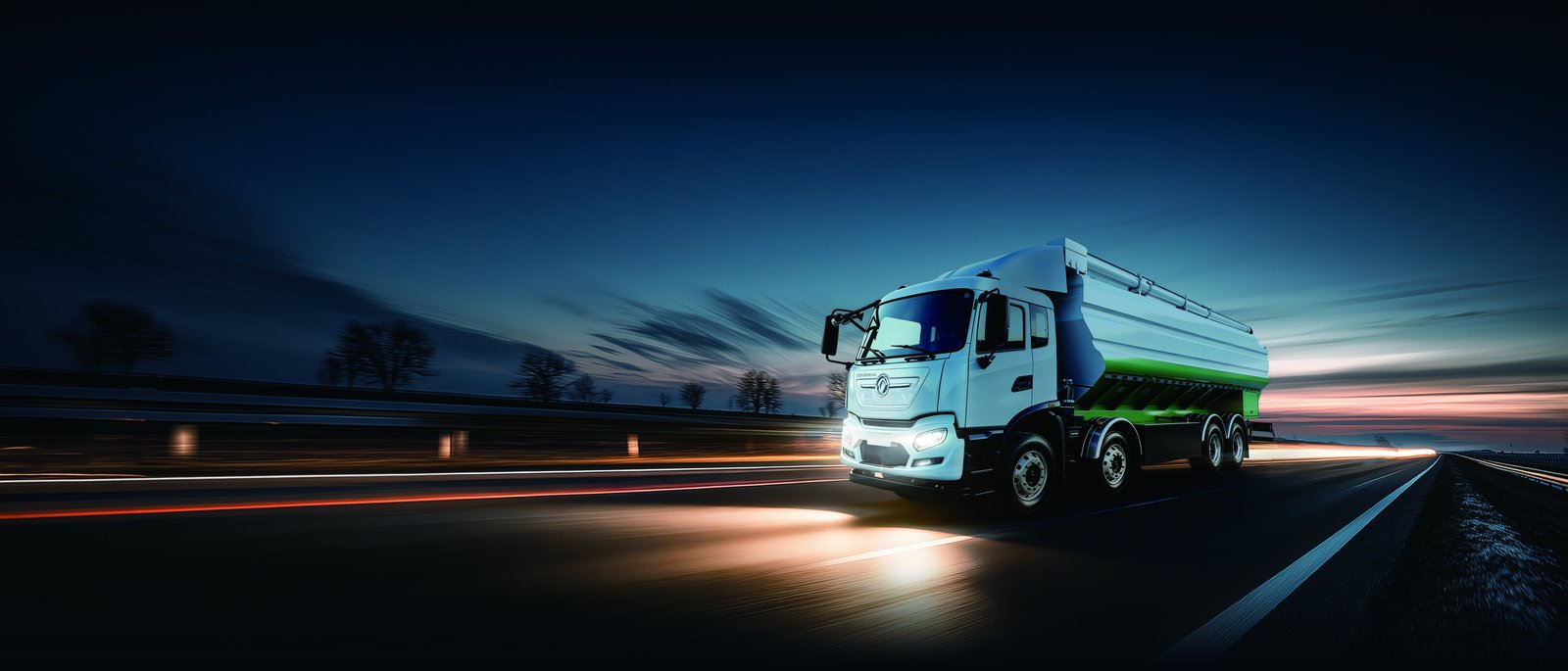
The Lualaba province of the Democratic Republic of Congo produces most of the world's cobalt and a rising share of its copper, and almost every tonne of it moves on diesel trucks — from pit to crusher, from mine gate to the railheads at Kolwezi and Tenke, and across the border to Zambia's smelters. Those haul roads are among the most punishing duty cycles on the planet: laterite dust that eats air filters, 35 °C heat that stresses cooling systems, grades that send diesel consumption past 120 L/100 km on loaded hauls, and fuel that arrives by tanker convoy at mine-gate prices far above the world benchmark. It is also, paradoxically, one of the best EV truck environments available: the DRC sits on some of Africa's largest hydro resources, several Lualaba mines already buy firm hydro power at attractive industrial rates, and a solar array at 1,800 m altitude in the southern hemisphere dry season out-produces most of the continent. This article sets out the case for the Dongfeng TZ5Y 80-tonne electric mining truck on Congolese copper-cobalt duty: the machine, the power architecture, the operating economics, and the import logistics that make or break a Congolese deployment.
| Parameter | Dongfeng TZ5Y Electric Mining Truck |
|---|---|
| Configuration | 6x4 rigid dump, mining-spec, 80 t GCW class |
| Battery | CATL LFP 400–600 kWh class, liquid-cooled, IP-rated for dust |
| Drive | LvKong electric drive up to 510 kW class with continuous mining torque |
| Real haul range (loaded) | Up to ~200 km; typical pit-to-crusher cycles all day on one overnight charge + midday top-up |
| Charging / swap | Dual-gun DC fast charge, or battery swap in 5–6 minutes at swap-equipped sites |
| Battery warranty | 8 years / 4,500 cycles |
| Indicative FOB | USD 150,000–180,000 depending on pack size and body spec |
Three design choices matter more than headline numbers on Congolese duty. First, the electric drivetrain's full torque from zero rpm out-pulls a diesel on the loaded ramp out of a pit — a diesel truck lugs its torque curve up the grade while the TZ5Y simply applies full torque continuously. Second, regenerative braking on the descent converts a loaded downhill haul from a brake-wearing fuel-none event into a battery-charging one, recovering 15–30% of consumed energy on roller-coaster haul profiles. Third, the sealed electric drive eliminates the air-filter and aftertreatment chain — no DPF, no EGR, no turbo — that Congolese dust destroys fastest on diesel equipment.
Every mine in Lualaba is already an electricity buyer. The strategic question is which energy source the fleet charges on:
In practice the strongest deployments combine all three: hydro or solar for cheap bulk energy, the buffer bank for reliability, and swap or dual-gun fast charge for availability. The mine's existing electrical department is the natural owner of this infrastructure — it is power engineering, not trucking.
The DRC's diesel economics are uniquely bad. Mine-gate delivered fuel — trucked from coastal terminals or across borders — historically lands at USD 1.30–1.80 per litre equivalent at remote sites, before the handling losses and pilferage that every mine comptroller knows. Modelling a 15-truck TZ5Y fleet on pit-to-crusher duty at 250 km per truck-day, 330 operating days, diesel at USD 1.45/L, electricity at an effective USD 0.08/kWh:
| Annual cost per truck | Diesel haul fleet | TZ5Y electric fleet |
|---|---|---|
| Fuel / energy | USD 45,000–58,000 | USD 7,500–11,500 |
| Engine & aftertreatment maintenance | USD 9,000–14,000 | USD 2,500–4,000 |
| Brake consumables (haul descents) | USD 3,500–5,500 | USD 900–1,600 (regen-assisted) |
| Annual saving per truck | — | USD 38,000–55,000 |
| 15-truck annual fleet saving | — | USD 570,000–825,000 |
| 8-year fleet saving (before energy CAPEX) | — | USD 4.5–6.6 million |
Even after a USD 1.5–3 million energy investment (swap station or charging plaza plus solar and buffer), the programme clears payback in roughly three years — and the saving is denominated in electricity largely generated inside the country rather than fuel trucked in from the coast, which also removes a supply-security exposure that Congolese operations know intimately.
Three routing options dominate for Chinese-built electric mining trucks entering the DRC, each with different time-cost profiles:
Whichever corridor is chosen, the battery documentation is decisive: UN 38.3 test summaries, MSDS, and IMDG-compliant packing declarations must accompany every unit, and transit-country customs (Zambia and Namibia review EV battery papers carefully) need consistent paperwork. As the exporter we prepare the complete file and coordinate with the mine's freight forwarder before wheels move.
A composite profile drawn from comparable Central African mining deployments: a mid-size copper-cobalt operation near Kolwezi runs 18 diesel haul trucks on a 14 km pit-to-crusher circuit, each covering 220–260 km a day in two shifts. Fuel arrives by contractor tanker convoy at mine-gate pricing; two engine rebuilds a year sit in the maintenance budget as a standing line item; and dust-driven filter consumption is a monthly procurement event. The electrification programme starts with three TZ5Y units on the highest-frequency circuit, charged overnight at the workshop yard from the mine's existing hydro allocation, with a midday top-up under a new 800 kWp solar canopy at the crusher. From month eight it scales to fifteen units and adds a pit-rim swap station, after which haul availability no longer depends on charging windows at all. The comptroller's line item that changes first is not fuel — it is the tanker convoy's invoice, which simply shrinks.
The technology transition is a workforce transition, and mining operations know it. An electric haul fleet introduces high-voltage systems to a maintenance culture built around diesel — and the mines that electrify successfully treat HV competence as a formal training programme, not an assumption. The curriculum we deploy with electric mining trucks covers four blocks: high-voltage safety fundamentals (lockout, isolation verification, PPE discipline); the drivetrain and pack diagnostic chain (reading BMS data, interpreting fault codes, safe fault isolation); charger and swap-station operations; and driver technique for regen-heavy haul profiles. Miners learn fast — the safety culture already in place on a modern mine is exactly the discipline HV work requires — and the certified-technician layer that emerges becomes a career asset the operation retains. One practical note on supervision: Congolese operations run mixed fleets for years, so the workshop must handle diesel and HV under one roof; separating bays, tooling and signage for HV work is an inexpensive layout decision made at programme start rather than after the first incident near-miss.
A note on staging the CAPEX: the programme does not need everything on day one. The economics work on grid-charged trucks alone; solar improves the energy cost; the buffer improves reliability; swap improves availability. Each layer can follow the last as the fleet grows, funded by the savings the previous layer banked. Mining comptrollers who structure the investment this way — tranching the energy build-out against realised fuel savings — routinely clear each tranche's internal hurdle rate faster than the original model predicted, because mine-gate diesel prices tend to worsen rather than improve over any multi-year window.
Shaanxi Fenghan Trading is an authorised Dongfeng EV truck exporter with mining-deployment experience across Africa and Asia. We supply TZ5Y electric mining trucks with complete UN 38.3 battery documentation, coordinate corridor logistics into the DRC, support remote commissioning with mine engineering teams, and maintain a spares channel for HV components, chargers and consumables — the part-provision question that separates mining electrification programmes that run from ones that stall.
Ready to electrify your fleet? Contact Shaanxi Fenghan Trading — authorized Dongfeng EV truck exporter. WhatsApp: +86 153 1943 1311 | Email: sales@fenghan-trade.com | dongfengevtrucks.com
🌐 Our Network: Fenghan Trade (SAGMOTO/SHACMAN Truck Export) · heavy duty mining dump truck 6x4 8x4