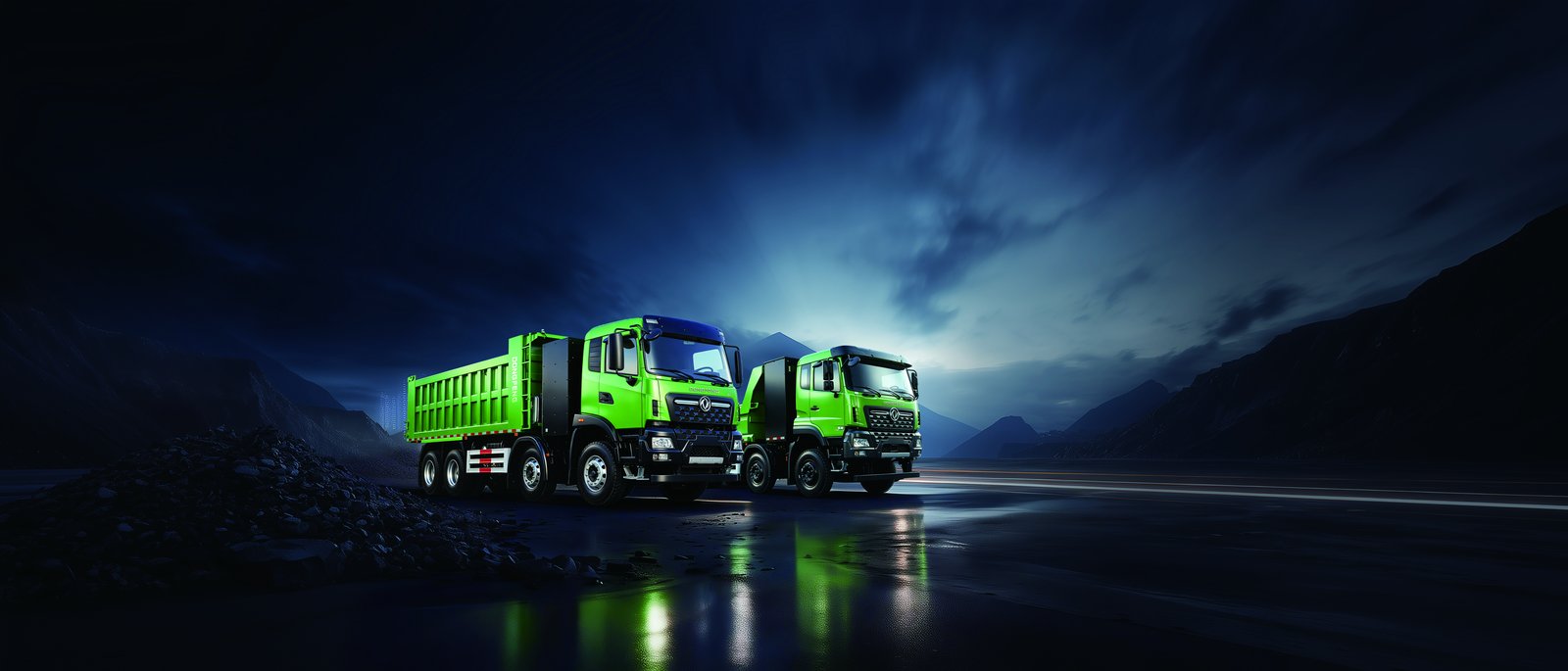
Dhaka is one of the fastest-growing construction markets on Earth, and one of the slowest cities on Earth to drive through. That combination — massive earthworks demand combined with average traffic speeds of 5–10 km/h for much of the day — is precisely where an electric truck beats a diesel one hardest. A diesel tipper stuck in Mohakhali traffic burns 12–16 L of fuel per hour while covering almost no distance; a Dongfeng TZ3Z electric dump truck in the same queue consumes almost nothing, because there is no idling engine and the drivetrain only draws power when the wheels turn. With metro Line-6 operational, the Elevated Expressway extending, and thousands of private high-rise projects underway in Gulshan, Bashundhara and Purbachal, construction logistics in the Dhaka metropolitan area now move more soil, sand and aggregate per year than most national ports handle in general cargo. This article examines how the TZ3Z 8x4 electric dump truck and the compact KTA1 electric dump truck fit into that market, what the Bangladesh import and duty structure looks like, and what a realistic fleet TCO model shows for a contractor ready to make the switch. For the wider country picture — RMG corridor logistics, Chattogram port and garment export flows — see our companion piece on Dongfeng electric trucks for the Bangladesh market.
Construction haulage in Dhaka is defined by short, stop-start trips. The typical aggregate cycle runs from a river-side stockyard in Keraniganj or Savar to a project site inside the city: 15–35 km each way, two to four hours of elapsed time, and enormous amounts of standing time at signals, police checkpoints and site gates. On that profile a diesel 8x4 tipper achieves 8–12 L per 100 km of actual fuel efficiency but the real penalty is engine hours — a 10-hour shift may include 5–6 hours of stationary idling with the engine running for the PTO, air conditioning and simply keeping the truck ready to move.
An electric dump truck eliminates essentially all of that stationary fuel burn. The electric PTO that raises the tipper body draws from the same CATL LFP traction pack that moves the truck, and the cab HVAC runs on a dedicated low-voltage circuit. Field data from comparable South Asian urban construction fleets shows total energy consumption of 110–150 kWh per 100 km on loaded out / empty back cycles — the equivalent of roughly 13–18 L of diesel at the wheel, before counting the idle savings that add another 20–30% in Dhaka-style congestion.
| Parameter | TZ3Z 8x4 Electric | KTA1 Compact Electric | Diesel 8x4 Baseline |
|---|---|---|---|
| Battery capacity | CATL LFP 400 kWh | CATL LFP 352 kWh | — |
| Motor output | LvKong 360 kW | LvKong 282 kW | ~260 kW diesel |
| Payload class | 25–28 t (55 t GVW) | 18–20 t | 25–28 t |
| Typical Dhaka cycle range | 200–260 km | 220–280 km | ~600 km tank |
| Fuel/energy cost per 100 km | USD 14–19 | USD 12–16 | USD 48–62 |
| FOB reference price | USD 125,000–145,000 | USD 95,000–115,000 | USD 58,000–72,000 |
The 2.5–3x energy-cost advantage is the core of the business case, and it compounds in Bangladesh because diesel there is imported, priced in dollars and periodically scarce, while grid electricity — even with gas-fired generation — is taka-denominated and structurally cheaper per unit of delivered energy.
Bangladesh applies some of the highest vehicle import duties in Asia, and electric trucks are no exception — but the structure still rewards the right configuration choices:
Landed cost for a TZ3Z in Bangladesh typically runs 1.75–2.0× FOB after duties, freight, port charges and clearance. That premium is exactly why the operating savings matter: the truck needs to recover roughly USD 90,000–110,000 of incremental capital versus diesel, which at USD 30,000–45,000 per year of fuel and maintenance savings takes 26–36 months on a two-shift construction duty cycle.
Dhaka's operating environment is genuinely hard on trucks, and it is worth being honest about which parts of it an electric truck handles better and which need planning:
Heat and humidity. Ambient temperatures of 30–38 °C with high humidity are well within the CATL LFP pack's operating window, and the liquid-cooled battery thermal management system holds cell temperatures in the 25–35 °C band that preserves cycle life. The 8-year / 4,500-cycle warranty terms assume exactly this kind of duty. Air-cooled packs from lower-tier suppliers are the ones that degrade in Bengal delta conditions — one of several reasons we specify CATL on every export unit.
Monsoon flooding. The IP67-rated battery enclosure and IP6K9K-rated connectors tolerate standing water better than a diesel engine's air intake does. Still, we advise operators not to route electric trucks through flooded underpasses above 600 mm of water — the drivetrain survives, but the charging port seals and body electrics should not be submerged, and salt-brackish Dhaka floodwater is corrosive to chassis steel regardless of powertrain.
Wet-season site conditions. The 8x4 TZ3Z's traction advantage is real on soft ground: peak electric torque at zero rpm out-pulls a comparable diesel on muddy haul-in roads, and regenerative braking on loaded descents reduces brake wear — which matters because brake service in Bangladesh is frequent and wet brakes fade.
Grid electricity in Dhaka runs at commercial tariffs around BDT 10–14 per kWh (USD 0.09–0.12), with load-shedding largely resolved since 2023 but voltage stability still variable in outer industrial zones. For construction fleets we recommend a depot-first architecture:
The KTA1, with its smaller 352 kWh pack, can also be opportunity-charged during the driver's lunch break at 60 kW, recovering 20–25% of range in 45 minutes.
Consider a contractor running 15 tippers on Purbachal and metro-civil works: 10 TZ3Z units on primary soil and aggregate haulage, 5 KTA1 units on tighter inner-city redevelopment sites where an 8x4 cannot manoeuvre. Assuming 220 working days, 120 km per day per truck, diesel at USD 1.05/L equivalent and grid power at USD 0.10/kWh:
| Annual item (15 trucks) | Diesel fleet | Electric fleet |
|---|---|---|
| Fuel / energy | USD 620,000–740,000 | USD 165,000–200,000 |
| Engine / drivetrain maintenance | USD 105,000–135,000 | USD 35,000–48,000 |
| Brake wear (regen saves ~50%) | USD 28,000 | USD 14,000 |
| Charging infrastructure (annualised) | — | USD 22,000–30,000 |
| Net annual operating advantage | — | USD 520,000–610,000 |
Against an incremental capital outlay of roughly USD 1.3–1.5 million (including charging), the fleet pays back in year three, and the eight-year battery warranty horizon — 4,500 cycles at CATL LFP chemistry — covers the entire finance period. Contractors bidding on international-standard projects (JICA-funded metro civils, World Bank road packages) increasingly find that electric haulage also strengthens ESG scoring sections of the tender, a small but growing scoring differentiator in Bangladeshi public procurement.
For a first deployment we recommend three to five units rather than fifteen: enough to run a genuine comparative trial against the existing diesel fleet, small enough that a single depot charger and a 400 kVA connection support it. Fenghan's export package includes route-energy modelling against your actual site coordinates, the charger sizing calculation, spare parts for the first year, and remote diagnostic support from the Xi'an engineering team. Units ship from the Dongfeng new-energy production line with CATL battery certificates and English documentation for the BRTA file.
Dhaka's construction cycle has years left to run, and the contractors who build electric operating experience now will hold the cost curve when the market turns competitive. The technology is ready for Bengal delta duty — the question is only which fleets bank the savings first.
Ready to electrify your fleet? Contact Shaanxi Fenghan Trading — authorized Dongfeng EV truck exporter. WhatsApp: +86 153 1943 1311 | Email: sales@fenghan-trade.com | dongfengevtrucks.com
🌐 Our Network: Fenghan Trade (SAGMOTO/SHACMAN Truck Export) · heavy duty mining dump truck 6x4 8x4