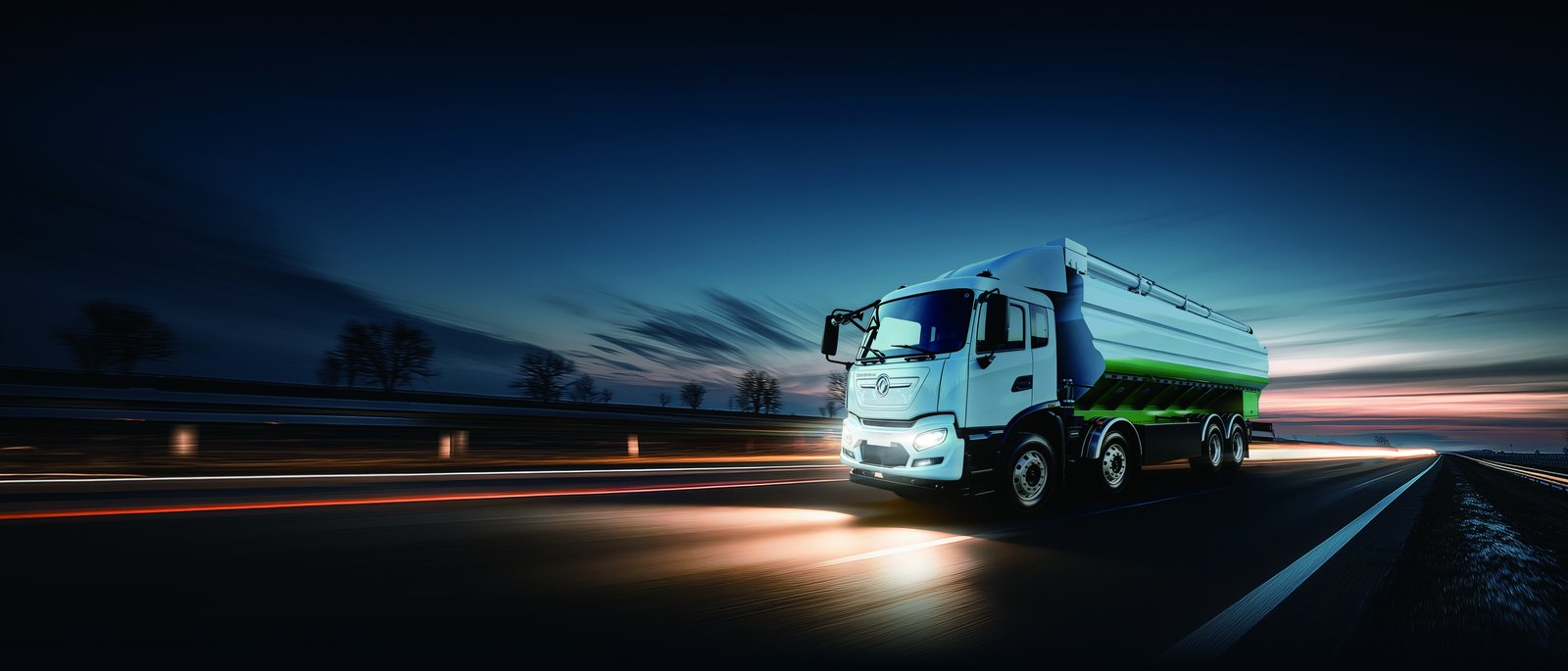
Ethiopia has done something no other African country has dared: in 2024 it banned the import of combustion-engine passenger vehicles outright, and it has since extended aggressively pro-electric treatment across the vehicle market. For a country that imports every drop of fuel but generates nearly all of its electricity from domestic hydro, the logic is macroeconomic as much as environmental — every electric truck imported is foreign-exchange saved forever. The result is that Addis Ababa, a city of five million people sitting at 2,355 m altitude with a fast-expanding industrial park ring and the continent's largest light-rail network, is becoming Africa's most interesting EV truck laboratory. This article examines how the Dongfeng TE46 electric tractor and the KT5M electric box truck fit into Ethiopian logistics: the unique import economics, the altitude and climate file, charging strategy under Ethiopian grid realities, and a worked fleet model. For the broader country picture, see our Ethiopia electric truck market guide.
Three policy facts define the opportunity:
Set against this are real constraints: a small economy, foreign-currency rationing that makes letters of credit slow, rough roads outside Addis, and a young EV service ecosystem. The fleets that succeed in Ethiopia are the ones that treat it as a marathon — starting with the applications where electric trucks win by the widest margin, inside and immediately around Addis Ababa.
Addis freight moves on radii of 20–80 km: Modjo dry port to Kality warehouses, Kaliti industrial zone to Merkato distribution, factories to their Addis depots. The Modjo–Addis corridor alone carries most of the country's containerised imports after they clear the Djibouti corridor. This is drayage-plus-distribution duty — fixed, predictable, return-to-base — and it is exactly what the TE46 was engineered for. The 4x2 electric tractor carries a 400 kWh CATL LFP pack, drives a 282 kW LvKong motor through a two-speed gearbox, and pulls up to 42 t GCW. On the flat-to-rolling Modjo corridor it consumes roughly 1.0–1.2 kWh/km at 38–40 t, giving a real-world range of 280–320 km — a full day of Addis-area drayage on one charge.
Altitude is an interesting variable. At 2,300–2,500 m, naturally aspirated diesel engines lose 20–25% of their rated power — every Ethiopian trucker knows the feeling of a loaded diesel crawling the Sululta climb. Electric drivetrains lose essentially nothing at altitude: the TE46 delivers full torque at 2,500 m exactly as it does at sea level. The 60 km Modjo–Addis climb back to the plateau is also a regenerative harvest — the descent into the Awash valley recovers 10–15% of the day's energy back into the pack.
| Parameter | TE46 4x2 Electric | KT5M 4x2 Box | Diesel baseline |
|---|---|---|---|
| Battery | CATL LFP 400 kWh | CATL LFP ~350 kWh | — |
| Duty | Container drayage, 42 t GCW | City distribution, 8–10 t body | Comparable |
| Range on Addis duty | 280–320 km | 220–280 km | ~700 km tank |
| Altitude power loss | ~0% | ~0% | 20–25% |
| Energy cost per 100 km | USD 5–8 | USD 5–7 | USD 55–70 |
| FOB reference | USD 98,000–118,000 | USD 78,000–95,000 | USD 55,000–68,000 |
That energy-cost line is the story: with electricity at USD 0.05/kWh and diesel at roughly USD 1.10–1.25/L equivalent in birr terms, the per-kilometre energy gap between electric and diesel in Ethiopia is close to 10:1 — the widest we model in any market.
Units ship from China on 40–50 day transits to Djibouti and then road 900 km to Addis — or increasingly via the electrified Ethio-Djibouti standard-gauge railway for containerised cargo. Key import notes:
Addis grid power is cheap but not always reliable at the distribution level — local outages remain part of life. Our recommended architecture for an Addis fleet is therefore solar-hybrid depot design: a 200–400 kWp array with 500 kWh–1 MWh of battery buffering feeding two to four 120 kW DC chargers. On Ethiopian irradiation (among the best in Africa at 5.5–6.5 kWh/m²/day), a 300 kWp array generates 500–650 kWh per day — enough to fully power six KT5M units on distribution duty with zero grid draw, or to bridge any outage for the rest of the fleet. The TE46's CCS2-standard 240 kW fast-charge capability also means one shared fast charger serves multiple trucks through the midday window.
Consider an Addis logistics company running 4 TE46 tractors (Modjo drayage, 100 km/day) and 6 KT5M box trucks (city distribution, 90 km/day), 280 working days, electricity at USD 0.06/kWh blended, diesel at USD 1.15/L:
| Annual item (10 trucks) | Diesel fleet | Electric fleet |
|---|---|---|
| Fuel / energy | USD 236,000 | USD 17,000–22,000 |
| Maintenance | USD 74,000 | USD 26,000 |
| Charging infra (annualised, solar-hybrid) | — | USD 28,000 |
| Total annual operating | USD 310,000 | USD 74,000 |
Because Ethiopian EV import treatment strips most of the duty premium, the incremental capital cost of the electric fleet versus diesel (including the solar-hybrid depot) may be as low as USD 350,000–450,000 — recovered in 18–24 months, with USD 2.3 million+ of cumulative savings over an eight-year horizon. No other market in our portfolio offers a payback profile this aggressive.
Three cautions from comparable emerging-market deployments. First, birr depreciation and FX access make the timing of the order as important as the spec — lock pricing when the LC opens. Second, Ethiopia's road network limits long-haul EV applications for now; stay inside the 200 km Addis–Modjo–Adama triangle until fast-charging exists beyond it. Third, cold-chain and body-equipped units need local body integration; the KT5M's standard box and reefer-ready chassis simplify this, and we supply body-mounted drawings for local fabrication.
Ethiopia has decided that its transport future is electric — the policy, the hydro grid and the economics all point the same way. The fleets that build electric operating muscle in Addis now will run the corridors when the rest of the country opens up.
Ready to electrify your fleet? Contact Shaanxi Fenghan Trading — authorized Dongfeng EV truck exporter. WhatsApp: +86 153 1943 1311 | Email: sales@fenghan-trade.com | dongfengevtrucks.com
🌐 Our Network: Fenghan Trade (SAGMOTO/SHACMAN Truck Export) · SAGMOTO cargo truck flatbed box stake